GPT-Load
July 27, 2026 · View on GitHub


A high-performance, enterprise-grade AI API transparent proxy service designed specifically for enterprises and developers who need to integrate multiple AI services. Built with Go, featuring intelligent key management, load balancing, and comprehensive monitoring capabilities, designed for high-concurrency production environments.
For detailed documentation, please visit Official Documentation

Sponsors
 |
Thanks to TeamoRouter for sponsoring this project! TeamoRouter is an enterprise-grade Agentic LLM gateway that lets developers, AI teams, and businesses access Claude Code, Codex, Gemini CLI, and other AI agents through one unified API without separate subscriptions, with discounts of up to 90%. It connects to official providers and trusted partners like OpenAI, Anthropic, Vertex, Azure, and AWS Bedrock, offering verified Agent protocol compatibility, request traceability, near-official TTFT, 99.6% SLA, and up to 5,000 QPM. It also includes centralized billing, team management, BYOK, smart routing, analytics, provider optimization, and dedicated support. Teamo Desktop enables one-click setup with no API key management or manual configuration, and new users can register via this link for 10% off their first top-up. |
 |
Thank you very much for the support from the LINUX DO community! |
 |
This project is supported by DigitalOcean. |
Features
- Transparent Proxy: Complete preservation of native API formats, supporting OpenAI, Google Gemini, and Anthropic Claude among other formats
- Intelligent Key Management: High-performance key pool with group-based management, automatic rotation, and failure recovery
- Load Balancing: Weighted load balancing across multiple upstream endpoints to enhance service availability
- Smart Failure Handling: Automatic key blacklist management and recovery mechanisms to ensure service continuity
- Dynamic Configuration: System settings and group configurations support hot-reload without requiring restarts
- Enterprise Architecture: Distributed leader-follower deployment supporting horizontal scaling and high availability
- Modern Management: Vue 3-based web management interface that is intuitive and user-friendly
- Comprehensive Monitoring: Real-time statistics, health checks, and detailed request logging
- High-Performance Design: Zero-copy streaming, connection pool reuse, and atomic operations
- Production Ready: Graceful shutdown, error recovery, and comprehensive security mechanisms
- Dual Authentication: Separate authentication for management and proxy, with proxy authentication supporting global and group-level keys
Supported AI Services
GPT-Load serves as a transparent proxy service, completely preserving the native API formats of various AI service providers:
- OpenAI Format: Official OpenAI API, Azure OpenAI, and other OpenAI-compatible services
- Google Gemini Format: Native APIs for Gemini Pro, Gemini Pro Vision, and other models
- Anthropic Claude Format: Claude series models, supporting high-quality conversations and text generation
Quick Start
System Requirements
- Go 1.24+ (for source builds)
- Docker (for containerized deployment)
- MySQL, PostgreSQL, or SQLite (for database storage)
- Redis (for caching and distributed coordination, optional)
Method 1: Docker Quick Start
docker run -d --name gpt-load \
    -p 3001:3001 \
    -e AUTH_KEY=your-secure-key-here \
    -v "$(pwd)/data":/app/data \
    ghcr.io/tbphp/gpt-load:latest
Please change
your-secure-key-hereto a strong password (never use the default value), then you can log in to the management interface: http://localhost:3001
Method 2: Using Docker Compose (Recommended)
Installation Commands:
# Create Directory
mkdir -p gpt-load && cd gpt-load

# Download configuration files
wget https://raw.githubusercontent.com/tbphp/gpt-load/refs/heads/main/docker-compose.yml
wget -O .env https://raw.githubusercontent.com/tbphp/gpt-load/refs/heads/main/.env.example

# Edit the .env file and change AUTH_KEY to a strong password. Never use default or simple keys like sk-123456.

# Start services
docker compose up -d
Before deployment, you must change the default admin key (AUTH_KEY). A recommended format is: sk-prod-[32-character random string].
The default installation uses the SQLite version, which is suitable for lightweight, single-instance applications.
If you need to install MySQL, PostgreSQL, and Redis, please uncomment the required services in the docker-compose.yml file, configure the corresponding environment variables, and restart.
Other Commands:
# Check service status
docker compose ps

# View logs
docker compose logs -f

# Restart Service
docker compose down && docker compose up -d

# Update to latest version
docker compose pull && docker compose down && docker compose up -d
After deployment:
- Access Web Management Interface: http://localhost:3001
- API Proxy Address: http://localhost:3001/proxy
Use your modified AUTH_KEY to log in to the management interface.
Method 3: Source Build
Source build requires a locally installed database (SQLite, MySQL, or PostgreSQL) and Redis (optional).
# Clone and build
git clone https://github.com/tbphp/gpt-load.git
cd gpt-load
go mod tidy

# Create configuration
cp .env.example .env

# Edit the .env file and change AUTH_KEY to a strong password. Never use default or simple keys like sk-123456.
# Modify DATABASE_DSN and REDIS_DSN configurations in .env
# REDIS_DSN is optional; if not configured, memory storage will be enabled

# Run
make run
After deployment:
- Access Web Management Interface: http://localhost:3001
- API Proxy Address: http://localhost:3001/proxy
Use your modified AUTH_KEY to log in to the management interface.
Method 4: Cluster Deployment
Cluster deployment requires all nodes to connect to the same MySQL (or PostgreSQL) and Redis, with Redis being mandatory. It's recommended to use unified distributed MySQL and Redis clusters.
Deployment Requirements:
- All nodes must configure identical
AUTH_KEY,DATABASE_DSN,REDIS_DSN - Leader-follower architecture where follower nodes must configure environment variable:
IS_SLAVE=true
For details, please refer to Cluster Deployment Documentation
Configuration System
Configuration Architecture Overview
GPT-Load adopts a dual-layer configuration architecture:
1. Static Configuration (Environment Variables)
- Characteristics: Read at application startup, immutable during runtime, requires application restart to take effect
- Purpose: Infrastructure configuration such as database connections, server ports, authentication keys, etc.
- Management: Set via
.envfiles or system environment variables
2. Dynamic Configuration (Hot-Reload)
- System Settings: Stored in database, providing unified behavioral standards for the entire application
- Group Configuration: Behavior parameters customized for specific groups, can override system settings
- Configuration Priority: Group Configuration > System Settings > Environment Configuration
- Characteristics: Supports hot-reload, takes effect immediately after modification without application restart
Static Configuration (Environment Variables)
Server Configuration:
| Setting | Environment Variable | Default | Description |
|---|---|---|---|
| Service Port | PORT | 3001 | HTTP server listening port |
| Service Address | HOST | 0.0.0.0 | HTTP server binding address |
| Read Timeout | SERVER_READ_TIMEOUT | 60 | HTTP server read timeout (seconds) |
| Write Timeout | SERVER_WRITE_TIMEOUT | 600 | HTTP server write timeout (seconds) |
| Idle Timeout | SERVER_IDLE_TIMEOUT | 120 | HTTP connection idle timeout (seconds) |
| Graceful Shutdown Timeout | SERVER_GRACEFUL_SHUTDOWN_TIMEOUT | 10 | Service graceful shutdown wait time (seconds) |
| Follower Mode | IS_SLAVE | false | Follower node identifier for cluster deployment |
| Timezone | TZ | Asia/Shanghai | Specify timezone |
Security Configuration:
| Setting | Environment Variable | Default | Description |
|---|---|---|---|
| Admin Key | AUTH_KEY | - | Access authentication key for the management end, please change it to a strong password |
| Encryption Key | ENCRYPTION_KEY | - | Encrypts API keys at rest. Supports any string or leave empty to disable encryption. See Data Encryption Migration |
Database Configuration:
| Setting | Environment Variable | Default | Description |
|---|---|---|---|
| Database Connection | DATABASE_DSN | ./data/gpt-load.db | Database connection string (DSN) or file path |
| Redis Connection | REDIS_DSN | - | Redis connection string, uses memory storage when empty |
Performance & CORS Configuration:
| Setting | Environment Variable | Default | Description |
|---|---|---|---|
| Max Concurrent Requests | MAX_CONCURRENT_REQUESTS | 100 | Maximum concurrent requests allowed by system |
| Enable CORS | ENABLE_CORS | false | Whether to enable Cross-Origin Resource Sharing |
| Allowed Origins | ALLOWED_ORIGINS | - | Allowed origins, comma-separated |
| Allowed Methods | ALLOWED_METHODS | GET,POST,PUT,DELETE,OPTIONS | Allowed HTTP methods |
| Allowed Headers | ALLOWED_HEADERS | * | Allowed request headers, comma-separated |
| Allow Credentials | ALLOW_CREDENTIALS | false | Whether to allow sending credentials |
Logging Configuration:
| Setting | Environment Variable | Default | Description |
|---|---|---|---|
| Log Level | LOG_LEVEL | info | Log level: debug, info, warn, error |
| Log Format | LOG_FORMAT | text | Log format: text, json |
| Enable File Logging | LOG_ENABLE_FILE | false | Whether to enable file log output |
| Log File Path | LOG_FILE_PATH | ./data/logs/app.log | Log file storage path |
Proxy Configuration:
GPT-Load automatically reads proxy settings from environment variables to make requests to upstream AI providers.
| Setting | Environment Variable | Default | Description |
|---|---|---|---|
| HTTP Proxy | HTTP_PROXY | - | Proxy server address for HTTP requests |
| HTTPS Proxy | HTTPS_PROXY | - | Proxy server address for HTTPS requests |
| No Proxy | NO_PROXY | - | Comma-separated list of hosts or domains to bypass the proxy |
Supported Proxy Protocol Formats:
- HTTP:
http://user:pass@host:port - HTTPS:
https://user:pass@host:port - SOCKS5:
socks5://user:pass@host:port
Dynamic Configuration (Hot-Reload)
Basic Settings:
| Setting | Field Name | Default | Group Override | Description |
|---|---|---|---|---|
| Project URL | app_url | http://localhost:3001 | ❌ | Project base URL |
| Global Proxy Keys | proxy_keys | Initial value from AUTH_KEY | ❌ | Globally effective proxy keys, comma-separated |
| Log Retention Days | request_log_retention_days | 7 | ❌ | Request log retention days, 0 for no cleanup |
| Log Write Interval | request_log_write_interval_minutes | 1 | ❌ | Log write to database cycle (minutes) |
| Enable Request Body Logging | enable_request_body_logging | false | ✅ | Whether to log complete request body content in request logs |
Request Settings:
| Setting | Field Name | Default | Group Override | Description |
|---|---|---|---|---|
| Request Timeout | request_timeout | 600 | ✅ | Forward request complete lifecycle timeout (seconds) |
| Connection Timeout | connect_timeout | 15 | ✅ | Timeout for establishing connection with upstream service (seconds) |
| Idle Connection Timeout | idle_conn_timeout | 120 | ✅ | HTTP client idle connection timeout (seconds) |
| Response Header Timeout | response_header_timeout | 600 | ✅ | Timeout for waiting upstream response headers (seconds) |
| Max Idle Connections | max_idle_conns | 100 | ✅ | Connection pool maximum total idle connections |
| Max Idle Connections Per Host | max_idle_conns_per_host | 50 | ✅ | Maximum idle connections per upstream host |
| Proxy URL | proxy_url | - | ✅ | HTTP/HTTPS proxy for forwarding requests, uses environment if empty |
Key Configuration:
| Setting | Field Name | Default | Group Override | Description |
|---|---|---|---|---|
| Max Retries | max_retries | 3 | ✅ | Maximum retry count using different keys for single request |
| Blacklist Threshold | blacklist_threshold | 3 | ✅ | After how many cumulative failures does the key get blacklisted |
| Key Validation Interval | key_validation_interval_minutes | 60 | ✅ | Background scheduled key validation cycle (minutes) |
| Key Validation Concurrency | key_validation_concurrency | 10 | ✅ | Concurrency for background validation of invalid keys |
| Key Validation Timeout | key_validation_timeout_seconds | 20 | ✅ | API request timeout for validating individual keys in background (seconds) |
Data Encryption Migration
GPT-Load supports encrypted storage of API keys. You can enable, disable, or change the encryption key at any time.
View Data Encryption Migration Details
Migration Scenarios
- Enable Encryption: Encrypt plaintext data for storage - Use
--to <new-key> - Disable Encryption: Decrypt encrypted data to plaintext - Use
--from <current-key> - Change Encryption Key: Replace the encryption key - Use
--from <current-key> --to <new-key>
Operation Steps
Docker Compose Deployment
# 1. Update the image (ensure using the latest version)
docker compose pull

# 2. Stop the service
docker compose down

# 3. Backup the database (strongly recommended)
# Before migration, you must manually backup the database or export your keys to avoid key loss due to operations or exceptions.

# 4. Execute migration command
# Enable encryption (your-32-char-secret-key is your key, recommend using 32+ character random string)
docker compose run --rm gpt-load migrate-keys --to "your-32-char-secret-key"

# Disable encryption
docker compose run --rm gpt-load migrate-keys --from "your-current-key"

# Change encryption key
docker compose run --rm gpt-load migrate-keys --from "old-key" --to "new-32-char-secret-key"

# 5. Update configuration file
# Edit .env file, set ENCRYPTION_KEY to match the --to parameter
# If disabling encryption, remove ENCRYPTION_KEY or set it to empty
vim .env
# Add or modify: ENCRYPTION_KEY=your-32-char-secret-key

# 6. Restart the service
docker compose up -d
Source Build Deployment
# 1. Stop the service
# Stop the running service process (Ctrl+C or kill process)

# 2. Backup the database (strongly recommended)
# Before migration, you must manually backup the database or export your keys to avoid key loss due to operations or exceptions.

# 3. Execute migration command
# Enable encryption
make migrate-keys ARGS="--to your-32-char-secret-key"

# Disable encryption
make migrate-keys ARGS="--from your-current-key"

# Change encryption key
make migrate-keys ARGS="--from old-key --to new-32-char-secret-key"

# 4. Update configuration file
# Edit .env file, set ENCRYPTION_KEY to match the --to parameter
echo "ENCRYPTION_KEY=your-32-char-secret-key" >> .env

# 5. Restart the service
make run
Important Notes
⚠️ Important Reminders:
- Once ENCRYPTION_KEY is lost, encrypted data CANNOT be recovered! Please securely backup this key. Consider using a password manager or secure key management system
- Service must be stopped before migration to avoid data inconsistency
- Strongly recommended to backup the database in case migration fails and recovery is needed
- Keys should use 32 characters or longer random strings for security
- Ensure
ENCRYPTION_KEYin.envmatches the--toparameter after migration - If disabling encryption, remove or clear the
ENCRYPTION_KEYconfiguration
Key Generation Examples
# Generate secure random key (32 characters)
openssl rand -base64 32 | tr -d "=+/" | cut -c1-32
Web Management Interface
Access the management console at: http://localhost:3001 (default address)
Interface Overview


The web management interface provides the following features:
- Dashboard: Real-time statistics and system status overview
- Key Management: Create and configure AI service provider groups, add, delete, and monitor API keys
- Request Logs: Detailed request history and debugging information
- System Settings: Global configuration management and hot-reload
API Usage Guide
Proxy Interface Invocation
GPT-Load routes requests to different AI services through group names. Usage is as follows:
1. Proxy Endpoint Format
http://localhost:3001/proxy/{group_name}/{original_api_path}
{group_name}: Group name created in the management interface{original_api_path}: Maintain complete consistency with original AI service paths
2. Authentication Methods
Configure Proxy Keys in the web management interface, which supports system-level and group-level proxy keys.
- Authentication Method: Consistent with the native API, but replace the original key with the configured proxy key.
- Key Scope: Global Proxy Keys configured in system settings can be used in all groups. Group Proxy Keys configured in a group are only valid for the current group.
- Format: Multiple keys are separated by commas.
3. OpenAI Interface Example
GPT-Load currently supports two OpenAI-compatible group types:
openai(OpenAI Chat Completions format)openai-response(OpenAI Responses format)
Assuming a group named openai was created:
Original invocation:
curl -X POST https://api.openai.com/v1/chat/completions \
  -H "Authorization: Bearer sk-your-openai-key" \
  -H "Content-Type: application/json" \
  -d '{"model": "gpt-4.1-mini", "messages": [{"role": "user", "content": "Hello"}]}'
Proxy invocation:
curl -X POST http://localhost:3001/proxy/openai/v1/chat/completions \
  -H "Authorization: Bearer your-proxy-key" \
  -H "Content-Type: application/json" \
  -d '{"model": "gpt-4.1-mini", "messages": [{"role": "user", "content": "Hello"}]}'
Changes required:
- Replace
https://api.openai.comwithhttp://localhost:3001/proxy/openai - Replace original API Key with the Proxy Key
OpenAI Responses format example (openai-response group):
curl -X POST http://localhost:3001/proxy/openai-response/v1/responses \
  -H "Authorization: Bearer your-proxy-key" \
  -H "Content-Type: application/json" \
  -d '{"model": "gpt-4.1-mini", "input": "Hello"}'
4. Gemini Interface Example
Assuming a group named gemini was created:
Original invocation:
curl -X POST https://generativelanguage.googleapis.com/v1beta/models/gemini-2.5-pro:generateContent?key=your-gemini-key \
  -H "Content-Type: application/json" \
  -d '{"contents": [{"parts": [{"text": "Hello"}]}]}'
Proxy invocation:
curl -X POST http://localhost:3001/proxy/gemini/v1beta/models/gemini-2.5-pro:generateContent?key=your-proxy-key \
  -H "Content-Type: application/json" \
  -d '{"contents": [{"parts": [{"text": "Hello"}]}]}'
Changes required:
- Replace
https://generativelanguage.googleapis.comwithhttp://localhost:3001/proxy/gemini - Replace
key=your-gemini-keyin URL parameter with the Proxy Key
5. Anthropic Interface Example
Assuming a group named anthropic was created:
Original invocation:
curl -X POST https://api.anthropic.com/v1/messages \
  -H "x-api-key: sk-ant-api03-your-anthropic-key" \
  -H "anthropic-version: 2023-06-01" \
  -H "Content-Type: application/json" \
  -d '{"model": "claude-sonnet-4-20250514", "messages": [{"role": "user", "content": "Hello"}]}'
Proxy invocation:
curl -X POST http://localhost:3001/proxy/anthropic/v1/messages \
  -H "x-api-key: your-proxy-key" \
  -H "anthropic-version: 2023-06-01" \
  -H "Content-Type: application/json" \
  -d '{"model": "claude-sonnet-4-20250514", "messages": [{"role": "user", "content": "Hello"}]}'
Changes required:
- Replace
https://api.anthropic.comwithhttp://localhost:3001/proxy/anthropic - Replace the original API Key in
x-api-keyheader with the Proxy Key
6. Supported Interfaces
OpenAI Chat Completions Format (openai):
/v1/chat/completions- Chat conversations/v1/completions- Text completion/v1/embeddings- Text embeddings/v1/models- Model list- And all other OpenAI-compatible interfaces
OpenAI Responses Format (openai-response):
/v1/responses- Unified response generation/v1/models- Model list- And all other OpenAI Responses-compatible interfaces
Gemini Format:
/v1beta/models/*/generateContent- Content generation/v1beta/models- Model list- And all other Gemini native interfaces
Anthropic Format:
/v1/messages- Message conversations/v1/models- Model list (if available)- And all other Anthropic native interfaces
7. Client SDK Configuration
OpenAI Python SDK:
from openai import OpenAI

client = OpenAI(
    api_key="your-proxy-key",  # Use the proxy key
    base_url="http://localhost:3001/proxy/openai"  # Use proxy endpoint
)

response = client.chat.completions.create(
    model="gpt-4.1-mini",
    messages=[{"role": "user", "content": "Hello"}]
)
Google Gemini SDK (Python):
import google.generativeai as genai

# Configure API key and base URL
genai.configure(
    api_key="your-proxy-key",  # Use the proxy key
    client_options={"api_endpoint": "http://localhost:3001/proxy/gemini"}
)

model = genai.GenerativeModel('gemini-2.5-pro')
response = model.generate_content("Hello")
Anthropic SDK (Python):
from anthropic import Anthropic

client = Anthropic(
    api_key="your-proxy-key",  # Use the proxy key
    base_url="http://localhost:3001/proxy/anthropic"  # Use proxy endpoint
)

response = client.messages.create(
    model="claude-sonnet-4-20250514",
    messages=[{"role": "user", "content": "Hello"}]
)
Important Note: As a transparent proxy service, GPT-Load completely preserves the native API formats and authentication methods of various AI services. You only need to replace the endpoint address and use the Proxy Key configured in the management interface for seamless migration.
Related Projects
- New API - Excellent AI model aggregation management and distribution system
Contributing
Thanks to all the developers who have contributed to GPT-Load!
License
MIT License - see LICENSE file for details.
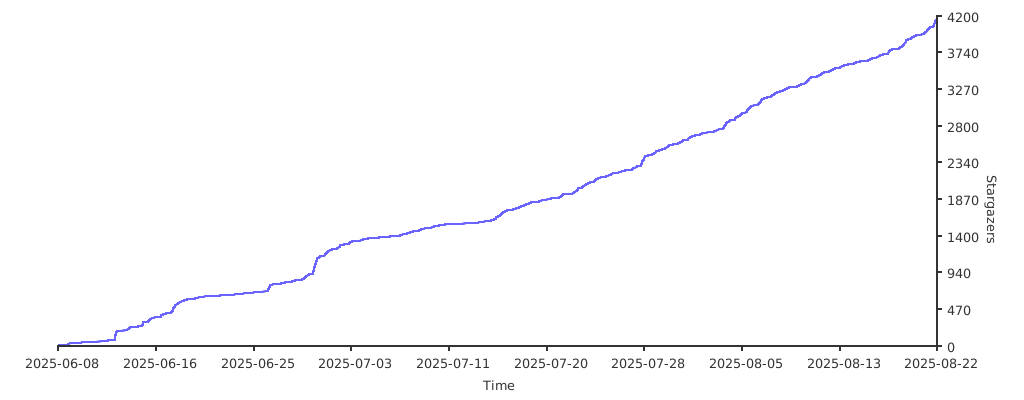
Star History