[T-PAMI'23] CCVPE: Convolutional Cross-View Pose Estimation
May 5, 2026 · View on GitHub
[Arxiv] [Paper] [Demo Video] [BibTeX]
This work is an extension of "Visual Cross-View Metric Localization with Dense Uncertainty Estimates, ECCV2022"

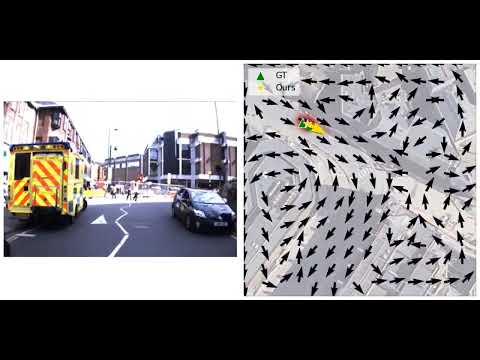
Demo video of per-frame pose estimation on Oxford RobotCar traversals with different weather and lighting conditions
Pose estimation (localization + orientation estimation) on images with different horizontal field-of-view (HFoV). From left to right: HFoV= $360^{\circ}, \180^{\circ}, \108^{\circ}$


Abstract
We propose a novel end-to-end method for cross-view pose estimation. Given a ground-level query image and an aerial image that covers the query's local neighborhood, the 3 Degrees-of-Freedom camera pose of the query is estimated by matching its image descriptor to descriptors of local regions within the aerial image. The orientation-aware descriptors are obtained by using a translational equivariant convolutional ground image encoder and contrastive learning. The Localization Decoder produces a dense probability distribution in a coarse-to-fine manner with a novel Localization Matching Upsampling module. A smaller Orientation Decoder produces a vector field to condition the orientation estimate on the localization. Our method is validated on the VIGOR and KITTI datasets, where it surpasses the state-of-the-art baseline by 72% and 36% in median localization error for comparable orientation estimation accuracy. The predicted probability distribution can represent localization ambiguity, and enables rejecting possible erroneous predictions. Without re-training, the model can infer on ground images with different field of views and utilize orientation priors if available. On the Oxford RobotCar dataset, our method can reliably estimate the ego-vehicle's pose over time, achieving a median localization error under 1 meter and a median orientation error of around 1 degree at 14 FPS.
Datasets
VIGOR dataset can be found at https://github.com/Jeff-Zilence/VIGOR.
We use the revised ground truth from https://github.com/tudelft-iv/SliceMatch
KITTI dataset can be found at https://github.com/shiyujiao/HighlyAccurate
For Oxford RobotCar, the aerial image is provided by https://github.com/tudelft-iv/CrossViewMetricLocalization, the ground images are from https://robotcar-dataset.robots.ox.ac.uk/datasets/
Models
Our trained models are available at: https://drive.google.com/drive/folders/1Fw3X0s_hbIurw3neB55Ic3DVPKT4d5if?usp=drive_link
Training and testing
Training or testing on VIGOR dataset:
samearea split: python train_VIGOR.py --area samearea
crossarea split: python train_VIGOR.py --area crossarea
For testing, add argument --training False
For testing with an orientation prior that contains up to noise, e.g. for noise, add the argument --ori_noise 72. corresponds to testing with known orientation
For testing with images with a limited HFoV, e.g. $180^{\circ}$, add the argument --FoV 180
Training on KITTI dataset: python train_KITTI.py
For testing, add argument --training False
For training or testing with an orientation prior, e.g. , add argument --rotation_range 10
We also provide the model trained with orientation prior, please change the test_model_path in train_KITTI.py
Training or testing on Oxford RobotCar dataset:
python train_OxfordRobotCar.py or python train_OxfordRobotCar.py --training False
Visualize qualitative results
Visualize qualitative results on VIGOR same-area or cross-area test set:
python visualize_qualitative_results_VIGOR.py --area samearea --ori_prior 180 --idx 0
idx: image index in VIGOR test set
ori_prior: means assuming known orientation with noise, stands for no orientation prior
Citation
@ARTICLE{10373898,
  author={Xia, Zimin and Booij, Olaf and Kooij, Julian F. P.},
  journal={IEEE Transactions on Pattern Analysis and Machine Intelligence},
  title={Convolutional Cross-View Pose Estimation},
  year={2024},
  volume={46},
  number={5},
  pages={3813-3831},
  keywords={Location awareness;Cameras;Pose estimation;Task analysis;Feature extraction;Image retrieval;Decoding;Aerial imagery;camera pose estimation;cross-view matching;localization;orientation estimation},
  doi={10.1109/TPAMI.2023.3346924}}