GraphUniverse: Enabling Systematic Evaluation of Inductive Generalization
February 18, 2026 · View on GitHub




Generate families of graphs with finely controllable properties for systematic evaluation of inductive graph learning models.
Quick Start | Interactive UI | Validation | Paper Experiments
Key Features
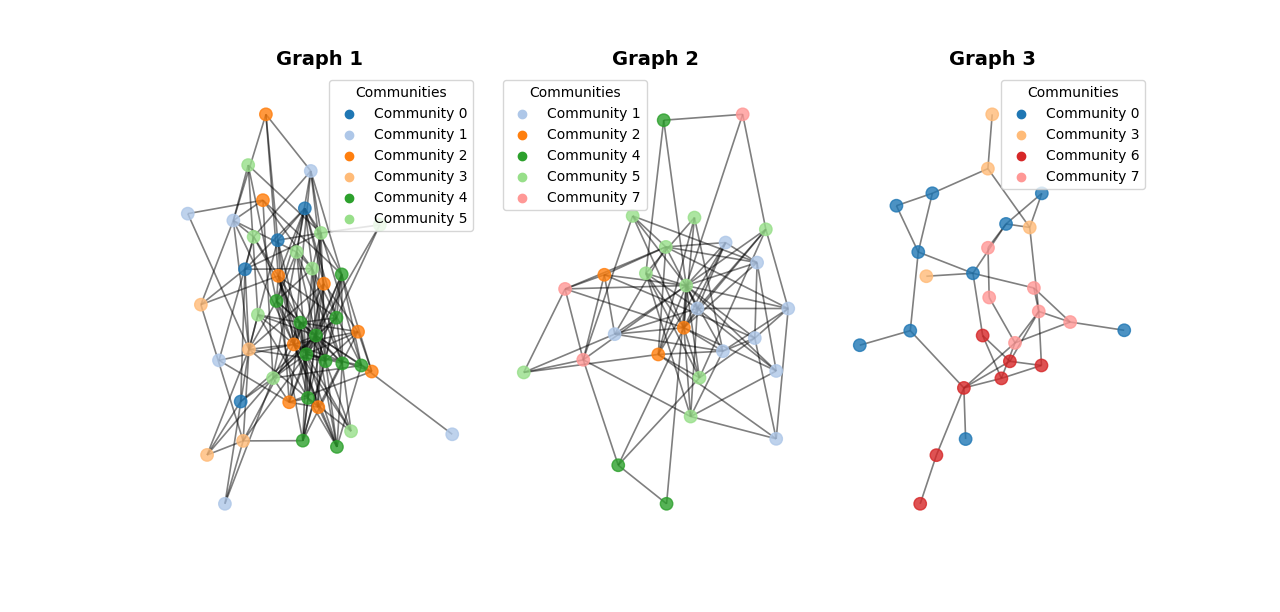
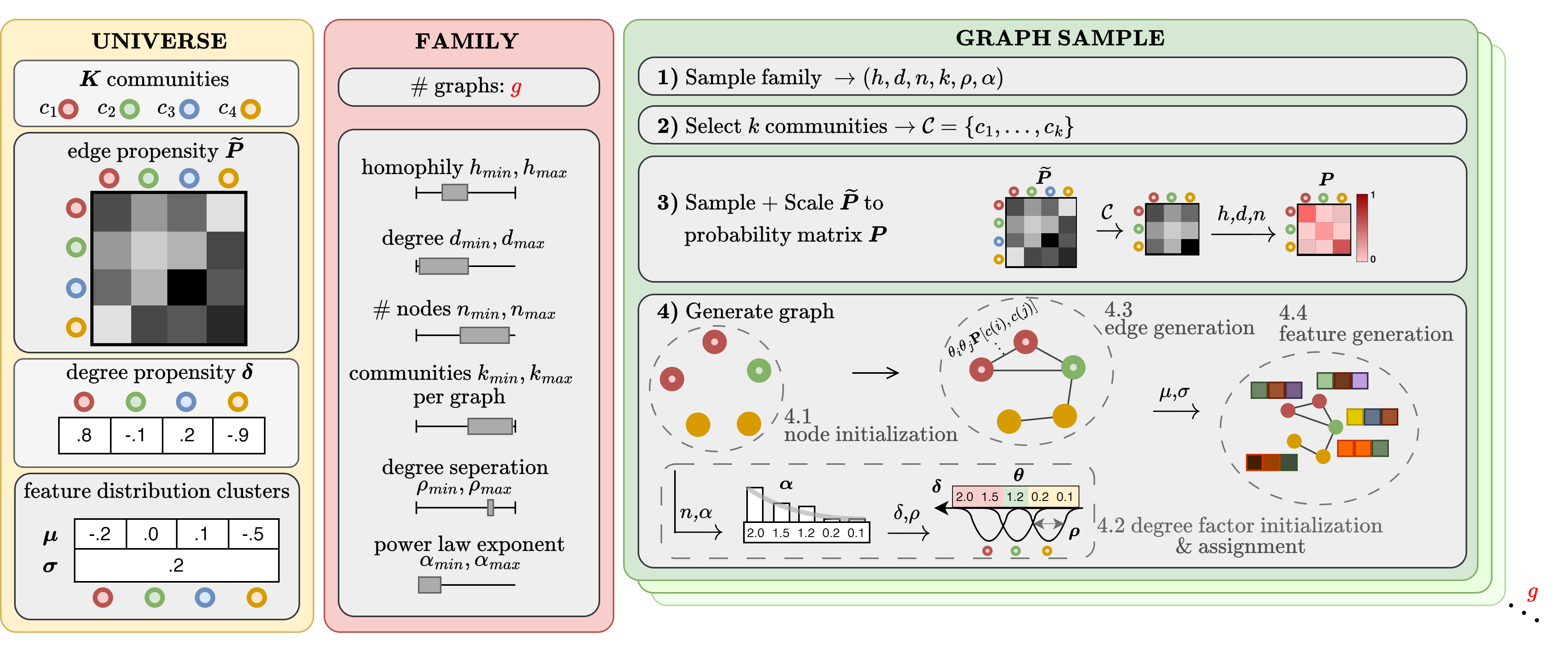
Synthetic graph learning benchmarks are limited to single-graph, transductive settings. GraphUniverse enables the first systematic evaluation of inductive generalization by generating entire families of graphs with:
- Consistent Semantics: Communities maintain stable identities across graphs
- Fine-grained Control: Tune homophily, degree distributions, community structure
- Scalable Generation: Linear scaling, thousands of graphs per minute
- Validated Framework: Comprehensive parameter sensitivity analysis
- Interactive Tool: Web-based exploration and visualization and Downloadable Pyg-dataset object ready to train!
Installation
Install from PyPI:
pip install graph-universe
For the interactive UI (streamlit) and visualization tools:
pip install graph-universe[viz]
Optional extras:
[viz]- Streamlit UI + seaborn visualization tools[dev]- Development dependencies (testing, linting)[all]- Everything (includes documentation tools)
Install from source:
git clone https://github.com/LouisVanLangendonck/GraphUniverse.git
cd GraphUniverse
pip install -e ".[dev]"
Interactive UI
After installing with [viz], launch the interactive dashboard:
graph-universe-ui
Hosted demo: Try it online at graphuniverse.streamlit.app
Launch from Python:
from graph_universe import launch_ui
launch_ui()  # Opens browser, press Ctrl+C to stop
Quick Start
Option 1: Python API with Individual Classes
from graph_universe import GraphUniverse, GraphFamilyGenerator

# Create universe with 8 communities and 10-dimensional features
universe = GraphUniverse(K=8, edge_propensity_variance=0.3, feature_dim=10)

# Generate family with full parameter control
family = GraphFamilyGenerator(
    universe=universe,
    n_nodes_range=(35, 50),
    n_communities_range=(2, 6),
    homophily_range=(0.2, 0.8),
    avg_degree_range=(2.0, 10.0),
    power_law_exponent_range=(2.0, 5.0),
    degree_separation_range=(0.1, 0.7),
    seed=42
)

# Generate 30 graphs
family.generate_family(n_graphs=30, show_progress=True)

print(f"Generated {len(family.graphs)} graphs!")

# Convert to PyTorch Geometric format for training
pyg_graphs = family.to_pyg_graphs(task="community_detection")
Option 2: Config-Driven Workflow
Create config.yaml:
universe_parameters:
  K: 10
  edge_propensity_variance: 0.5
  feature_dim: 16
  center_variance: 1.0
  cluster_variance: 0.3
  seed: 42

family_parameters:
  n_graphs: 100
  n_nodes_range: [25, 200]
  n_communities_range: [3, 7]
  homophily_range: [0.1, 0.9]
  avg_degree_range: [2.0, 8.0]
  power_law_exponent_range: [2.0, 3.0]
  degree_separation_range: [0.4, 0.8]
  seed: 42

task: "community_detection"
Then load and generate:
import yaml
from graph_universe import GraphUniverseDataset

with open("config.yaml") as f:
    config = yaml.safe_load(f)

dataset = GraphUniverseDataset(root="./data", parameters=config)
print(f"Generated dataset with {len(dataset)} graphs!")
Validation & Analysis
GraphUniverse includes built-in validation to ensure generated graphs match target properties:
# Validate standard graph properties
family_properties = family.analyze_graph_family_properties()
for property_name in ['node_counts', 'avg_degrees', 'homophily_levels']:
    values = family_properties[property_name]
    print(f"{property_name}: mean={np.mean(values):.3f}")

# Analyze within-graph community signals (fits Random Forest per graph)
family_signals = family.analyze_graph_family_signals()
for signal in ['structure_signal', 'feature_signal', 'degree_signal']:
    values = family_signals[signal]
    print(f"{signal}: mean={np.mean(values):.3f}")

# Measure between-graph consistency
family_consistency = family.analyze_graph_family_consistency()
for metric in ['structure_consistency', 'feature_consistency', 'degree_consistency']:
    value = family_consistency[metric]
    print(f"{metric}: {value:.3f}")
Documentation & Support
- GitHub Repository: https://github.com/LouisVanLangendonck/GraphUniverse
- PyPI Package: https://pypi.org/project/graph-universe/
- Issue Tracker: https://github.com/LouisVanLangendonck/GraphUniverse/issues
- Changelog: https://github.com/LouisVanLangendonck/GraphUniverse/blob/main/CHANGELOG.md
Citation
If you use GraphUniverse in your research, please cite:
@article{van2025graphuniverse,
  title={GraphUniverse: Enabling Systematic Evaluation of Inductive Generalization},
  author={Van Langendonck, Louis and Bern{\'a}rdez, Guillermo and Miolane, Nina and Barlet-Ros, Pere},
  journal={arXiv preprint arXiv:2509.21097},
  year={2025}
}
For Researchers & Contributors
The sections below contain resources for reproducing paper experiments and contributing to development.
Reproducing Paper Experiments
Clone the repository to access validation and experiment scripts:
git clone https://github.com/LouisVanLangendonck/GraphUniverse.git
cd GraphUniverse
pip install -e ".[dev]"
Run parameter sensitivity validation (reproduces paper results):
python experiments/validate_parameter_sensitivity.py --n-random-samples 100 --n-graphs 30
Run scalability experiments:
python experiments/scalability_experiment.py
License
MIT License - see LICENSE for details.
Copyright (c) 2025 Louis Van Langendonck and Guillermo Bernardez