🌐 GEO Checker
June 10, 2026 · View on GitHub
Audit your landing page's AI search visibility and citation potential in seconds. A production-ready, self-hostable Next.js SaaS boilerplate for marketers, SEO agencies, and developers — checks how well pages are indexed and cited by AI search engines like ChatGPT, Perplexity, and Gemini. A free open-source alternative to SEMrush, Surfer SEO, and enterprise GEO auditing suites — powered by the MuAPI AI engine.
Tech stack: Next.js 14 (App Router) · Prisma · PostgreSQL · NextAuth (Google OAuth) · Stripe · Tailwind CSS · MuAPI (Gemini 2.5 Flash via any-llm) Use cases: Marketing agency SEO reports · Landing page AI visibility audits · Pre-launch GEO optimization · Content teams · Startup growth · SaaS product pages · AI search ranking research · SEO consultants

🌐 Project Details
GitHub Repository: github.com/SamurAIGPT/geo-checker
Live Demo Preview: geo-checker-silk.vercel.app
GEO Checker is a production-ready, highly-optimized AI web application. Out of the box, it seamlessly manages User Authentication, Credits & Billing, Website HTML Scraping, and asynchronous deep AI reviews using a sleek Next.js (App Router) architecture. It empowers users, agencies, and developers to analyze website copy against LLM indexing rules — all within a stunning visual dashboard.
Why use GEO Checker?
- Production-Ready SaaS — Complete with Google OAuth and Stripe Checkout workflows built-in.
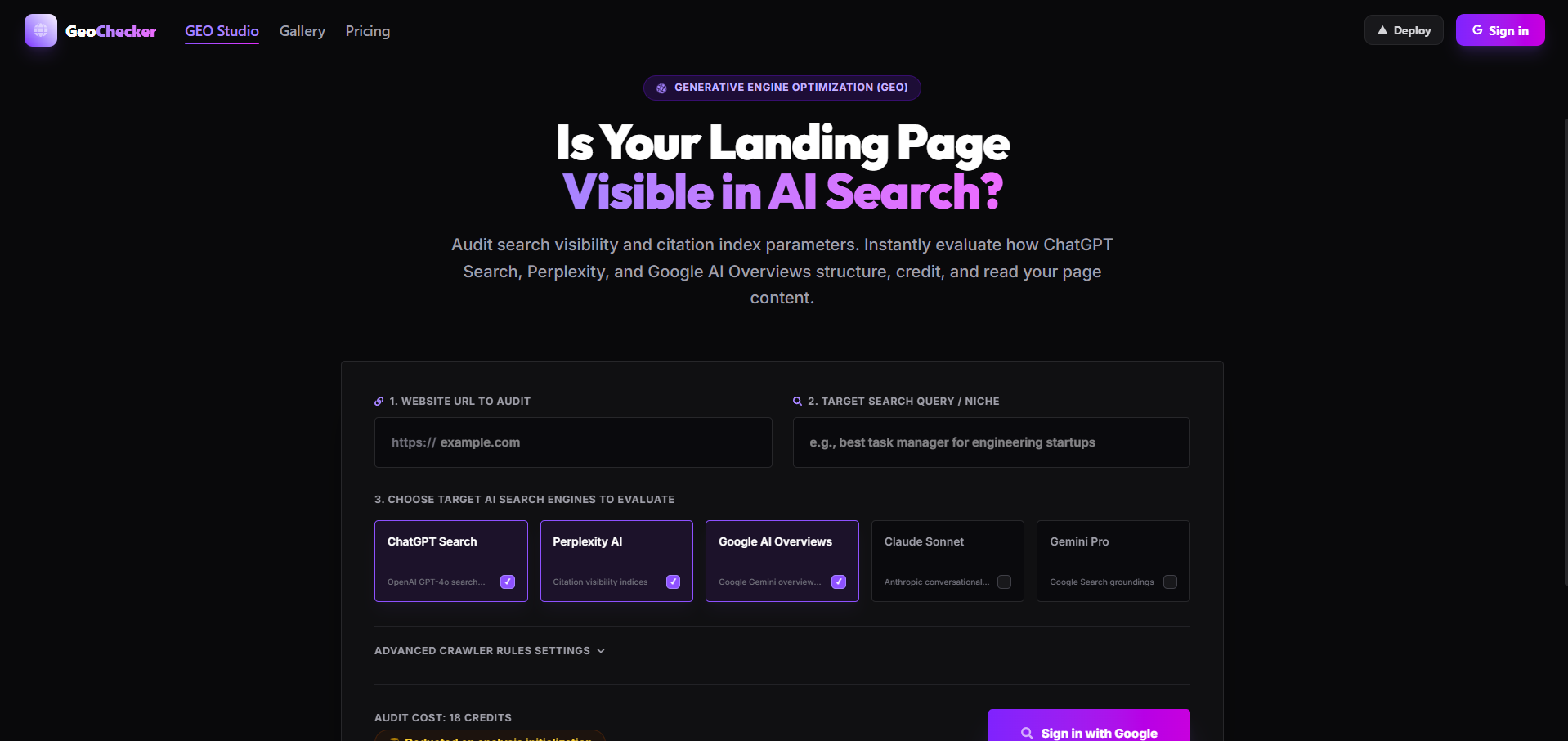
- Virtual GEO Audit Studio — Enter any landing page URL and your target keyword niche to get immediate optimization reviews.
- Webhook-Backed AI Delivery — MuAPI async webhook delivers results directly into the database (
/api/webhook/muapi), keeping API routes non-blocking and preventing request timeouts. - Personal Showroom Gallery — All generated reports are saved to PostgreSQL. Users can review, compare, download, and delete their audits from
/gallery. - Responsive Screen-Fitting — Designed with a fluid layout that fits perfectly on all screens (mobile, tablet, desktop) using stacked adaptive grids on mobile and viewport-locked scrolling on desktop.
✨ Core Features
🎨 GEO Auditor Studio (Main Page /)
- Website url entry alongside custom query target keyword inputs.
- Multi-Select checkboxes to specify which engines to optimize for:
- ChatGPT Search
- Perplexity AI
- Google AI Overviews
- Claude Sonnet
- Gemini Pro
- Advanced settings dropdown panel for:
- Prioritize Reasoning Depth (toggles slower deep-reasoning chains)
- Audit Structured Schema (validates JSON-LD semantic models)
- Cost: 18 credits per AI Visibility simulation.
🖼️ Personal Showroom Gallery (/gallery)
- Visual card grid of all generated website audits.
- Cards show a thumbnail/niche description, visibility score, target query, and status (
processing/completed/failed). - Full-screen details modal with a floating overview of recommendations, sitemap rules, and direct Export JSON actions utilizing the local proxy.
💳 Stripe Credit Billing (/pricing)
- Four credit packs based on a $1 = 200 credits conversion rate:
- Basic Pack ($5 / 1,000 credits)
- Standard Pack ($10 / 2,000 credits)
- Professional Pack ($20 / 4,000 credits — Most Popular)
- Business Pack ($50 / 10,000 credits)
- No recurring subscriptions — pay once, use at your own pace.
- Credit balance is automatically topped up via Stripe webhook on checkout completion.
🔐 Google Auth + Credit Persistence
- NextAuth Google provider with Prisma adapter — user sessions, credit balances, and galleries are all persisted per account.
- Credits displayed live in the Navbar with a pulsing coin icon.
⚡ Deployment: Vercel & Production
This architecture is engineered explicitly for Vercel serverless environments.
One-Click Deploy
Live App: geo-checker-silk.vercel.app
🔑 Required Environment Variables
To successfully deploy and run, you must populate the following environment variables in your Vercel project settings:
| Service | Variable | Description & Source |
|---|---|---|
| Database | DATABASE_URL | PostgreSQL connection string (Supabase or Neon) |
| NextAuth / Google | NEXTAUTH_SECRET | Secure random string generated via openssl rand -base64 32 |
NEXTAUTH_URL | Your production domain (e.g. https://my-app.vercel.app) | |
WEBHOOK_URL | Public URL for MuAPI async callbacks (same as NEXTAUTH_URL in production) | |
GOOGLE_CLIENT_ID | Get from Google Cloud Console | |
GOOGLE_CLIENT_SECRET | Get from Google Cloud Console | |
| Stripe Billing | STRIPE_SECRET_KEY | Get from Stripe Dashboard |
NEXT_PUBLIC_STRIPE_PUBLISHABLE_KEY | Get from Stripe Dashboard | |
STRIPE_WEBHOOK_SECRET | Webhook secret for resolving credit purchases | |
| AI Generation | MUAPIAPP_API_KEY | Create an account and get key from muapi.ai |
🚀 Launching on Vercel: Step-by-Step
- Database Provisioning: Create a new Postgres database (via Supabase or Neon). Retrieve the connection string (
DATABASE_URL). - Project Creation: Import your GitHub fork into the Vercel dashboard.
- Configure Environment Variables: Copy the variables above into the Vercel project settings environment tab.
- Deploy: Hit "Deploy". Vercel will automatically run the build steps (
npm run build). - Database Push: Run
npx prisma db pushto synchronize database models before launching. - Integrations Setup:
- Establish a Google Cloud OAuth app, enabling the callback URL:
https://your-app.vercel.app/api/auth/callback/google - Setup a Stripe Webhook, pointing to
https://your-app.vercel.app/api/stripe/webhookand selecting thecheckout.session.completedevent. - Register a MuAPI Webhook pointing to
https://your-app.vercel.app/api/webhook/muapito receive async generation results.
- Establish a Google Cloud OAuth app, enabling the callback URL:
🛠️ Local Development
Ready to iterate locally? Setup is straightforward.
Prerequisites
- Node.js (v18 or higher)
- A local PostgreSQL instance or a free cloud Database URL.
- ngrok (optional, for local MuAPI webhook testing)
Setup
# 1. Clone the repository
git clone https://github.com/SamurAIGPT/geo-checker
cd geo-checker

# 2. Install dependencies
npm install

# 3. Setup Environment
cp .env.example .env
# Open .env and insert your specific keys.

# 4. Initialize Database Schema
# Note: Because the database is shared, see the Safety Warning below!
npx prisma generate
npx prisma db push

# 5. Start the Development Server
npm run dev
The console should now be active on http://localhost:3000.
Webhook Tip: For local MuAPI webhook testing, run
ngrok http 3000and setWEBHOOK_URLto the generated HTTPS URL in your.env.
⚠️ Database Safety Warning (Shared Pool)
The workspace database is shared with other applications. Running npx prisma db push on a clean, empty schema will drop tables belonging to other applications. Always follow the Pull-Declare-Push-Cleanup sequence:
- Run
npx prisma db pullto fetch all database tables. - Declare your
GeoReporttable and update the relations on theUsermodel. - Run
npx prisma db pushto add your changes safely. - Clean up
schema.prismato keep only NextAuth models,GeoReport, and the updatedUserrelations. - Run
npx prisma generateto rebuild the type-safe client.
🏗️ Technical Architecture
geo-checker/
├── prisma/
│   └── schema.prisma           # Postgres schema (User, Account, Session, GeoReport)
├── src/
│   ├── app/                    # Next.js App Router
│   │   ├── page.js             # Main Studio Workspace (Auditor Interface)
│   │   ├── gallery/            # Dedicated showroom gallery view grid
│   │   ├── pricing/            # 4-Plan credit pricing grid (\$1 = 200 credits)
│   │   └── api/
│   │       ├── auth/           # NextAuth handler
│   │       ├── scrape/         # Website HTML scrape utility proxy
│   │       ├── generation/     # Credit deduction + MuAPI trigger endpoint
│   │       ├── creations/      # GET / DELETE creations history (with webhook bypass sync)
│   │       ├── download/       # CORS proxy for exporting JSON report files
│   │       ├── webhook/muapi/  # MuAPI async webhook callback handler
│   │       └── stripe/         # Stripe checkout creation + checkout webhook
│   ├── components/
│   │   ├── Providers.jsx       # NextAuth SessionProvider wrapper
│   │   └── layout/Navbar.jsx   # Sticky header with Hamburger, Vercel Deploy & credit balance
│   └── lib/
│       ├── auth.js             # NextAuth config with Prisma adapter
│       ├── config.js           # Central config mapping Google, Stripe, MuAPI keys
│       ├── prisma.js           # Cached Prisma client singleton
│       ├── stripe.js           # Stripe instance initializer
│       └── services/
│           ├── user.js         # Credit management service (18 credits per run)
│           └── billing.js      # Stripe checkout and payment webhook parser
└── next.config.mjs             # Next.js configuration
📄 License
MIT Licensed.
GEO Checker: A premium, dark-mode, fully responsive Generative Engine Optimization audit suite built for modern search visibility analysis.