demucs-onnx
May 22, 2026 · View on GitHub
demucs-onnx






Run and export HT-Demucs / Demucs music source separation as ONNX —
Python, browser, iOS, and Android. Pure numpy + onnxruntime at
inference (no PyTorch), a one-call export pipeline that fixes the four
known blockers in torch.onnx.export, pre-built ONNX models on Hugging
Face, and a copy-pasteable onnxruntime-web path for the browser.
Powers the StemSplit production stack.
pip install 'demucs-onnx[mp3]'
demucs-onnx separate song.mp3 out/ --karaoke --mp3
# writes out/karaoke.mp3  (drums + bass + other, vocals removed)
Quick links
- Documentation — full guides, API reference, and walkthroughs
- GitHub — source, issues, and discussions
- Hugging Face models — 7 pre-built ONNX repos
- CLI reference — every flag, every example
- Browser guide —
onnxruntime-webintegration - Hosted API — skip the infra, get stems via HTTP
stemsplit-python— official Python SDK for the StemSplit API (pip install stemsplit-python)
Why use this instead of X?
Snapshot 2026-05-21. Distilled from
COMPETITIVE_LANDSCAPE.md.
| Want to … | demucs-onnx | facebookresearch/demucs | nomadkaraoke/audio-separator | deezer/spleeter | sevagh/demucs.onnx |
|---|---|---|---|---|---|
pip install it | ✅ | ✅ | ✅ | ✅ | ❌ (C++ build) |
| Run HT-Demucs as ONNX with no PyTorch at inference | ✅ | ❌ | ❌ (uses torch for Demucs) | ❌ (TensorFlow, not Demucs) | ✅ (C++ only) |
| Pre-built models on Hugging Face | ✅ 7 repos | — | — | — | ❌ |
Browser / onnxruntime-web support | ✅ scaffold + bundler configs | ❌ | ❌ | ❌ | ❌ |
| Mobile-friendly (iOS / Android via ORT) | ✅ | ❌ | ❌ | ❌ | ⚠️ build yourself |
| 6-stem (drums, bass, other, vocals, guitar, piano) | ✅ ONNX | ✅ PyTorch | ⚠️ via Demucs/PyTorch | ❌ | ⚠️ all variants |
| Karaoke / mix-stems CLI shortcut | ✅ --karaoke --mp3 | ❌ | ⚠️ scriptable | ❌ | ❌ |
| Auto-resample any sample rate / mono | ✅ | ❌ (44.1 kHz stereo only) | ✅ | ❌ | ⚠️ |
| Export your own Demucs checkpoint to ONNX | ✅ one call, parity-verified | ❌ | ❌ | ❌ | ❌ (uses pre-export) |
demucs-onnx is the only pip-installable Python package that runs
HT-Demucs as ONNX cross-platform with no PyTorch dependency at
inference. If you find a comparable working solution after this package
was published, please open an issue
so we can update this table.
Quick start
Install
pip install demucs-onnx                # inference only — onnxruntime + numpy + soundfile + soxr
pip install "demucs-onnx[mp3]"         # adds the lameenc encoder for --mp3 output
pip install "demucs-onnx[export]"      # adds torch + demucs for the export pipeline
Separate (Python)
from demucs_onnx import separate, separate_stem

# Full 4-stem bag (default). Auto-downloads from HF on first run, auto
# picks the best execution provider for this host (CoreML / CUDA / DML).
stems = separate("song.mp3")
# stems: {"drums": ndarray (2, S), "bass": ..., "other": ..., "vocals": ...}

# Just one stem — 4× faster, 75% less RAM, model size 316 MB instead of 1.26 GB.
vocals = separate_stem("song.mp3", "vocals")

# Smaller download (166 MB per stem instead of 316 MB), no runtime cost.
stems = separate("song.mp3", precision="fp16weights")

# Write straight to MP3, including a karaoke instrumental mix.
separate(
    "song.mp3", "stems/",
    output_format="mp3", bitrate_kbps=192,
    mix_stems=("drums", "bass", "other"), mix_output_name="karaoke",
)
Separate (CLI)
# Killer feature — one command -> karaoke.mp3 ready to share.
demucs-onnx separate song.mp3 stems/ --karaoke --mp3

# All 4 stems, auto provider (CoreML on macOS, CUDA on Linux, etc).
demucs-onnx separate song.mp3 stems/

# 6-stem mode with guitar + piano.
demucs-onnx separate song.mp3 stems/ --model htdemucs_6s

# Single specialist mode — 4x faster than the bag.
demucs-onnx separate song.mp3 stems/ --stem vocals

# Smaller download (1.91x), same runtime cost.
demucs-onnx separate song.mp3 stems/ --small

# Custom mix-down: write one file that's vocals + drums only.
demucs-onnx separate song.mp3 stems/ --mix-stems vocals,drums --mp3

# Explicit provider override (auto is the default).
demucs-onnx separate song.mp3 stems/ --providers coreml
demucs-onnx separate song.mp3 stems/ --providers cuda
demucs-onnx separate song.mp3 stems/ --providers dml

demucs-onnx list-models
Models auto-download from the Hugging Face Hub on first run and are cached forever. Inputs at any sample rate (8 kHz – 192 kHz, mono or stereo) are auto-resampled in for inference and back out so the file you get matches the file you put in.
Browser
# Print a copy-pasteable onnxruntime-web config snippet for any major bundler.
demucs-onnx browser-config --bundler vite      # or webpack, esbuild, next, rollup

# Scaffold a runnable demo into a directory (zero build, just python -m http.server).
demucs-onnx browser-demo /tmp/demo
demucs-onnx browser-demo /tmp/demo --react     # Vite + React + TypeScript variant
See the browser guide
or the in-tree examples/browser/
and examples/browser-react/
demos.
Export (Python)
from demucs_onnx.export import export_to_onnx
from pathlib import Path

# Export every specialist of htdemucs_ft into out/ as 4 .onnx files.
paths = export_to_onnx("htdemucs_ft", "out/")
# paths == {"drums": Path("out/htdemucs_ft_drums.onnx"), "bass": ..., ...}

# Export just the vocals specialist to a single file.
export_to_onnx("htdemucs_ft", "vocals.onnx", stem="vocals")

# Export your own fine-tuned checkpoint.
export_to_onnx(Path("my_finetune.th"), "my_finetune.onnx")
Export (CLI)
demucs-onnx export htdemucs_ft out/                    # all 4 specialists
demucs-onnx export htdemucs_ft drums.onnx --stem drums # one stem -> single file
demucs-onnx export htdemucs_ft out/ --opset 17         # change opset
demucs-onnx export htdemucs_ft out/ --no-parity-check  # advanced (don't)
Mobile / web (after exporting)
// iOS / Swift, ORT 1.17+
import onnxruntime_objc
let opts = try ORTSessionOptions()
try opts.appendCoreMLExecutionProvider(with: ORTCoreMLExecutionProviderOptions())
let session = try ORTSession(env: env,
                              modelPath: bundle.path(forResource: "htdemucs_ft_vocals",
                                                     ofType: "onnx")!,
                              sessionOptions: opts)
// Browser / web, onnxruntime-web
import * as ort from "onnxruntime-web";
const session = await ort.InferenceSession.create("htdemucs_ft_vocals.onnx", {
  executionProviders: ["wasm"],
  graphOptimizationLevel: "all",
});
const tensor = new ort.Tensor("float32", audioBuffer, [1, 2, 343980]);
const out = await session.run({ mix: tensor });
What's new in v0.3 — browser, htdemucs/htdemucs_6s, docs site
htdemucs_6sflavor — single-file 6-stem ONNX model with guitar and piano in addition to the standard 4. The only ONNX export of the 6-stem variant on the Hub. (StemSplitio/htdemucs-6s-onnx)htdemucsflavor — single-file 4-stem ONNX model. ~30% faster than the FT bag (1 session vs 4), slightly lower SDR. (StemSplitio/htdemucs-onnx)- Browser support via
onnxruntime-web— copy-pasteable bundler configs and ademucs-onnx browser-demo PATHCLI that scaffolds a zero-build vanilla HTML/JS demo or a Vite + React + TS demo. SessionPool+prewarm()— process-wide session cache and a one-shot prewarm so the firstseparate()call doesn't pay the CoreML graph-compile tax. Reusing sessions acrosshtdemucs_ftbag calls is now automatic.- Docs site at stemsplit.github.io/demucs-onnx with the canonical 4-blocker write-up, browser guide, model registry, and autogenerated API reference via
mkdocstrings[python].
See CHANGELOG.md
for the full diff vs v0.2.0 and the v0.2.0 UX bundle (--karaoke,
--mix-stems, --mp3, providers="auto", fp16-weight downloads,
auto-resampling, progress bars).
Why this package exists
For the entire history of the demucs
repo (2021 – 2026), nobody on PyPI has shipped working ONNX export
tooling for HT-Demucs. Searching GitHub turns up half a dozen
abandoned forks, all stuck on one of four blockers, all without a
working .onnx file to show for it. The official demucs README has no
mention of ONNX. We solved it.
This package ships a pure-numpy + onnxruntime inference path that runs
the official HT-Demucs FT models with no PyTorch dependency (install
footprint drops from ~2 GB to ~50 MB), a one-call export pipeline
(export_to_onnx("htdemucs_ft", ...)) that applies all four patches
and parity-checks the output against PyTorch fp32, and the same patches
as independent grep-able modules (stft.py, mha.py, pos_embed.py,
segment.py) so you can debug your own exports of related
architectures.
| Want to … | Use this |
|---|---|
| Run htdemucs_ft on CPU / mobile / web with no PyTorch | from demucs_onnx import separate |
| Convert your own demucs checkpoint to ONNX | from demucs_onnx.export import export_to_onnx |
| Skip the infrastructure entirely | The hosted StemSplit API |
Used by / integrations
- StemSplit — production stack for Vocal Remover, Karaoke Maker, Acapella Maker, and the hosted API. The same ONNX models on Hugging Face power the production endpoints — what you install is what we run.
- Pre-built ONNX models on Hugging Face at
StemSplitio— 7 ONNX repos- 4 PyTorch source repos, all MIT-licensed and parity-verified.
If you ship demucs-onnx in a project and would like to be listed
here, please
open an issue or
PR a one-line addition.
The 4 blockers explained
These are the four things that break vanilla torch.onnx.export on
HT-Demucs (PyTorch 2.4 / opset 17). Each lives in its own grep-able
module so you can lift the fix into a different project.
Blocker 1 — torch.stft returns complex tensors
# demucs/htdemucs.py
z = torch.stft(x, n_fft, hop_length, return_complex=True)  # complex64 output
torch.onnx.export raises Exporting STFT does not currently support complex types. The dynamo exporter sometimes lowers it, but the
resulting graph fails ORT shape inference.
Fix — demucs_onnx/export/stft.py.
Replace torch.stft with a Conv1d whose kernels are precomputed
sin/cos DFT bases for n_fft = 4096, hop = 1024, hann window,
normalized=True. The output is two real channels (real, imag) instead
of one complex channel. Inverse: a matching ConvTranspose1d plus an
OLA(window²) envelope normalisation. The class also overrides
demucs's own _spec / _ispec / _magnitude / _mask methods so the
rest of the network sees (B, C, 2, F, T) real tensors throughout.
Verified to 5×10⁻⁶ max abs diff against torch.stft on real audio.
Blocker 2 — model.segment is a fractions.Fraction
# demucs/htdemucs.py
self.segment = Fraction(39, 5)  # = 7.8 seconds
torch._dynamo allow-lists a small set of "user-defined classes" it
can trace through. Fraction is not on it (PyTorch 2.4) and graph
capture crashes. The legacy exporter is more permissive but still
produces a wrong graph because Fraction arithmetic is opaque to it.
Fix — demucs_onnx/export/segment.py.
Coerce to float. Mathematically identical at inference, side-steps
both exporter limitations.
Blocker 3 — random.randrange in the transformer pos-embedding
# demucs/transformer.py
shift = random.randrange(self.sin_random_shift + 1)  # = 0 at eval
Used during training for positional-embedding augmentation. At eval,
sin_random_shift = 0 so the call always returns 0, but neither the
legacy exporter nor dynamo can trace through a call to random —
UnsupportedOperatorError and graph break, respectively.
Fix — demucs_onnx/export/pos_embed.py.
Monkey-patch CrossTransformerEncoder._get_pos_embedding with a
deterministic version that hardcodes shift = 0. Mathematically
identical at inference time.
Blocker 4 — aten::_native_multi_head_attention has no ONNX symbolic
# torch/nn/functional.py — internally
return torch._native_multi_head_attention(...)  # fused C++ kernel
nn.MultiheadAttention dispatches to a fast fused C++ kernel when its
inputs satisfy a fast-path check. The fused kernel has no ONNX
symbolic: the exporter raises UnsupportedOperatorError: Exporting the operator 'aten::_native_multi_head_attention' to ONNX opset version 17 is not supported.
Fix — demucs_onnx/export/mha.py.
Replace nn.MultiheadAttention.forward (per instance, via
types.MethodType) with a manual scaled-dot-product attention built
from Linear / bmm / softmax. The exporter handles those
primitives without complaint. Output is bit-identical to the fused
kernel up to fp32 round-off.
Net result
After all four patches, end-to-end parity vs PyTorch fp32:
| Stem | max abs diff (1×2×343980 random input) |
|---|---|
| drums | 1.63 × 10⁻⁴ |
| bass | 1.42 × 10⁻⁴ |
| other | 1.71 × 10⁻⁴ |
| vocals | 1.55 × 10⁻⁴ |
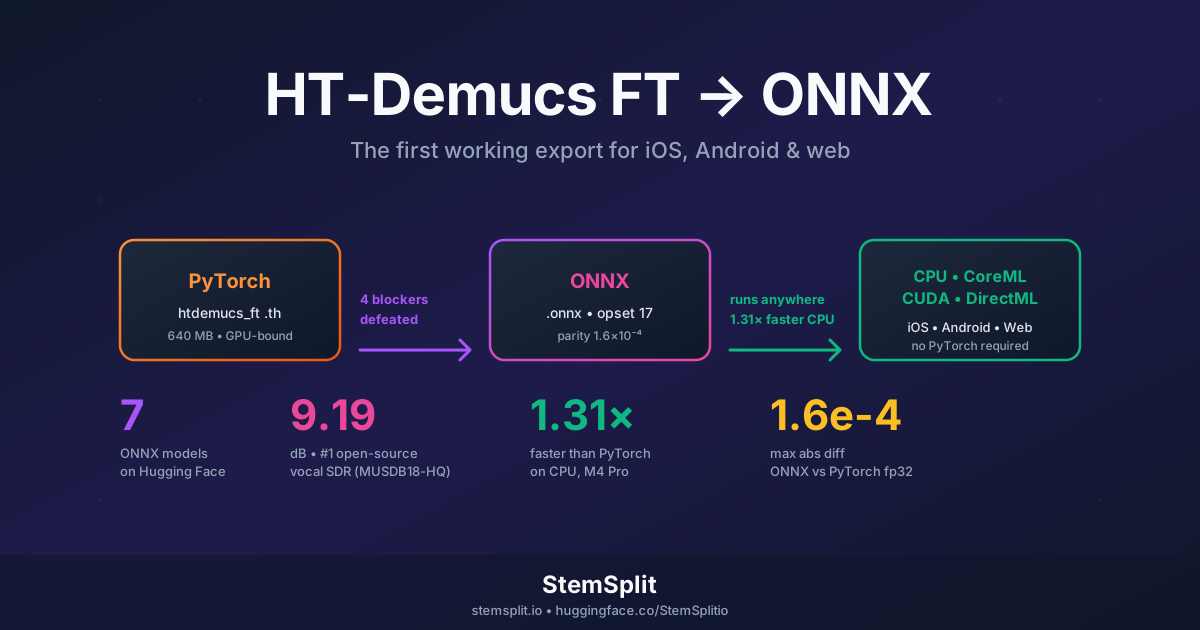
…and the ONNX graph runs in onnxruntime CPU at 1.31× the speed of
PyTorch CPU on Apple M4 Pro (no GPU).
Pre-trained ONNX models on Hugging Face
We host seven companion ONNX model repos (plus four PyTorch source repos for parity-checking your own exports). The Python package downloads from these automatically on first run; you can also fetch them by hand.
| Repo | Stems | Size | Use case |
|---|---|---|---|
StemSplitio/htdemucs-ft-onnx | all 4 (bag) | 1.26 GB | Full FT bag, best SDR, default |
StemSplitio/htdemucs-onnx | all 4 (single) | 316 MB | Fastest 4-stem startup, ~30% faster than the bag |
StemSplitio/htdemucs-6s-onnx | 6 (incl. guitar + piano) | 258 MB | The only 6-stem ONNX export on the Hub |
StemSplitio/htdemucs-ft-drums-onnx | drums | 316 MB | Drum extraction, beat transcription |
StemSplitio/htdemucs-ft-bass-onnx | bass | 316 MB | Bassline isolation, mix rebalancing |
StemSplitio/htdemucs-ft-other-onnx | other | 316 MB | Karaoke instrumental, sample-flipping |
StemSplitio/htdemucs-ft-vocals-onnx | vocals | 316 MB | #1 open-source vocal SDR — vocal removal, acapella, karaoke |
Every repo also ships a *_fp16weights.onnx variant (~half the
download) with identical runtime memory / latency. All MIT-licensed
and parity-verified to < 1e-3 vs PyTorch fp32. See the
Models page in the docs
for full size / speed / quality tables.
Performance
Real measurements on Apple M4 Pro (8-core CPU, no GPU):
| Mode | Per 7.8-s segment | Per 3-min song | RTF |
|---|---|---|---|
demucs-onnx, single specialist (CPU) | 1.59 s | ~22 s | 0.20 |
demucs-onnx, full bag (CPU) | 6.4 s | ~88 s | 0.49 |
| PyTorch CPU (single specialist) | 2.09 s | ~29 s | 0.26 |
| PyTorch MPS (full bag) | 1.0 s | ~12 s | 0.07 |
CUDA / DirectML / CoreML ONNX EPs are all ≥ 5× faster than the CPU EP on real GPUs — see the model card on each HF repo for hardware-specific numbers.
API
demucs_onnx.separate(input, output_dir=None, *, model="htdemucs_ft", stems=None, providers="auto", precision="fp32", cache_dir=None, token=None, verbose=False, progress=True, output_format="wav", bitrate_kbps=192, mix_stems=None, mix_output_name="mix") -> dict[str, np.ndarray]
Run separation on an audio file. Returns
{stem_name: (channels, samples)} in float32 at the input file's
native sample rate (we auto-resample for inference and back). If
output_dir is given, also writes <stem>.wav (or .mp3) files into
it; pass mix_stems=("drums","bass","other") to additionally write a
single karaoke instrumental file.
model accepts:
"htdemucs_ft"(default) — full 4-stem fine-tuned bag"htdemucs"— single-file 4-stem, ~30% faster than the bag"htdemucs_6s"— single-file 6-stem (drums, bass, other, vocals, guitar, piano)"htdemucs_ft_<stem>"or just"<stem>"— single specialist (drums/bass/other/vocals)
providers accepts:
"auto"(default) — auto-detect the best EP for this host (CoreML / CUDA / DML / CPU)- A short alias (
"cpu","coreml","cuda","dml"), an explicit ORT provider name, or a list of either
precision accepts "fp32" (default) or "fp16weights". The latter
downloads a 166 MB variant per stem (1.91× smaller) with identical
runtime memory and latency; max abs diff vs fp32 is ~6e-5.
demucs_onnx.separate_stem(input, stem, output_dir=None, **kwargs) -> np.ndarray
Shorthand: run only one specialist and return the single stem as a
numpy array. ~4× faster than running the full bag when you only need
one stem. Accepts guitar / piano (auto-routes to htdemucs_6s).
demucs_onnx.separate_all(input, output_dir=None, **kwargs) -> dict[str, np.ndarray]
Shorthand for separate(..., model="htdemucs_ft").
demucs_onnx.prewarm(models=("htdemucs_ft",), **kwargs) -> None
Pre-download and pre-compile ORT sessions so the first separate()
call doesn't pay the CoreML graph-compile or HF-download tax.
demucs_onnx.auto_select_providers() -> list[str]
Return the EP list separate() would pick on this host. Useful for
debugging — print it from your code if auto selects something
surprising.
demucs_onnx.describe_runtime() -> dict[str, object]
Returns {system, machine, python, onnxruntime, available_providers, in_browser}. Print this if auto doesn't pick the EP you expect.
demucs_onnx.export.export_to_onnx(checkpoint, output, *, stem=None, stems=None, opset=17, parity_check=True, parity_tolerance=1e-3, ...) -> dict[str, Path]
Convert a demucs/htdemucs PyTorch checkpoint (by name or .th path) to
one or more ONNX files. Applies all four patches, runs a numerical
parity check before writing, and aborts if max abs diff > tolerance.
demucs_onnx.export.patch_htdemucs_for_onnx(model) -> nn.Module
Apply all four patches in place, return the same model. Useful when you want to keep the patched model around for alternative tracers.
Individual patches
Each blocker is a single-purpose module so you can pull just one fix into a different project:
demucs_onnx.export.coerce_segment_to_float— Fraction → floatdemucs_onnx.export.disable_random_pos_shift— droprandom.randrangedemucs_onnx.export.onnx_friendly_mha_forward— manual MHA forwarddemucs_onnx.export.RealSTFT/RealISTFT— complex STFT replacement
Skip the infrastructure — use the StemSplit API
Don't want to bundle a 316 MB model in your app, manage a GPU pool, or write overlap-add chunking? Use the StemSplit API instead — same models under the hood, hosted for you, with credits and a dashboard.
- stemsplit.io
- Developer docs
- API reference
- Python SDK:
pip install stemsplit-python—stemsplit-pythonon PyPI, source
Or use the no-code tools that ship the same model family: Vocal Remover · Karaoke Maker · Acapella Maker · YouTube Stem Splitter.
License & attribution
This package is MIT-licensed, matching the original HT-Demucs. Please cite the original authors if you use the model in research:
@inproceedings{rouard2023hybrid,
  title     = {Hybrid Transformers for Music Source Separation},
  author    = {Rouard, Simon and Massa, Francisco and D{\'e}fossez, Alexandre},
  booktitle = {ICASSP},
  year      = {2023}
}
- Original PyTorch model:
facebookresearch/demucs - ONNX export, parity verification, packaging, and host inference by StemSplit Online Vocal Remover