Tutorial: A four-state traffic light
May 5, 2026 · View on GitHub
A short walkthrough that builds a four-state traffic light from scratch:
the three colors plus an Off state. By the end you will have used
all three of jssm's arrow types (->, =>, ~>), named actions, and
the array-notation shortcut for collapsing repeated edges.
At any time, you can take the code and put it into the graph explorer to mess with it as you see fit.
0: Lights always have an off state
Our light will start in the Off state, with the ability to switch to
the Red state.
Since that's a normal, not-notable thing, we'll just make it a regular
-> legal transition.
Off -> Red;
We will give that transition an action, and call it TurnOn.
Off 'TurnOn' -> Red;
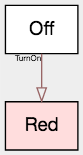
So far, our machine is simple:
1: Traffic lights have a three-color cycle
The main path of a traffic light is cycling from Green to Yellow,
then to Red, then back again. Because this is the main path, we'll
mark these steps => main transitions.
Off 'TurnOn' -> Red => Green => Yellow => Red;
We will give those all the same action name, Proceed, indicating "next color" without needing to know what we're currently on.
Off 'TurnOn' -> Red 'Proceed' => Green 'Proceed' => Yellow 'Proceed' => Red;
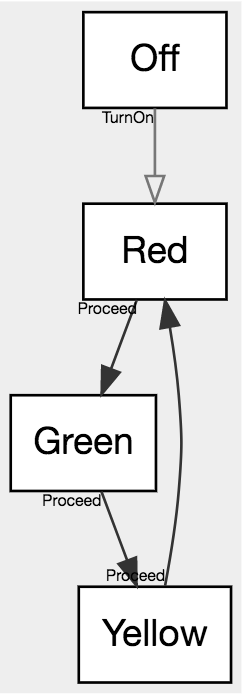
Machine's still pretty simple:
2: Traffic lights can be shut down
We'd also like to be able to turn this light back off. Because that's
expected to be a rarity, we'll require that it be a ~> forced transition.
We could write
Off 'TurnOn' -> Red 'Proceed' => Green 'Proceed' => Yellow 'Proceed' => Red;
Red ~> Off;
Yellow ~> Off;
Green ~> Off;
But that takes a lot of space even with this short list, so, instead we'll use the array notation
Off 'TurnOn' -> Red 'Proceed' => Green 'Proceed' => Yellow 'Proceed' => Red;
[Red Yellow Green] ~> Off;
And we'd like those all to have the action TurnOff, so
Off 'TurnOn' -> Red 'Proceed' => Green 'Proceed' => Yellow 'Proceed' => Red;
[Red Yellow Green] 'TurnOff' ~> Off;
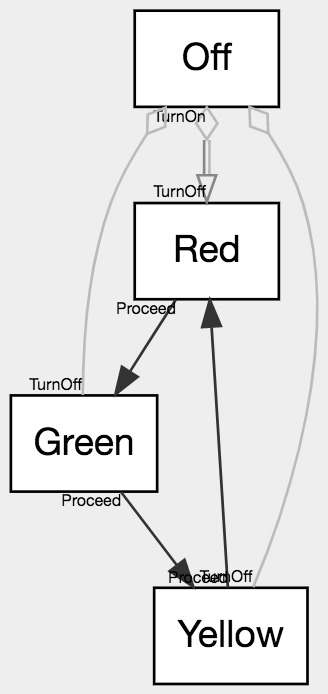
Machine's still not too bad:
What's next
That's the bulk of the language. There are other features (hooks, validators, styling, history, data) but you now know how to write a state machine.
- Tutorial: building an ATM state machine — a longer walkthrough that exercises more of the language
- Language reference — the full DSL
- Catalog of example machines
- Generated API reference