xlf-sync
February 3, 2026 · View on GitHub






📝 Read the article: The Missing Piece in Angular i18n
The definitive CLI tool for synchronizing Angular XLIFF (1.2 & 2.0) locale files.
xlf-sync is a robust, production-ready utility designed to solve the persistent challenge of Angular i18n management: keeping your locale files (messages.<locale>.xlf) in perfect sync with your source file (messages.xlf), without data loss or corruption.
It is built to integrate seamlessly into professional workflows, supporting both local development and strict CI/CD pipelines.
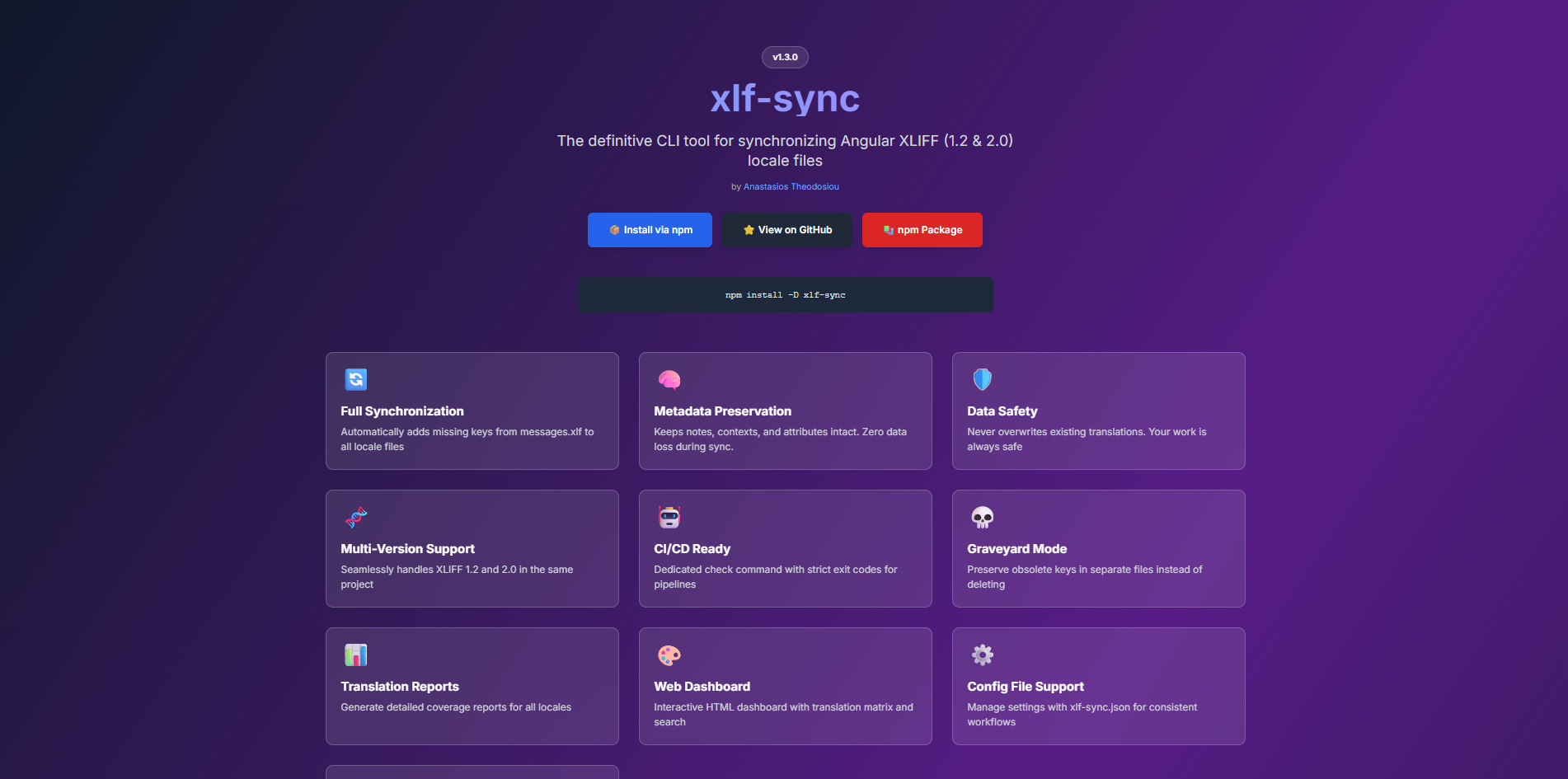
🌐 Visit the Official Landing Page & Documentation
🚀 Why xlf-sync?
If you are coming from xliffmerge or ng-extract-i18n-merge, you'll find xlf-sync to be a modern, faster, and more reliable alternative.
| Feature | xlf-sync | xliffmerge | ng-extract-i18n-merge |
|---|---|---|---|
| XLIFF 1.2 & 2.0 | ✅ Yes | ✅ Yes | ⚠️ Partial |
| Metadata Preservation | ✅ Absolute | ⚠️ Limited | ⚠️ Limited |
| Visual Dashboard | ✅ Yes | ❌ No | ❌ No |
| Zero Data Loss | ✅ Guaranteed | ⚠️ Risky | ✅ Yes |
| Active Maintenance | ✅ Active | ❌ Legacy | ✅ Active |
Tip
Migration follows a similar flow: Simply point xlf-sync to your source and locale files. It will automatically detect your XLIFF version and merge without stripping your approved translations or translator notes.
✨ Key Features
- 🔄 Full Synchronization: Automatically adds missing keys from
messages.xlfto all your locale files. - 🧠 Metadata Preservation: Preserves all notes, context groups, and custom attributes (e.g.,
approved="yes") during sync. Zero data loss. - 🛡️ Data Safety: Never overwrites existing translations. Your work is safe.
- 🧬 Multi-Version Support: Seamlessly handles XLIFF 1.2 and 2.0 in the same project. It auto-detects the version per file.
- 🧹 Auto-Sorting: Reorders translations in locale files to match the source file's order, ensuring clean and readable diffs.
- 💀 Graveyard Mode: Optionally moves obsolete keys to a separate "graveyard" file instead of deleting them, preserving historical work.
- 🤖 CI/CD Ready: Dedicated
checkcommand with strict exit codes for your build pipelines. - ✨ Pretty Printing: Normalizes XML formatting across all files, eliminating "dirty" diffs from other tools.
📦 Installation
Install globally or as a dev dependency in your project:
npm install -D xlf-sync
npx xlf-sync --help
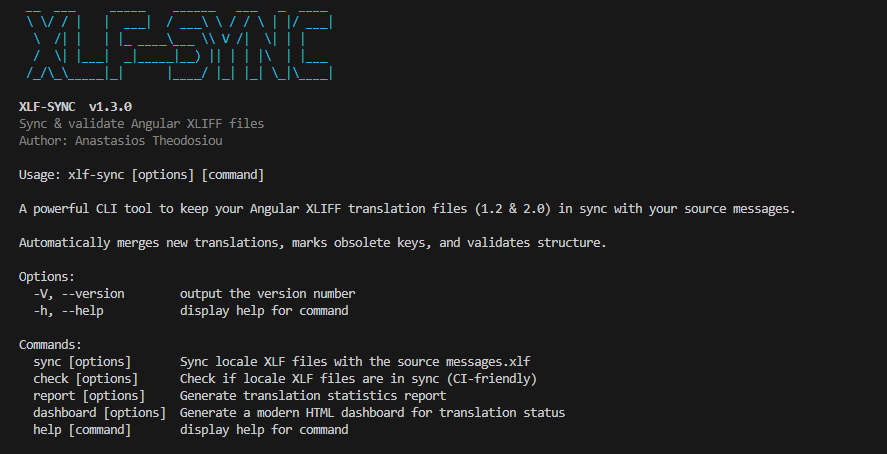
🎮 How it looks
$ npx xlf-sync sync

  xlf-sync v1.3.7
  --------------------------------------------------
  ✔ messages.xlf parsed (142 keys)
  ✔ messages.el.xlf synced (+12 new, -3 obsolete)
  ✔ messages.de.xlf synced (+12 new, -3 obsolete)
  ✔ messages.fr.xlf synced (+12 new, -3 obsolete)
  --------------------------------------------------
  ✨ Done! Your locale files are in perfect sync.
📂 Configuration
You can avoid passing command-line arguments every time by creating an xlf-sync.json (or xlf-sync.config.json) file in your project root.
Example xlf-sync.json
{
  "source": "src/locale/messages.xlf",
  "locales": "src/locale/messages.*.xlf",
  "sync": {
    "newTarget": "todo",
    "obsolete": "mark",
    "dryRun": false
  },
  "check": {
    "failOnMissing": true,
    "verbose": true
  }
}
All Configuration Options
| Option | JSON Key | Type | Description |
|---|---|---|---|
| Global | source | string | Path to source messages.xlf |
locales | string | Glob for locale files | |
| Sync | sync.newTarget | string | todo | empty | source |
sync.obsolete | string | delete | mark | graveyard | |
sync.graveyardFile | string | Path pattern for graveyard files | |
sync.failOnMissing | boolean | Exit non-zero on missing targets | |
sync.dryRun | boolean | Do not write files | |
| Check | check.failOnMissing | boolean | Exit non-zero on missing targets |
check.failOnObsolete | boolean | Exit non-zero on obsolete keys | |
check.failOnAdded | boolean | Exit non-zero on un-synced keys | |
check.newTarget | string | todo | empty | source (for diff only) | |
check.verbose | boolean | Print missing keys list |
Tip
Precedence: Command Line Flags > xlf-sync.json > Default Values.
🚀 Usage
1. The sync Command
The core command to update your locale files. It reads the source file and updates all target locale files found by the glob pattern.
# Basic usage
npx xlf-sync sync \
  --source src/locale/messages.xlf \
  --locales "src/locale/messages.*.xlf"
Sync Options
| Option | Default | Description |
|---|---|---|
--source <path> | src/locale/messages.xlf | Path to the source XLIFF file generated by ng extract-i18n. |
--locales <glob> | src/locale/messages.*.xlf | Glob pattern to find your target locale files (e.g., src/locale/*.xlf). |
--new-target <mode> | todo | Strategy for new keys: • todo: Fills target with TODO.• empty: Leaves target empty.• source: Copies source text to target. |
--obsolete <mode> | mark | Strategy for removed source keys: • mark: Keeps key with state="obsolete" (or prefix).• delete: Permanently removes the key.• graveyard: Moves key to a separate file (see below). |
--graveyard-file <pattern> | src/locale/_obsolete.{locale}.xlf | Pattern for the output "graveyard" file. Used only if --obsolete graveyard. {locale} is replaced dynamically. |
--fail-on-missing | false | Exits with error (code 1) if any keys are missing translations. Useful if you want to enforce 100% translation coverage during sync. |
--dry-run | false | Simulates the operation without writing changes to disk. |
2. The report Command
Generates a detailed console report about the translation coverage for each locale file. Useful for getting a quick overview of work remaining.
npx xlf-sync report --source src/locale/messages.xlf --locales "src/locale/messages.*.xlf"
Output Example:
┌────────┬─────┬──────┬────────────┬─────────┬────────┬───────┐
│ Locale │ XLF │ Keys │ Translated │ Pending │ % Cov  │ Words │
├────────┼─────┼──────┼────────────┼─────────┼────────┼───────┤
│ de     │ 2.0 │ 120  │ 115        │ 5       │ 95.8%  │ 432   │
│ fr     │ 2.0 │ 120  │ 40         │ 80      │ 33.3%  │ 150   │
└────────┴─────┴──────┴────────────┴─────────┴────────┴───────┘
Report Options
| Option | Default | Description |
|---|---|---|
--source <path> | src/locale/messages.xlf | Path to the source XLIFF file. |
--locales <glob> | src/locale/messages.*.xlf | Glob pattern for target locale files. |
3. The dashboard Command
Generates a modern, standalone HTML dashboard to visualize your translation progress with beautiful charts, tables, and an interactive translation matrix.
npx xlf-sync dashboard --out report.html
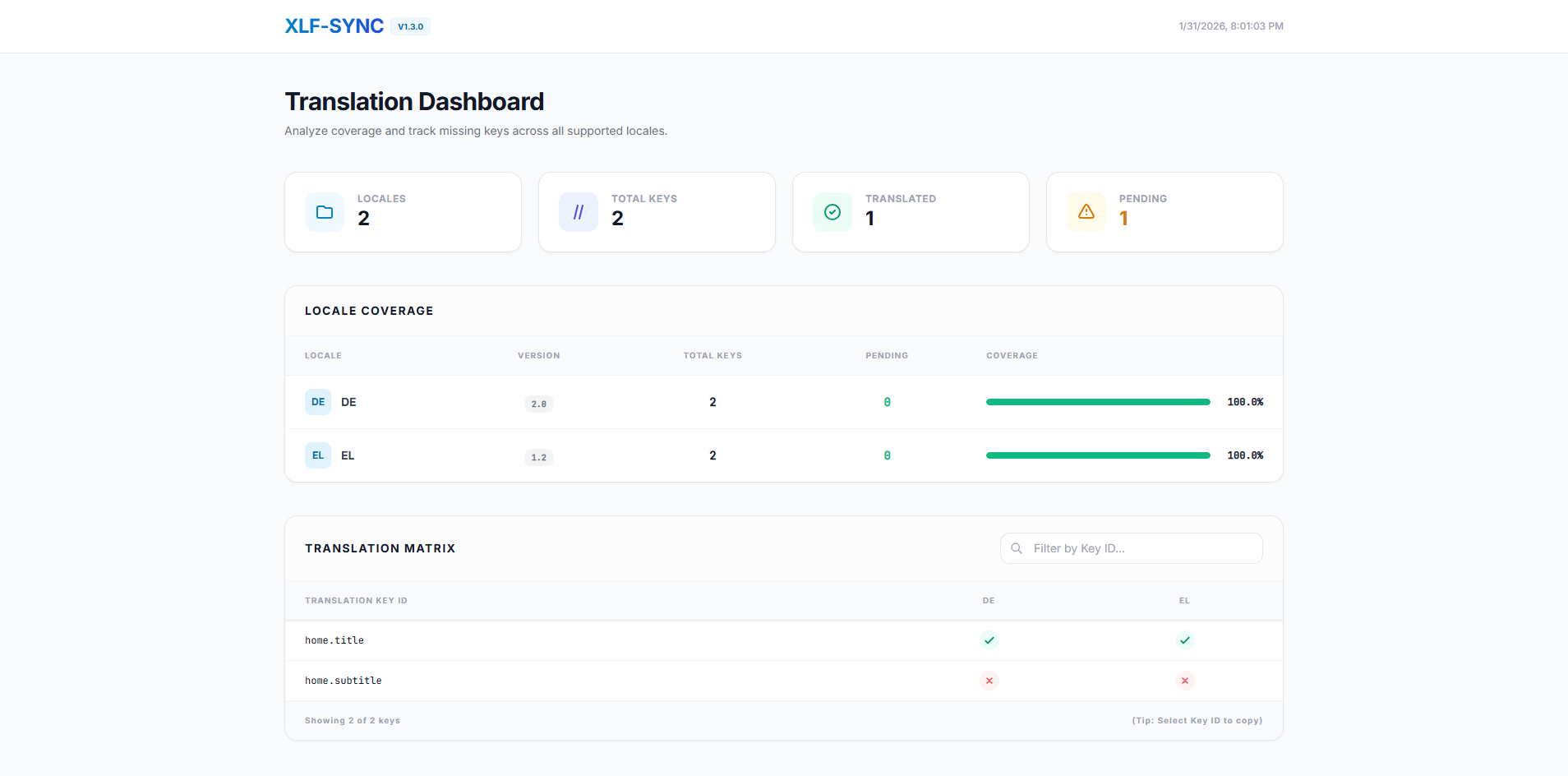
Features:
- 📊 Visual Statistics Cards: Overview of locales, total keys, translated count, and pending translations
- 📈 Coverage Progress Bars: Per-locale translation progress with percentage indicators
- 🔍 Translation Matrix: Interactive table showing which keys exist in each locale
- ✅ Green checkmark for translated keys
- ❌ Red X for missing translations
- Search bar to filter by key ID
- 🎨 Modern UI: Built with Tailwind CSS and Alpine.js for a premium, responsive experience
- 📱 Mobile-Friendly: Fully responsive design that works on all devices
Dashboard Options
| Option | Default | Description |
|---|---|---|
--source <path> | src/locale/messages.xlf | Path to the source XLIFF file. |
--locales <glob> | src/locale/messages.*.xlf | Glob pattern for target locale files. |
--out <path> | xlf-report.html | Path where the HTML file will be saved. |
4. The check Command
A read-only command designed for Continuous Integration (CI) pipelines. It verifies the state of your translations without modifying any files.
# Check if files are in sync
npx xlf-sync check --fail-on-missing
Check Options
| Option | Default | Description |
|---|---|---|
--source <path> | src/locale/messages.xlf | Path to the source XLIFF file. |
--locales <glob> | src/locale/messages.*.xlf | Glob pattern for target locale files. |
--verbose | false | Lists exactly which keys are missing or obsolete for each locale. |
--fail-on-missing | false | CI Failure Condition: Fail if any translation targets are missing or empty. |
--fail-on-obsolete | false | CI Failure Condition: Fail if obsolete keys exist in locale files. |
--fail-on-added | false | CI Failure Condition: Fail if new keys exist in source that haven't been synced to locales yet. |
📚 Advanced Workflows
Keeping Files Clean (Graveyard Mode)
For large, long-lived projects, we recommend the Graveyard Strategy. Instead of cluttering your main files with obsolete keys or deleting them immediately (and losing work), this mode moves them to a separate file.
npx xlf-sync sync --obsolete graveyard
Result:
messages.fr.xlf: Contains only active, valid translations._obsolete.fr.xlf: Contains all retired keys. You can restore them later if needed.
Standard CI/CD Pipeline
Add this step to your Pull Request validation workflow to ensure no developer merges broken translations:
- name: Verify i18n Sync
  run: npx xlf-sync check --fail-on-missing --fail-on-added --verbose
🛠️ Supported Formats
| Format | Support Level |
|---|---|
| XLIFF 1.2 | Legacy Angular projects. Supported fully. |
| XLIFF 2.0 | Modern Angular default. Supported fully. |
| Hybrid | Mixed version projects are detecting and handled automatically per file. |
🤝 Contributing
We welcome contributions! Whether it's bug reports, feature requests, or code contributions, your help is appreciated.
Please read our Contributing Guidelines to get started.
Quick ways to contribute:
- ⭐ Star the project on GitHub
- 🐛 Report bugs
- 💡 Suggest features
- 🔧 Submit pull requests

📄 License
MIT © Anastasios Theodosiou