gcf-python
August 16, 2026 · View on GitHub



gcf-python
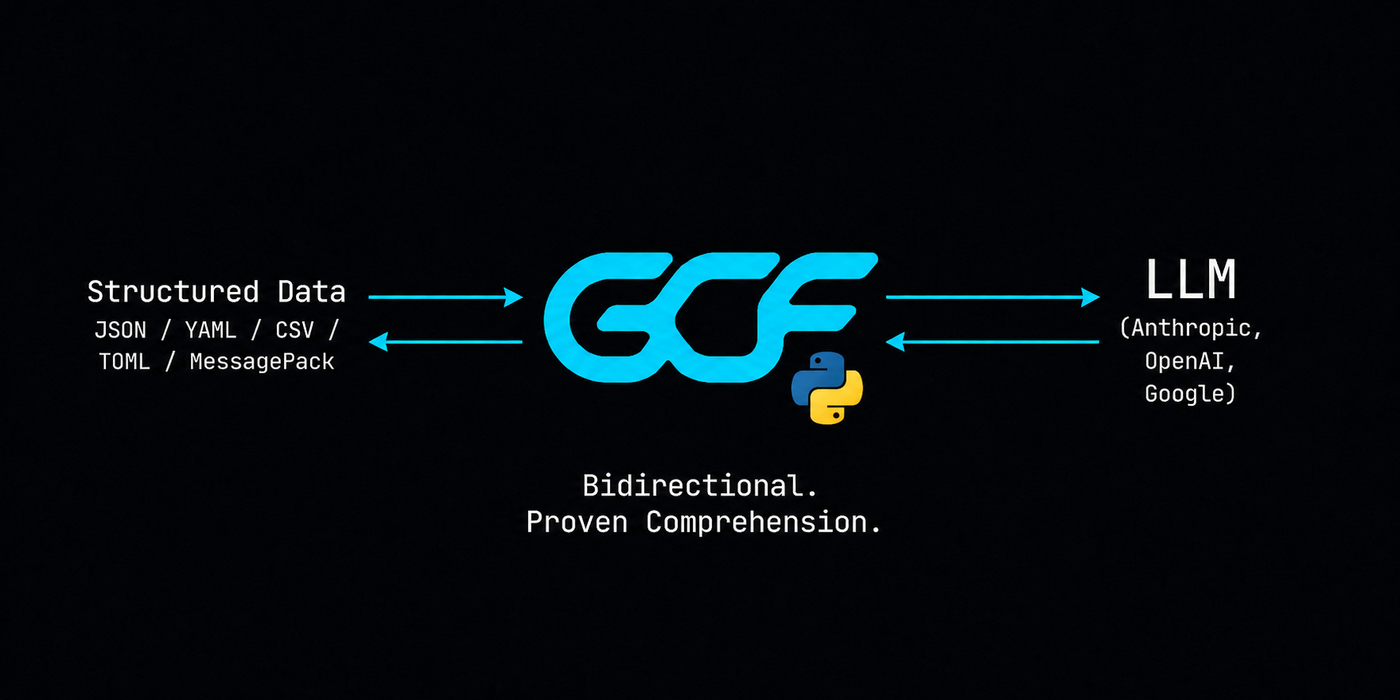
Python implementation of GCF, the most token-efficient wire format for LLMs. A drop-in alternative to JSON and TOON for any structured data.


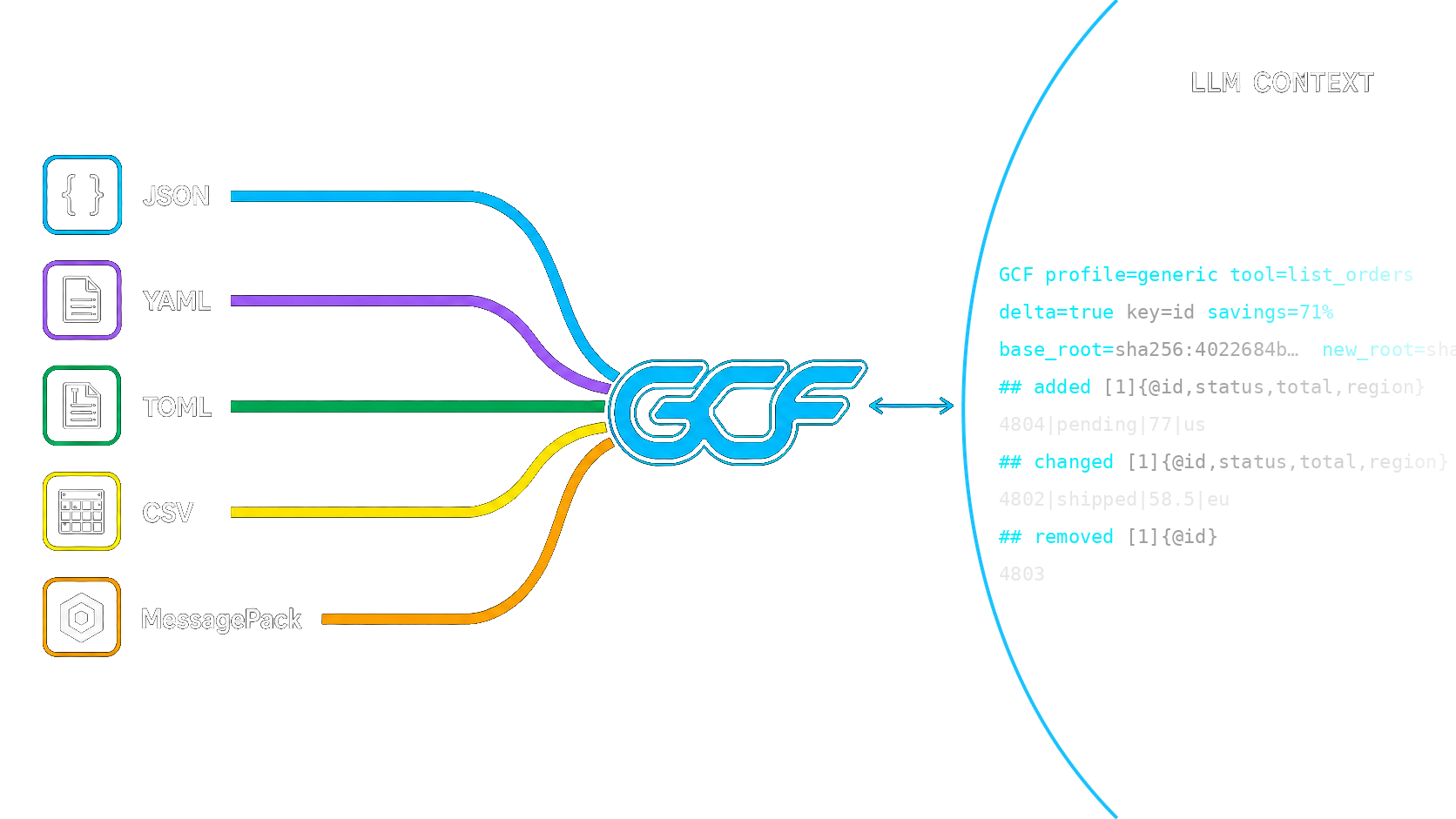
Built for the agentic loop, where the same structured context crosses the model boundary turn after turn. A single payload is 50-92% smaller than JSON, but GCF also deduplicates repeated structure across turns and sends only deltas when context changes, so by the 5th overlapping call each response costs 99% fewer tokens than JSON, and a 10-call session runs 94.4% cheaper than re-sending JSON every turn. Session dedup and delta both need local IDs and a multi-turn design that neither JSON nor TOON has.
- 100% comprehension on every frontier model, zero training. 29% fewer tokens than TOON and 56% fewer than JSON across 16 datasets; 91.2% on structurally complex code graphs (vs TOON 68.8%, JSON 54.1%).
- Proven lossless across 43,000,000,000+ round-trips in 5 formats and 6 languages. Zero runtime dependencies.
- One format, four properties no other single format holds at once: schema-free, lossless, token-compact (50-92% vs JSON), and model-readable with zero training. JSON is verbose, Protobuf needs a schema, MessagePack is binary, and TOON isn't reliably lossless.
2,500+ LLM evaluations. Full benchmarks.
Docs: gcformat.com · Playground · GCF vs TOON
Install
pip install gcf-python
Zero dependencies. Pure Python. Python 3.9+. Includes CLI. Don't want to change code? Use the MCP proxy for zero-code adoption.
CLI
gcf encode < payload.json    # JSON to GCF
gcf decode < payload.gcf     # GCF to JSON
gcf stats  < payload.json    # token comparison with visual bar
Payload: 50 symbols, 20 edges

  JSON  ██████████████████████████████  4,200 tokens
  GCF   ████████░░░░░░░░░░░░░░░░░░░░░░  1,150 tokens

  Savings: 73% fewer tokens with GCF
Library
Quick Start
from gcf import encode_generic

output = encode_generic({
    "employees": [
        {"id": 1, "name": "Alice", "department": "Engineering", "salary": 95000},
        {"id": 2, "name": "Bob", "department": "Sales", "salary": 72000},
    ],
})
Output:
## employees [2]{id,name,department,salary}
1|Alice|Engineering|95000
2|Bob|Sales|72000
Decode
from gcf import decode

p = decode(input_text)
print(p.tool, len(p.symbols), "symbols", len(p.edges), "edges")
Session Deduplication
Track transmitted symbols across multiple tool responses. Previously-sent symbols become bare references instead of full declarations:
from gcf import encode_with_session, Session, Payload, Symbol

sess = Session()

out1 = encode_with_session(payload1, sess)  # full declarations
out2 = encode_with_session(payload2, sess)  # reused symbols as "@N  # previously transmitted"
By the 5th call in a session: 86% fewer tokens than JSON from dedup alone, 99% stacked with delta encoding.
Streaming Encode
Write GCF output incrementally as symbols and edges arrive. Zero buffering, O(1) memory per row:
from gcf import StreamEncoder, Symbol, Edge

enc = StreamEncoder(sys.stdout, "context_for_task", token_budget=5000)

enc.write_symbol(Symbol(qualified_name="pkg.Auth", kind="function", score=0.95, provenance="lsp", distance=0))
enc.write_symbol(Symbol(qualified_name="pkg.Server", kind="function", score=0.60, provenance="lsp", distance=1))
enc.write_edge(Edge(source="pkg.Server", target="pkg.Auth", edge_type="calls"))
enc.close()  # emits ##! summary trailer
Output:
GCF tool=context_for_task budget=5000
## targets
@0 fn pkg.Auth 0.95 lsp
## related
@1 fn pkg.Server 0.60 lsp
## edges [?]
@0<@1 calls
##! summary symbols=2 edges=1 counts=1,1,1
The writer is any object with a write(s: str) method. Thread-safe. Standard decode() handles streaming output with no changes.
Delta Encoding
When the consumer already has a prior context pack, send only what changed:
from gcf import encode_delta, DeltaPayload, Symbol, Edge

delta = DeltaPayload(
    tool="context_for_task",
    base_root="aaa111",
    new_root="bbb222",
    removed=[Symbol(qualified_name="pkg.OldFunc", kind="function")],
    added=[Symbol(qualified_name="pkg.NewFunc", kind="function", score=0.85, provenance="rwr")],
    delta_tokens=30,
    full_tokens=200,
)

output = encode_delta(delta)
81.2% savings on re-queries where the pack changed slightly.
Generic Encoding
Encode any Python value (not just graph payloads) into GCF tabular format:
from gcf import encode_generic

output = encode_generic({
    "employees": [
        {"id": 1, "name": "Alice", "department": "Engineering", "salary": 95000},
        {"id": 2, "name": "Bob", "department": "Sales", "salary": 72000},
    ],
})
Output:
## employees [2]{id,name,department,salary}
1|Alice|Engineering|95000
2|Bob|Sales|72000
Works on dicts, lists, and primitives. Lists of uniform dicts get tabular rows. Nested dicts use ## key section headers.
Generic-Profile Delta (multi-turn)
In an agent loop the same keyed table gets re-queried turn after turn. Instead of re-sending the whole table each time, send only the changed rows (SPEC §10a):
from gcf import GenericSet, diff_generic_sets, encode_generic_delta, verify_generic_delta

base = GenericSet(key="id", fields=["id", "status"], rows=[
    {"id": 1001, "status": "pending"},
    {"id": 1002, "status": "shipped"},
])
nxt = GenericSet(key="id", fields=["id", "status"], rows=[
    {"id": 1001, "status": "shipped"},   # changed
    {"id": 1003, "status": "pending"},   # added (1002 removed)
])

d = diff_generic_sets(base, nxt)
wire = encode_generic_delta(d)                       # ## added / ## changed / ## removed
held = verify_generic_delta(base, d, d.new_root)     # atomic apply + new_root verification
Opt-in and bilateral, keyed on content-addressed pack roots. By the 5th overlapping call, ~97% fewer tokens than re-sending JSON.
Re-anchor session helper
GenericDeltaSession manages the delta/re-anchor cadence for you: each next() returns either a compact delta or, on its cadence, a full re-anchor (which re-grounds the consumer), updating its held base.
from gcf import GenericDeltaSession, fixed_n, size_guard

sess = GenericDeltaSession(base, tool="orders", policy=size_guard())
wire = sess.current_full()                # transmit the base once to establish it
for snapshot in stream:                   # each turn's current GenericSet
    wire, is_full = sess.next(snapshot)    # a compact delta, or a periodic full re-anchor
fixed_n(15) re-anchors every N turns; size_guard() (recommended) re-anchors once the cumulative delta reaches a full payload's size. It introduces no new wire syntax and the decoder stays cadence-agnostic, so a re-anchor is just the protocol's "full" outcome on a schedule.
FastMCP middleware
A drop-in middleware for FastMCP servers that re-encodes JSON tool results as GCF, opt-in. It requires the fastmcp extra (the core package stays zero-dependency):
pip install "gcf-python[fastmcp]"
from gcf.fastmcp import GcfResponseMiddleware

mcp.add_middleware(GcfResponseMiddleware())
When RESPONSE_FORMAT=gcf is set in the environment, each tool result whose model-facing content is a single JSON text block is returned as a GCF generic wire instead of JSON. It is opt-in (nothing changes unless the variable is set), lossless and fail-safe (on any encoding error the original result is returned), and non-destructive: only a lone JSON text block is re-encoded, and the tool's structuredContent is preserved so output-schema validation and non-model clients keep receiving JSON.
API
| Function | Description |
|---|---|
encode(p: Payload) -> str | Encode a graph payload to GCF text |
encode_generic(data: Any) -> str | Encode any value to GCF tabular format |
decode(input_text: str) -> Payload | Parse GCF text back to a Payload |
encode_with_session(p: Payload, s: Session) -> str | Encode with session deduplication |
encode_delta(d: DeltaPayload) -> str | Encode a graph delta (added/removed only) |
diff_generic_sets(base, next) -> GenericDeltaPayload | Diff two keyed record sets (generic profile) |
encode_generic_delta(d) -> str / decode_generic_delta(s) | Generic-profile delta wire (§10a) |
verify_generic_delta(base, d, root) -> GenericSet | Atomic apply + new_root verification |
GenericDeltaSession(base, tool, policy) | Producer-side re-anchor cadence helper (§10a.8) |
Session() | Create a new session tracker (thread-safe) |
Types
| Type | Purpose |
|---|---|
Payload | Full GCF payload: tool, budget, symbols, edges, pack root |
Symbol | Graph node: qualified name, kind, score, provenance, distance |
Edge | Directed relationship: source, target, edge type |
DeltaPayload | Diff between two graph packs: added/removed symbols and edges |
GenericSet / GenericDeltaPayload | Keyed record set and its generic-profile diff (§10a) |
GenericDeltaSession | Stateful producer that schedules delta vs full re-anchor (§10a.8) |
Session | Thread-safe tracker for multi-call deduplication |
KIND_ABBREV / KIND_EXPAND | Bidirectional kind abbreviation dicts |
Benchmarks
2,500+ LLM evaluations across 11 models, 4 providers, and 50+ independent test runs.
| GCF | TOON | JSON | |
|---|---|---|---|
| Comprehension (23 runs, 10 models) | 91.2% | 68.8% | 54.1% |
| Generation (28 runs, 9 models) | 5/5 | 1.0/5 | 5.0/5 |
| Input tokens (500 symbols) | 11,090 | 16,378 | 53,341 |
| Output tokens (100 symbols) | 5,976 | 8,937 | 16,121 |
GCF wins 15/16 datasets on the expanded token efficiency benchmark. Full results: gcformat.com/guide/benchmarks
Implementations
| Language | Package | Repository |
|---|---|---|
| Go | go get github.com/blackwell-systems/gcf-go | gcf-go |
| TypeScript | npm install @blackwell-systems/gcf | gcf-typescript |
| Python | pip install gcf-python | gcf-python |
| Rust | cargo add gcf | gcf-rust |
| Swift | Swift Package Manager | gcf-swift |
| Kotlin | JitPack | gcf-kotlin |
| MCP Proxy | pip install gcf-proxy | gcf-proxy (bidirectional, session dedup, HTTP frontend) |
| Claude Code Plugin | /plugin install | gcf-claude-plugin (one-command install, session stats hook) |
| Codex Plugin | codex plugin add | gcf-codex-plugin (one-command install, session stats hook) |
| VS Code | ext install blackwell-systems.gcf-vscode | gcf-vscode (syntax highlighting) |
| n8n | npm install n8n-nodes-gcf | gcf-n8n-nodes (workflow encode/decode) |
| Tree-sitter | npm install tree-sitter-gcf | tree-sitter-gcf |
Zero runtime dependencies. Permanently. All six implementations depend only on their language's standard library. No transitive dependencies. No supply chain risk. This is a permanent commitment: GCF will never take on external runtime dependencies. MIT licensed. All implementations support both generic profile (encodeGeneric) and graph profile (encode). CLI included in all 6 languages.
Specification: SPEC v3.5.3 Stable with 281 conformance fixtures, 43,000,000,000+ lossless round-trips verified across 5 formats and 6 languages. Current versions: Go v1.7.1, TypeScript v2.6.1, Python v2.7.1, Rust v3.0.1, Swift v2.7.1, Kotlin v2.6.1, .NET v0.2.1. Cross-language conformance verified across all seven SDKs.
Adopted by
| Project | |
|---|---|
| Chrome DevTools MCP | 47K★ · the Google Chrome DevTools team's MCP server; exposes live browser state (DOM, network, console, performance) to AI coding agents |
| Speakeasy | OpenAPI tooling (customers include Google, Verizon, Mistral AI, DocuSign, Vercel); GCF is a native output format in their oq CLI |
| OmniRoute | 17K★ · AI gateway, registry, and proxy between AI clients and model providers; GCF vendored into its compression engine |
| NetClaw | 610★ · AI-powered network automation (113 skills, 66 MCP integrations); replaced TOON with GCF across every MCP server |
| ctx | 552★ · real-time context selector for Claude Code; surfaces only the relevant tools from a 103K-node knowledge graph |
| Lynkr | 531★ · local LLM gateway for AI coding clients; GCF as a drop-in tool-result compressor alongside TOON |
| Open Data Products SDK | Linux Foundation · Python toolkit and MCP server for data-product standards; GCF sidecars for agent context |
| NeuroNest | agent-first IDE; first commercial GCF adoption, across four encoding surfaces with session dedup and delta |
| Raycast | JSON-to-GCF Converter extension in the Raycast Store, for the macOS productivity launcher |
License
MIT - Dayna Blackwell