README.md
May 19, 2026 · View on GitHub




This component is responsible for provisioning Route 53 Resolver DNS Firewall resources, including Route 53 Resolver DNS Firewall, domain lists, firewall rule groups, firewall rules, and logging configuration.
Component Features
- Domain Filtering: Creates domain lists and firewall rules to allow or block DNS queries to specific domains
- VPC Association: Associates firewall rule groups with VPCs for DNS-level network protection
- Query Logging: Optionally logs all DNS queries to an S3 bucket for auditing and analysis
- Fail-Open/Fail-Closed: Controls whether DNS resolution continues or stops if the firewall fails
- Account Verification: Optional safety check that validates Terraform is running in the correct AWS account
- Flexible Account Map: Supports both remote-state account-map lookups and static account map variables (default)
Tip
👽 Use Atmos with Terraform
Cloud Posse uses atmos to easily orchestrate multiple environments using Terraform.
Works with Github Actions, Atlantis, or Spacelift.
Watch demo of using Atmos with Terraform
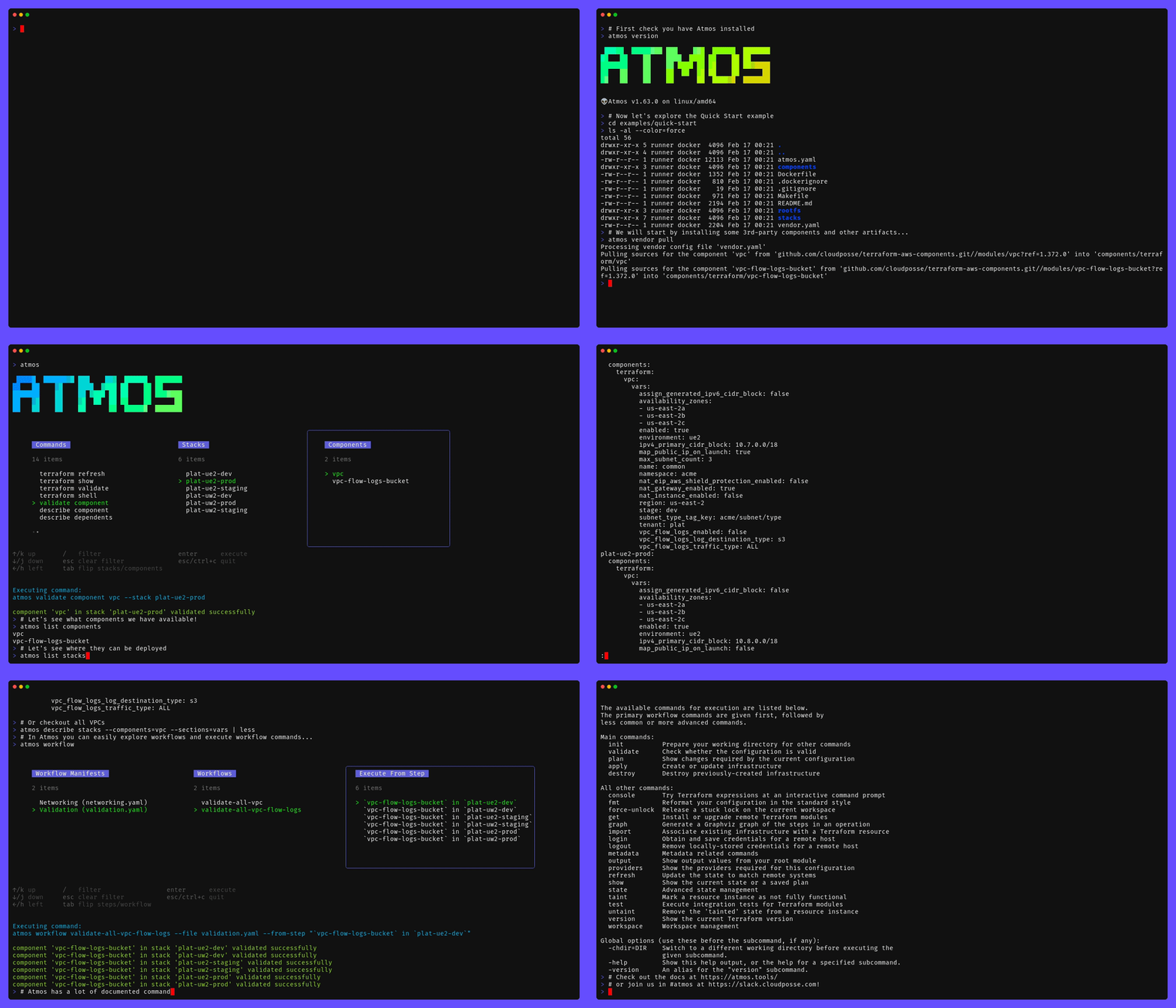
Example of running
atmos to manage infrastructure from our Quick Start tutorial.
Usage
Stack Level: Regional
Here's an example snippet for how to use this component.
# stacks/catalog/route53-resolver-dns-firewall/defaults.yaml
components:
  terraform:
    route53-resolver-dns-firewall/defaults:
      metadata:
        type: abstract
      settings:
        spacelift:
          workspace_enabled: true
      vars:
        enabled: true
        firewall_fail_open: "ENABLED"
        query_log_enabled: true
        logs_bucket_component_name: "route53-resolver-dns-firewall-logs-bucket"
        domains_config:
          allowed-domains:
            # Concat the lists of domains passed in the `domains` field and loaded from the file `domains_file`
            # The file is in the `components/terraform/route53-resolver-dns-firewall/config` folder
            domains_file: "config/allowed_domains.txt"
            domains: []
          blocked-domains:
            # Concat the lists of domains passed in the `domains` field and loaded from the file `domains_file`
            # The file is in the `components/terraform/route53-resolver-dns-firewall/config` folder
            domains_file: "config/blocked_domains.txt"
            domains: []
        rule_groups_config:
          blocked-and-allowed-domains:
            # 'priority' must be between 100 and 9900 exclusive
            priority: 101
            rules:
              allowed-domains:
                firewall_domain_list_name: "allowed-domains"
                # 'priority' must be between 100 and 9900 exclusive
                priority: 101
                action: "ALLOW"
              blocked-domains:
                firewall_domain_list_name: "blocked-domains"
                # 'priority' must be between 100 and 9900 exclusive
                priority: 200
                action: "BLOCK"
                block_response: "NXDOMAIN"
# stacks/mixins/stage/dev.yaml
import:
  - catalog/route53-resolver-dns-firewall/defaults

components:
  terraform:
    route53-resolver-dns-firewall/example:
      metadata:
        component: route53-resolver-dns-firewall
        inherits:
          - route53-resolver-dns-firewall/defaults
      vars:
        name: route53-dns-firewall-example
        vpc_component_name: vpc
Execute the following command to provision the route53-resolver-dns-firewall/example component using Atmos:
atmos terraform apply route53-resolver-dns-firewall/example -s <stack>
Important
In Cloud Posse's examples, we avoid pinning modules to specific versions to prevent discrepancies between the documentation and the latest released versions. However, for your own projects, we strongly advise pinning each module to the exact version you're using. This practice ensures the stability of your infrastructure. Additionally, we recommend implementing a systematic approach for updating versions to avoid unexpected changes.
Requirements
| Name | Version |
|---|---|
| terraform | >= 1.4.0 |
| aws | >= 4.9.0 |
Providers
| Name | Version |
|---|---|
| aws | 6.45.0 |
| terraform | n/a |
Modules
| Name | Source | Version |
|---|---|---|
| account_map | cloudposse/stack-config/yaml//modules/remote-state | 2.0.0 |
| logs_bucket | cloudposse/stack-config/yaml//modules/remote-state | 2.0.0 |
| route53_resolver_dns_firewall | cloudposse/route53-resolver-dns-firewall/aws | 2.0.0 |
| this | cloudposse/label/null | 0.25.0 |
| vpc | cloudposse/stack-config/yaml//modules/remote-state | 2.0.0 |
Resources
| Name | Type |
|---|---|
| terraform_data.account_verification | resource |
| aws_caller_identity.this | data source |
Inputs
| Name | Description | Type | Default | Required |
|---|---|---|---|---|
| account_map | Static account map configuration. Only used when account_map_enabled is false.Map keys use tenant-stage format (e.g., core-security, core-audit, plat-prod). | object({ | { | no |
| account_map_component_name | The name of the account-map component | string | "account-map" | no |
| account_map_enabled | Enable the account map component. When true, the component fetches account mappings from theaccount-map component via remote state. When false (default), the component uses the static account_map variable instead. | bool | false | no |
| account_map_tenant | The tenant where the account_map component required by remote-state is deployed | string | "core" | no |
| account_verification_enabled | Enable account verification. When true (default), the component verifies that Terraform is executing in the correct AWS account by comparing the current account ID against the expected account from the account_map based on the component's tenant-stage context. | bool | true | no |
| additional_tag_map | Additional key-value pairs to add to each map in tags_as_list_of_maps. Not added to tags or id.This is for some rare cases where resources want additional configuration of tags and therefore take a list of maps with tag key, value, and additional configuration. | map(string) | {} | no |
| attributes | ID element. Additional attributes (e.g. workers or cluster) to add to id,in the order they appear in the list. New attributes are appended to the end of the list. The elements of the list are joined by the delimiterand treated as a single ID element. | list(string) | [] | no |
| context | Single object for setting entire context at once. See description of individual variables for details. Leave string and numeric variables as null to use default value.Individual variable settings (non-null) override settings in context object, except for attributes, tags, and additional_tag_map, which are merged. | any | { | no |
| delimiter | Delimiter to be used between ID elements. Defaults to - (hyphen). Set to "" to use no delimiter at all. | string | null | no |
| descriptor_formats | Describe additional descriptors to be output in the descriptors output map.Map of maps. Keys are names of descriptors. Values are maps of the form {<br/> format = string<br/> labels = list(string)<br/>}(Type is any so the map values can later be enhanced to provide additional options.)format is a Terraform format string to be passed to the format() function.labels is a list of labels, in order, to pass to format() function.Label values will be normalized before being passed to format() so they will beidentical to how they appear in id.Default is {} (descriptors output will be empty). | any | {} | no |
| domains_config | Map of Route 53 Resolver DNS Firewall domain configurations | map(object({ | n/a | yes |
| enabled | Set to false to prevent the module from creating any resources | bool | null | no |
| environment | ID element. Usually used for region e.g. 'uw2', 'us-west-2', OR role 'prod', 'staging', 'dev', 'UAT' | string | null | no |
| firewall_fail_open | Determines how Route 53 Resolver handles queries during failures, for example when all traffic that is sent to DNS Firewall fails to receive a reply. By default, fail open is disabled, which means the failure mode is closed. This approach favors security over availability. DNS Firewall blocks queries that it is unable to evaluate properly. If you enable this option, the failure mode is open. This approach favors availability over security. In this case, DNS Firewall allows queries to proceed if it is unable to properly evaluate them. Valid values: ENABLED, DISABLED. | string | "ENABLED" | no |
| global_environment | Global environment name | string | "gbl" | no |
| id_length_limit | Limit id to this many characters (minimum 6).Set to 0 for unlimited length.Set to null for keep the existing setting, which defaults to 0.Does not affect id_full. | number | null | no |
| label_key_case | Controls the letter case of the tags keys (label names) for tags generated by this module.Does not affect keys of tags passed in via the tags input.Possible values: lower, title, upper.Default value: title. | string | null | no |
| label_order | The order in which the labels (ID elements) appear in the id.Defaults to ["namespace", "environment", "stage", "name", "attributes"]. You can omit any of the 6 labels ("tenant" is the 6th), but at least one must be present. | list(string) | null | no |
| label_value_case | Controls the letter case of ID elements (labels) as included in id,set as tag values, and output by this module individually. Does not affect values of tags passed in via the tags input.Possible values: lower, title, upper and none (no transformation).Set this to title and set delimiter to "" to yield Pascal Case IDs.Default value: lower. | string | null | no |
| labels_as_tags | Set of labels (ID elements) to include as tags in the tags output.Default is to include all labels. Tags with empty values will not be included in the tags output.Set to [] to suppress all generated tags.Notes: The value of the name tag, if included, will be the id, not the name.Unlike other null-label inputs, the initial setting of labels_as_tags cannot bechanged in later chained modules. Attempts to change it will be silently ignored. | set(string) | [ | no |
| logs_bucket_component_name | Flow logs bucket component name | string | null | no |
| name | ID element. Usually the component or solution name, e.g. 'app' or 'jenkins'. This is the only ID element not also included as a tag.The "name" tag is set to the full id string. There is no tag with the value of the name input. | string | null | no |
| namespace | ID element. Usually an abbreviation of your organization name, e.g. 'eg' or 'cp', to help ensure generated IDs are globally unique | string | null | no |
| privileged | true if the default provider already has access to the backend | bool | false | no |
| query_log_config_name | Route 53 Resolver query log config name. If omitted, the name will be generated by concatenating the ID from the context with the VPC ID | string | null | no |
| query_log_enabled | Flag to enable/disable Route 53 Resolver query logging | bool | false | no |
| regex_replace_chars | Terraform regular expression (regex) string. Characters matching the regex will be removed from the ID elements. If not set, "/[^a-zA-Z0-9-]/" is used to remove all characters other than hyphens, letters and digits. | string | null | no |
| region | AWS Region | string | n/a | yes |
| root_account_stage | The stage name for the Organization root (management) account. This is used to lookup account IDs from account names using the account-map component. | string | "root" | no |
| rule_groups_config | Rule groups and rules configuration. Each rule must specify exactly one of: - firewall_domain_list_name for custom lists defined in domains_config (created by the underlying module)- firewall_domain_list_id for AWS Managed Domain Lists or other pre-existing domain lists referenced by ID | map(object({ | n/a | yes |
| stage | ID element. Usually used to indicate role, e.g. 'prod', 'staging', 'source', 'build', 'test', 'deploy', 'release' | string | null | no |
| tags | Additional tags (e.g. {'BusinessUnit': 'XYZ'}).Neither the tag keys nor the tag values will be modified by this module. | map(string) | {} | no |
| tenant | ID element _(Rarely used, not included by default)_. A customer identifier, indicating who this instance of a resource is for | string | null | no |
| vpc_component_name | The name of a VPC component where the DNS Firewall is provisioned | string | n/a | yes |
Outputs
| Name | Description |
|---|---|
| domains | Route 53 Resolver DNS Firewall domain configurations |
| query_log_config | Route 53 Resolver query logging configuration |
| rule_group_associations | Route 53 Resolver DNS Firewall rule group associations |
| rule_groups | Route 53 Resolver DNS Firewall rule groups |
| rules | Route 53 Resolver DNS Firewall rules |
Related Projects
Check out these related projects.
- Cloud Posse Terraform Modules - Our collection of reusable Terraform modules used by our reference architectures.
- Atmos - Atmos is like docker-compose but for your infrastructure
References
For additional context, refer to some of these links.
- Deploy centralized traffic filtering using AWS Network Firewall -
- AWS Network Firewall – New Managed Firewall Service in VPC -
- Deployment models for AWS Network Firewall -
- Deployment models for AWS Network Firewall with VPC routing enhancements -
- Inspection Deployment Models with AWS Network Firewall -
- How to deploy AWS Network Firewall by using AWS Firewall Manager -
- A Deep Dive into AWS Transit Gateway -
- Appliance in a shared services VPC -
- Quotas on Route 53 Resolver DNS Firewall -
- Unified bad hosts -
- cloudposse-terraform-components - Cloud Posse's upstream component
Tip
Use Terraform Reference Architectures for AWS
Use Cloud Posse's ready-to-go terraform architecture blueprints for AWS to get up and running quickly.
✅ We build it together with your team.
✅ Your team owns everything.
✅ 100% Open Source and backed by fanatical support.

📚 Learn More
Cloud Posse is the leading DevOps Accelerator for funded startups and enterprises.
Your team can operate like a pro today.
Ensure that your team succeeds by using Cloud Posse's proven process and turnkey blueprints. Plus, we stick around until you succeed.
Day-0: Your Foundation for Success
- Reference Architecture. You'll get everything you need from the ground up built using 100% infrastructure as code.
- Deployment Strategy. Adopt a proven deployment strategy with GitHub Actions, enabling automated, repeatable, and reliable software releases.
- Site Reliability Engineering. Gain total visibility into your applications and services with Datadog, ensuring high availability and performance.
- Security Baseline. Establish a secure environment from the start, with built-in governance, accountability, and comprehensive audit logs, safeguarding your operations.
- GitOps. Empower your team to manage infrastructure changes confidently and efficiently through Pull Requests, leveraging the full power of GitHub Actions.
Day-2: Your Operational Mastery
- Training. Equip your team with the knowledge and skills to confidently manage the infrastructure, ensuring long-term success and self-sufficiency.
- Support. Benefit from a seamless communication over Slack with our experts, ensuring you have the support you need, whenever you need it.
- Troubleshooting. Access expert assistance to quickly resolve any operational challenges, minimizing downtime and maintaining business continuity.
- Code Reviews. Enhance your team’s code quality with our expert feedback, fostering continuous improvement and collaboration.
- Bug Fixes. Rely on our team to troubleshoot and resolve any issues, ensuring your systems run smoothly.
- Migration Assistance. Accelerate your migration process with our dedicated support, minimizing disruption and speeding up time-to-value.
- Customer Workshops. Engage with our team in weekly workshops, gaining insights and strategies to continuously improve and innovate.
✨ Contributing
This project is under active development, and we encourage contributions from our community.
Many thanks to our outstanding contributors:
For 🐛 bug reports & feature requests, please use the issue tracker.
In general, PRs are welcome. We follow the typical "fork-and-pull" Git workflow.
- Review our Code of Conduct and Contributor Guidelines.
- Fork the repo on GitHub
- Clone the project to your own machine
- Commit changes to your own branch
- Push your work back up to your fork
- Submit a Pull Request so that we can review your changes
NOTE: Be sure to merge the latest changes from "upstream" before making a pull request!
Running Terraform Tests
We use Atmos to streamline how Terraform tests are run. It centralizes configuration and wraps common test workflows with easy-to-use commands.
All tests are located in the test/ folder.
Under the hood, tests are powered by Terratest together with our internal Test Helpers library, providing robust infrastructure validation.
Setup dependencies:
- Install Atmos (installation guide)
- Install Go 1.24+ or newer
- Install Terraform or OpenTofu
To run tests:
- Run all tests:
atmos test run - Clean up test artifacts:
atmos test clean - Explore additional test options:
atmos test --help
The configuration for test commands is centrally managed. To review what's being imported, see the atmos.yaml file.
Learn more about our automated testing in our documentation or implementing custom commands with atmos.
🌎 Slack Community
Join our Open Source Community on Slack. It's FREE for everyone! Our "SweetOps" community is where you get to talk with others who share a similar vision for how to rollout and manage infrastructure. This is the best place to talk shop, ask questions, solicit feedback, and work together as a community to build totally sweet infrastructure.
📰 Newsletter
Sign up for our newsletter and join 3,000+ DevOps engineers, CTOs, and founders who get insider access to the latest DevOps trends, so you can always stay in the know. Dropped straight into your Inbox every week — and usually a 5-minute read.
📆 Office Hours 
Join us every Wednesday via Zoom for your weekly dose of insider DevOps trends, AWS news and Terraform insights, all sourced from our SweetOps community, plus a live Q&A that you can’t find anywhere else. It's FREE for everyone!
License

Preamble to the Apache License, Version 2.0
Licensed to the Apache Software Foundation (ASF) under one
or more contributor license agreements.  See the NOTICE file
distributed with this work for additional information
regarding copyright ownership.  The ASF licenses this file
to you under the Apache License, Version 2.0 (the
"License"); you may not use this file except in compliance
with the License.  You may obtain a copy of the License at

  https://www.apache.org/licenses/LICENSE-2.0

Unless required by applicable law or agreed to in writing,
software distributed under the License is distributed on an
"AS IS" BASIS, WITHOUT WARRANTIES OR CONDITIONS OF ANY
KIND, either express or implied.  See the License for the
specific language governing permissions and limitations
under the License.
Trademarks
All other trademarks referenced herein are the property of their respective owners.
Copyright © 2017-2026 Cloud Posse, LLC