Arena by Dravensoft
August 23, 2026 · View on GitHub
One design system, in React and in Angular, built to be operated by an AI agent.




MIT License · Token-driven design system for React, Angular and Tailwind.
What you get
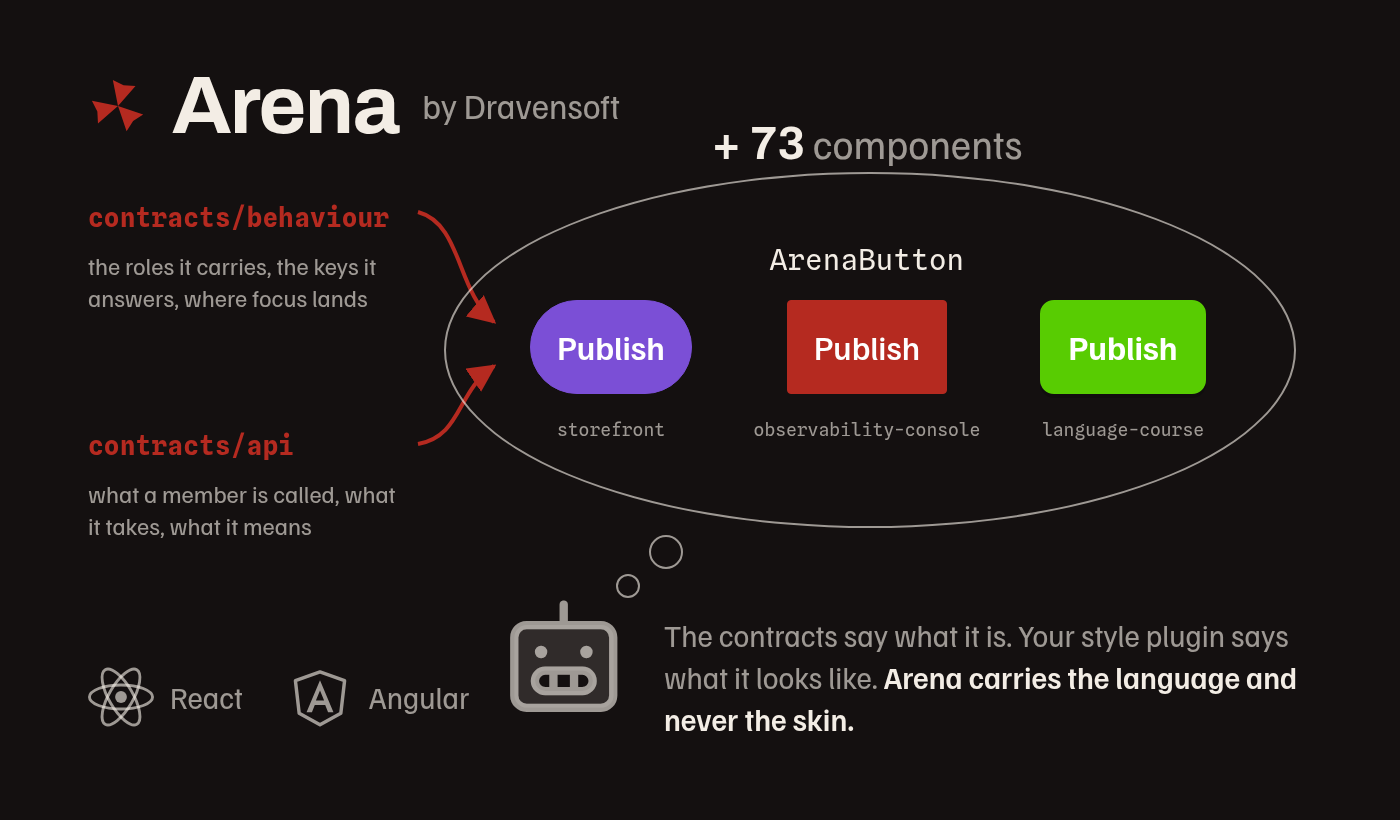
Components with a contracted API. The same components under both framework
names, rendering the same pixels, over one shared Tailwind layer. What a member
is called, what it takes, what it defaults to and what it means are written in
contracts/api/, and each layer's types and tables
are generated from there, so the two layers cannot drift apart quietly. Every
value a component draws resolves through a design token, so no hex and no bare
pixel sits anywhere inside one.
Accessibility bound per component instead of audited per release. Each
component declares which pattern it implements, most of them from the
WAI-ARIA Authoring Practices: the
roles it carries, the keys it answers, where focus lands, what dismisses it. A
requirement it does not meet yet is recorded beside it with its reason, and
bun run check:behaviour fails on the day a component stops answering the
pattern it named.
A style kernel, which is what a project answers to look like itself. The
questions about shape, space, weight and depth are Arena's; the answers are a
style plugin the project writes, and the appearance Arena installs with is one
such plugin rather than a floor under them. Palettes and fonts sit in an
arena.config.json, which the arena-to-prod command each package ships turns
into the one stylesheet a package cannot carry: Arena carries the language and
never the skin, and none of its own colours reach your build.
Metadata for a product that has to be found, which most products do not. The
Angular layer writes the document <head> from the routes it is handed, at
@dravensoft/arena-angular/metadata: title composition, a description, a
canonical and the og:* pair, with no route indexed until it says so. That
import path is a second entry point, so a project that never asks for metadata
never installs the router behind it. React writes no <head> at all, and both
layers publish the breadcrumb trail they draw in schema.org terms.
Why an agent can operate it
An API is a contract file rather than a paragraph, and so is the pattern a component binds and the role a style plugin answers; a gate holds the code, the documentation and the published packages to them. An agent handed this repository does not guess at Arena: it reads the contract that governs what it is about to write, and the gate tells it when it got it wrong.
That is also what makes the rules enforceable rather than aspirational. Tokens
are the only styling layer, danger is an outline, one primary accent per view,
no gradients, no emoji, and icons are class-name strings. Each of those is
decided in contracts/design/AGENTS.md and
handed to a builder by skills/design/SKILL.md.
Install
bun add @dravensoft/arena-react # or @dravensoft/arena-angular
That is the whole install. Phosphor is a peer rather than a second command, because Arena renders icon class names and never SVG; the layer page below says which peers each package declares.
Then write arena.config.json, run npx arena-to-prod (or bunx, or
pnpm exec), and import what it writes. frameworks/react/PACKAGE.md and
frameworks/angular/PACKAGE.md are the whole
of it, and they are the pages npm shows.
In an IDE
npx arena-to-prod --skill # or: bunx / pnpm exec / yarn dlx
One file, .agents/skills/arena/SKILL.md, which is the location VS Code,
Copilot, Cursor, Codex, Gemini CLI and Zed all scan. It is not a copy of the
language: the corpus travels inside the package, and the record routes into it,
so an agent reads the rules, the style kernel and every component's usage
document without a clone and without a network. --skill=.github/skills writes a
different scanned location, --global writes one for every project you open, and
--vendor copies the documents beside the record for a tree where
node_modules is not checked out.
npx arena-to-prod --skill-check reads it back. It reports that the record
is absent, that another version of the package wrote it, that it was edited by
hand, or that a document it routes to is not there; --strict=skill makes any of
those fatal, which is how a project holds it in its own CI. It is the only thing
in Arena that reads a consumer's project.
Over MCP
{
  "mcpServers": {
    "arena": { "command": "npx", "args": ["-y", "@dravensoft/arena-mcp"] }
  }
}
@dravensoft/arena-mcp serves the router, the references and every component document to an
agent that speaks the Model Context Protocol, as resources and as tools. It carries no copy of
the language: it reads the payload of the Arena package your project already installs, so it
cannot disagree with the components beside it.
Take the record above instead when you can. It needs no server and no configuration, and every editor listed there scans for it. Take this one when you would rather configure a server once than write a file per project, or when your client speaks MCP and scans for no skill.
As a Claude Code plugin
/plugin marketplace add dravensoft-dev/arena
/plugin install arena@dravensoft
/reload-plugins
Update
/plugin marketplace update dravensoft   # refresh the catalog: learns a new version exists
/plugin update arena@dravensoft         # update the plugin you actually have
/reload-plugins                         # apply it to the running session
A version means one commit. Each release is served from its git tag, with
the marketplace entry pinning source.ref to vX.Y.Z.
As a standalone Agent Skill
Hand any agent skills/design/SKILL.md. It is the
router, and it answers each question with one file. It routes over this tree,
so an agent handed the file alone has the questions and reaches the answers by
URL; one handed the clone or the plugin reaches them by path.
The packages work with this repository rather than instead of it. Install the plugin, or hand over the skill, and the agent gets the guidelines, the contracts and every component's usage document, which is what turns "integrate Arena" into a task it finishes on its own.
See it
arena.dravensoft.org carries the design guidelines, the kitchen sink, and a playground page for every component, with no clone and nothing to install.
The same pages come up locally with bun run demos, from the same list, and
scripts/build/AGENTS.md says what a fresh clone
has to build before they mean anything.
An agent reads llms.txt first, which
routes to the rules of the language and then to one corpus per framework,
React and
Angular. They are separate on purpose: every
component ships under both names and the two documents are not interchangeable.
Dependencies
- Fonts are self-hosted, and no CDN request is made. Arena ships the Archivo
/ Familjen Grotesk / Spline Sans Mono
.woff2binaries inassets/fonts/, andcontracts/design-generated/fonts.generated.cssdeclares them with@font-face, so they load from the same origin as the page that reads them. A package consumer names their own three families inarena.config.json, wheresrcis either a stylesheet URL or a binary they host. - Icons are Phosphor Icons (MIT), and are not
bundled. Install the official package by default, either
@phosphor-icons/web(webfont) or@phosphor-icons/react, for full weight and tree-shaking flexibility. The CDN is a prototype-only convenience, not the default. See Iconography.
Which version am I getting
The two packages and the plugin do not always carry the same number, because a
package publishes only when something it ships changed.
.github/workflows/AGENTS.md explains what
that means for an upgrade.
Latest project artifacts
- Repo/Claude Code plugin: 10.2.3
- npm React package
- npm Angular package
- npm contracts package
Where to go next
Which job is this? The two audiences read almost disjoint sets of these files, and starting on the wrong branch is how a short question turns into a long read.
Building something with Arena. skills/design/SKILL.md is the
router. From
it: frameworks/INDEX.md is every component in one
read and frameworks/<layer>/INDEX.md is the same list under your own
framework's names, each component's .prompt.md is how to use that one, and
frameworks/react/PACKAGE.md or
frameworks/angular/PACKAGE.md is how to
install it.
Working on Arena itself. AGENTS.md is the root of that
branch, and everything below is reached through it.
scripts/build/AGENTS.md: compile Arena for the first time, meaning what a machine has to already carry, what a fresh clone must build beforebun run demosorbun run checkmean anything, and why some generated files are tracked and some are not. Linux and macOS are the two supported platforms; on Windows the supported path is WSL2, with the clone in the Linux filesystem.frameworks/PACKAGING.md: the npm channel, meaning how the two packages are assembled from the tree in place, why a published Arena carries no skin, and what the consumer declares instead.contracts/AGENTS.md: Arena's three contract levels, and a map of everything in this repository.contracts/design/AGENTS.md: the normative design specification, covering voice, type, color, spacing, motion, the danger convention, iconography and theming.contracts/design/TokenTypes.mdbeside it carries the DTCG token type map, for whoever authors a token.frameworks/react/AGENTS.md: the React layer.frameworks/angular/AGENTS.md: the Angular layer, whose own last section hands adoption to the package page above.frameworks/tailwind/AGENTS.md: the shared Tailwind layer.frameworks/demos/AGENTS.md: the fixture behind every component's playground page, which is the one part of that page anybody writes.DOUBTS.md: what counts as a debt in Arena, and where the records live.
Contributing and security
Arena takes pull requests from anyone. CONTRIBUTING.md says
which changes go straight to one and which start as a proposal, and what a change
is not allowed to break. SECURITY.md is where a vulnerability
goes, and CODE_OF_CONDUCT.md is the Contributor Covenant
this project holds to.
About
Arena is the single interface language under which every Dravensoft software product is built, published under the MIT License so that anyone else can build under it too.