APISpec: Generate OpenAPI from Go code
September 2, 2026 · View on GitHub







APISpec analyzes your Go source and generates an OpenAPI 3.1 spec (YAML or JSON). It detects routes for popular frameworks (Gin, Echo, Chi, Fiber, Gorilla Mux, net/http), follows the call graph to the real handlers, and infers request/response types from actual code — struct tags, literals, generics, and more.
Point APISpec at your module. Get an OpenAPI spec — plus, optionally, an interactive call-graph diagram and a browser-based config UI.
- No annotations required. Routes, parameters and bodies come from the AST and the call graph, not from comments you have to keep in sync. (Doc comments you already write become
summary/descriptionwhen they're there.) - Six routers out of the box — Gin, Echo, Chi, Fiber, Gorilla Mux and
net/http, including mixed multi-framework binaries. - Your own router, detected automatically. House wrapper types and house contexts (
func (r *Router) Get(...),ctx.JSON/Bind/Query) need no configuration. - Type-aware schemas. Generics, aliases, enums from constants, arrays, pointers, embedded and inline structs, external package types, and
go-playground/validatorconstraints. - Auth-aware. Bearer/JWT, basic and apiKey schemes, with middleware followed through router-wide
Use, group closures, per-route chains and handler wrappers. An apiKey scheme is documented where the middleware's own configuration says the key travels (KeyLookup: "query:api_key"), not at the library default. - Deterministic output. Regenerating an unchanged project yields a byte-identical file, so the spec can be committed and diffed in CI without false failures.
- Debuggable when a route is missed. Call-graph diagram, metadata dump, and an insight report that says why a response has no body.
- Extensible without forking. Framework behaviour is regex patterns in YAML; adding a router touches no core logic.
📖 Documentation: apispec.ehabterra.com — installation, CLI reference, configuration, CI drift checking, and per-framework walkthroughs that show the spec APISpec actually produces for each router.
Coming from an annotation-based tool? See APISpec vs swaggo/swag, or the wider landscape if you are still choosing.
Table of Contents
- Demo
- Quick Start
- Framework Support
- What APISpec Understands
- The Tools
- Configuration
- How It Works
- Programmatic Usage
- Performance & Limits
- Development
- Documentation
- Forks & derivatives
- License
Demo

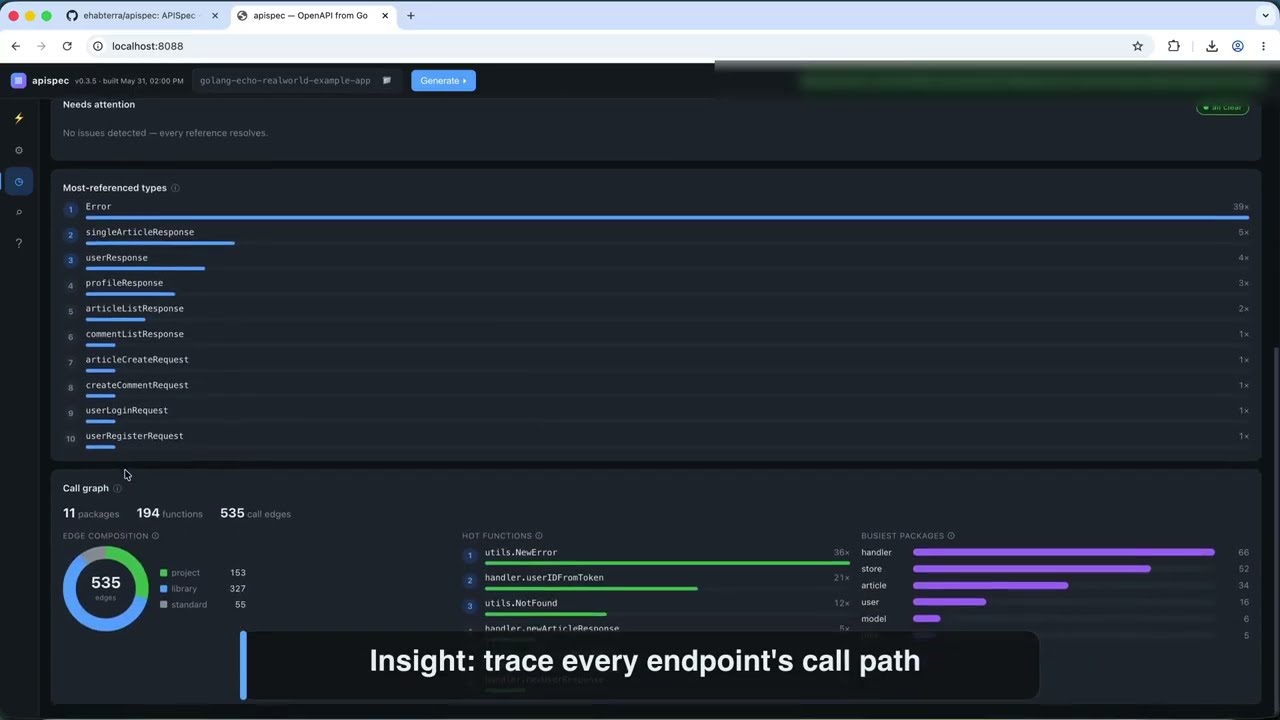
▶︎ Full 2-minute walkthrough on YouTube — Install → Generate → Explore → Configure → Insight.
Earlier end-to-end demo (e-commerce app): youtu.be/lkKO-a0-ZTU
Quick Start
Install
# Homebrew (macOS/Linux) — nothing to compile; pulls in Go, which apispec needs to run
brew install ehabterra/tap/apispec      # the CLI
brew install ehabterra/tap/apispecui    # the web UI

# or with Go
go install github.com/ehabterra/apispec/cmd/apispec@latest
go install github.com/ehabterra/apispec/cmd/apispecui@latest

# Make sure your Go bin is on PATH:
export PATH=$HOME/go/bin:$PATH
Both tools are published the same way — Homebrew, pre-built binaries for six
platforms, go install, from source, or the install script. See
docs/INSTALLATION.md, or the
installation guide on the site.
Generate an OpenAPI spec
Run from inside your Go module:
# YAML output (framework auto-detected)
apispec --output openapi.yaml

# JSON output
apispec --output openapi.json

# With a custom config and a call-graph diagram
apispec --config apispec.yaml --output openapi.yaml --diagram diagram.html
That's it for most projects. See Configuration for tuning and The Tools for the companion utilities.
Framework Support
| Framework | Routes & methods | Path params | Groups / mounting | Request body | Responses | Auth |
|---|---|---|---|---|---|---|
| Gin | ✅ | ✅ | ✅ | ✅ | ✅ | ✅ |
| Echo | ✅ | ✅ | ✅ | ✅ | ✅ | ✅ |
| Chi | ✅ | ✅ | ✅ (incl. render) | ✅ | ✅ | ✅ |
| Fiber | ✅ | ✅ | ✅ | ✅ | ✅ | ✅ |
| Gorilla Mux | ✅ | ✅ (mux.Vars(r)["id"], incl. helper-wrapped & {id:regex} → pattern) | ✅ (PathPrefix, Subrouter) | ✅ | ✅ | ✅ |
net/http | ✅ (HandleFunc, Handle; Go 1.22 method-aware patterns) | ✅ ({id} wildcards + r.PathValue) | basic | ✅ | ✅ | ✅ |
Conditional registration (dynamic routes built at runtime) is generally not supported.
Mixed / multi-framework projects
One binary often serves more than one routing surface — a framework API next to
plain net/http ops endpoints, a gin API beside a gorilla/mux admin router, or
a half-migrated codebase. APISpec handles this automatically:
- All recognised frameworks are detected (import scan), not just the first one. The first-seen framework is the primary — its defaults and info apply.
- Every additional framework's patterns are merged in, restricted to its receiver-scoped patterns, so each framework's registrations are documented.
- The stdlib
net/httpsurface is always layered underneath — it never appears ingo.mod, so it can't be "detected" as a second framework; instead a receiver-scoped subset of its config is always merged.
Receiver scoping is what makes the merge safe: a pattern like Handle on
*mux.Router can never claim another framework's calls, so it is inert unless
that framework is actually routing. Unscoped patterns are not merged from
secondaries, because gin's Handle(method, path, h) and mux's Handle(path, h)
would each misparse the other's calls.
| Scenario | Supported? |
|---|---|
Framework API + plain net/http ServeMux endpoints in one binary | ✅ both documented |
| Two frameworks side by side (e.g. gin API + mux admin router) | ✅ both documented, correct verbs |
Raw *http.Request reads (headers, query, PathValue) inside framework handlers | ✅ documented as parameters |
A framework router mounted under a net/http mux (root.Handle("/api/", http.StripPrefix("/api", chiRouter))) | ✅ the mount prefix composes across the boundary (/api/users) |
Mounts wired through a secondary framework's own Mount-style calls | ✅ those patterns are receiver-scoped in their home configs, so they survive the merge |
| Which framework is primary changing the output (it is decided by file-walk order) | ✅ it doesn't — every framework keeps its own patterns and type mappings whichever one leads, pinned by a rename-invariance test that compares the two specs in full |
A user-supplied --config | framework patterns are never auto-augmented — what you write is what matches. Library presets still apply on top (auth-scheme mappings by import, and CLI entrypoint fields) |
What APISpec Understands
APISpec aims for practical coverage of real-world Go services.
Routing & handlers
- Route groups, sub-routers, mounts and prefixes, including dependency-injected groups.
- Function literals (anonymous handlers) and handler factories — a route registered as a call that returns the framework's handler type (
g.POST("/users", h.Create())), including when dispatched through an interface implemented in another package. - House routers and house contexts, detected automatically — a project that puts its own type in front of the framework is documented with no configuration. See Automatic wrapper detection.
- Go 1.22
net/http.ServeMuxmethod-aware routing —mux.HandleFunc("GET /users/{id}", …)splits into method + path,{id}wildcards become path parameters, and ServeMux-only syntax ({path...},{$}) is normalised to OpenAPI templating. - Method dispatch in the handler — one handler registered without a verb that branches on
r.Methodis split into one operation per HTTP method, each with its own body, responses and operationId. Every handler shape splits: a plain function, a closure written at the registration site, and a method (pointer or value receiver, in any package). A body written a call deeper (case http.MethodGet: h.Get(w, r)) is attributed to the arm that reached it, and a registration that named its verb stays one operation, scoped to the matching arm. - CLI-dispatched services — routing code hanging off a command library's callback (
&cli.Command{Action: runWeb},&cobra.Command{RunE: runServe}) has no call edge from your code. APISpec treats those fields as entrypoints and documents everything below them. Presets ship for urfave/cli v1/v2/v3, spf13/cobra and peterbourgon/ff; a house dispatcher declares its own viaentrypointPatterns. - Route registration behind a func-typed struct field invoked in-module — package-level command vars, cross-package function values, method values and inline closures.
Requests
- Request bodies from
json.Decode/Unmarshal, framework binders, and custom wrapper helpers (util.ReadRequest(c, &dto)→ctx.Bind(dto)), traced through the wrapper's parameters. - Form and file-upload bodies — a file part or an explicit
ParseMultipartFormmakes itmultipart/form-datawith the file asstring/binary; plain form values alone stayapplication/x-www-form-urlencoded. Form reads onGETare documented as query parameters instead. - Parameters in path, query, header, cookie and form position.
- Which decoder calls count as request bodies is configurable — see Request body source disambiguation.
Responses
- Conditional status codes — when a status variable is reassigned across branches with distinct HTTP codes, one response per status is emitted, sharing the body schema.
- Wrapper/envelope specialisation — when a payload flows through a shared helper whose field is
interface{}/any, the concrete per-route type is recovered from the call site and emitted as anallOfof the base envelope plus adataoverride. - Map-literal envelopes — a response written as a map composite literal with constant string keys is documented as an object with those
properties, each value resolved to its own type instead of collapsing toadditionalProperties. - Interface-typed bodies resolved to the concrete type statically assigned, returned, or bound at the call site — including embedded-interface handler dispatch. When several concrete types are possible on different branches the interface is kept rather than guessed.
Types & schemas
- Import and type aliases, resolved to underlying primitives.
- Enum resolution from constants,
enumtags, oroneofvalidator tags — attributed per declared type, never borrowed between two types sharing an underlying type. - Assignment & alias tracking:
:=,=, multi-assign, tuple returns, alias chains, latest-wins shadowing. Registration paths are read through the same tracking (p := "/users", an alias chain, a variable prefix with a literal tail), through a type conversion (r.Mount(string(prefix), sub)), and — for a prefix a helper takes as a parameter — from the helper's call sites. Always subject to agreement: two branches assigning different paths, or two callers passing different prefixes, is reported as unresolvable rather than documented at one of them. - Composite literals, maps, slices, fixed-size and variable-length arrays (
[16]byte,[5]int,[...]int), pointers and automatic dereferencing, selectors and nested field access. - Struct fields, embedded fields, and tag-based metadata (
json,xml,form,validate, …). - Inline (anonymous) struct types as request/response bodies and as nested fields — captured structurally from
go/types, so the inline schema shows real properties and resolves named field types to$refs. - Generics on functions and parametric types —
Page[User]andPage[Product]get distinct schemas, and written, multi-parameter, nested and compiler-inferred instantiations all resolve. - Function-local named types used as bodies, emitted as real component schemas rather than dangling
$refs. - External package types resolved to underlying primitives, with
externalTypesfor custom overrides. go-playground/validatortags mapped to OpenAPI constraints, routed by field type (minon a string →minLength, on a number →minimum, on a slice →minItems), withdiveapplying post-diverules to elements.- Go doc comments on handlers → operation
summary/description; on types and fields → schema and propertydescription. - CGO packages can be skipped to avoid build errors.
Auth
Authentication and security detection is framework-agnostic and config-driven —
see Security & authentication detection.
Protected routes get a per-operation security requirement and the scheme is
registered under components.securitySchemes; explicitly-public routes render
security: []. An apiKey scheme is shaped from the middleware's own
configuration — echo's KeyAuthConfig.KeyLookup and fiber's
keyauth.Config.KeyLookup — so "query:api_key" is documented as
in: query, name: api_key rather than the library's default header. Two groups
configured differently become two schemes, and two key middlewares on one scope
become two required credentials in the same requirement. A lookup built at
runtime keeps the default and says so on stderr, as does a scheme you defined
yourself that the code contradicts — your definition is kept.
Not supported (yet)
- Two bodies under one status that never state that status. Alternative
bodies on branches that do write their status compose into an
anyOf; two that merely fall back to the framework's implicit status keep the first one and drop the rest. Within anr.Methodsplit, ananyOfthat two arms share is documented on both operations rather than divided between them. - Only
go-playground/validator-stylevalidate:tags are read; Gin/Echobinding:tags and comparison validators (gt/gte/lt/lte) are not yet mapped. - A path that exists only as a runtime value. Routes registered from a
table (
for _, r := range routes { adapter.Add(r.Method, r.Path, r.Handler) }) or by a house router chained through a returned object (Combo("/x").Get(h).Post(h)) cannot be located, so they are reported and left out rather than documented at the placeholder standing in for the expression. Each one names the registration site on stderr, andGenerator.UnresolvedPaths()returns the list, so the gap is countable instead of silent. A path that is only partly unresolved keeps its operation, with the placeholder flagged: an unresolved prefix (/{mountPoint}/clear), an unresolved segment before a literal tail (/{dynamicBase}/dyn), and an unreadable tail under a prefix that IS known (/repo/{owner}/{name}/info/lfs/{path}— a catch-all seen through a wrapper) are all real endpoints, documented approximately. - A payload erased inside a generic envelope — a helper that re-wraps the
value as
APIResponse[any]{Data: data}documentsdataas an open object (#163). A plainany/interface{}parameter is not affected: that resolves, and keeps resolving when one helper serves several routes with different types. A cross-package type used as a type argument also loses its package in the component name (app_Page_Product, where the same type returned directly isapp_inner_Product). - Command libraries that dispatch through a factory map (
mitchellh/cli,hashicorp/cli) or reflection-invoked methods (alecthomas/kong) — the command body is never reached from your code, so nothing it registers is documented.
Examples
Type alias and enum resolution
type AllowedUserType string

const (
    UserTypeAdmin    AllowedUserType = "admin"
    UserTypeCustomer AllowedUserType = "user"
)

type Permission struct {
    AllowedUserTypes []domain.AllowedUserType // → []string in the schema
}

type UserID *int64
type User struct {
    ID UserID // → integer / int64
}
A field's enum is built from the constants declared with that type. Two types sharing an underlying type (type Status string and type Band string) are different types, so one never lends its values to the other — and where the values genuinely cannot be attributed to one type, no enum is emitted rather than a guess.
Array support
type User struct {
    ID     [16]byte   // string, format: byte, maxLength: 16
    Scores [5]int     // array, minItems/maxItems: 5
    Tags   [10]string // array, minItems/maxItems: 10
}

type Config struct {
    Values [...]int   // array, no size constraint
}
Validator tag support
| Validator tag | OpenAPI mapping |
|---|---|
required | required: true |
omitempty | required: false |
min=N | minimum: N |
max=N | maximum: N |
len=N | minLength: N, maxLength: N |
email | format: email |
url | format: uri |
uuid | format: uuid |
oneof=a b | enum: [a, b] |
alphanum | pattern: "^[a-zA-Z0-9]+$" |
alpha | pattern: "^[a-zA-Z]+$" |
numeric | pattern: "^[0-9]+$" |
containsany=chars | pattern: ".*[chars].*" |
e164 | pattern: "^\\+[1-9]\\d{1,14}$" |
dive | rules after it apply to the elements (items.*) |
Struct-level (cross-field) rules on a blank marker field (_ struct{} `validate:"gtefield=Min"`) surface as a schema description note.
Go 1.22 net/http.ServeMux method-aware routing
mux := http.NewServeMux()
mux.HandleFunc("GET /users/{id}", getUser) // method + wildcard
mux.HandleFunc("POST /users", createUser)

func getUser(w http.ResponseWriter, r *http.Request) {
    id := r.PathValue("id") // → path parameter "id"
    // ...
}
GET /users/{id} becomes a GET operation on /users/{id} with an id path
parameter, and POST /users becomes a POST with its request body inferred as
usual. ServeMux-only syntax is normalised: trailing wildcards {path...}
collapse to {path} and the {$} end-of-path anchor is dropped.
Inline anonymous struct request / response bodies
func createOrder(w http.ResponseWriter, r *http.Request) {
    var req struct {
        Items []itemReq `json:"items"`
    }
    if err := render.DecodeJSON(r.Body, &req); err != nil {
        http.Error(w, "invalid JSON", http.StatusBadRequest)
        return
    }
    // ...
}
APISpec captures the local struct{...} type structurally from go/types,
emits an inline object schema on the requestBody, and promotes named field
types (itemReq here) to their own components with $ref. Nested anonymous
structs stay inlined.
Wrapper / envelope response specialisation
Many services wrap every response in a shared envelope whose payload field is
interface{} — so the concrete type is only knowable at the call site:
type Envelope struct {
    Message string      `json:"message"`
    Data    interface{} `json:"data"`
    Code    int         `json:"code"`
}

func RespondWithSuccess(w http.ResponseWriter, message string, data interface{}, code int) {
    _ = json.NewEncoder(w).Encode(NewEnvelope(message, data, code))
}

func listOrders(w http.ResponseWriter, r *http.Request) {
    common.RespondWithSuccess(w, "ok", orders.Order{...}, http.StatusOK)
}
APISpec follows the assignment + constructor + parameter chain to recover the caller-site payload type, then composes a per-route schema:
allOf:
  - $ref: '#/components/schemas/Envelope'   # base wrapper (message, code, …)
  - type: object
    properties:
      data:
        $ref: '#/components/schemas/Order'   # recovered per-route payload
Only genuinely generic fields (interface{}/any) are overridden; concrete
fields like message/code keep rendering from the base schema. The recovered
payload type is always registered as a component, so the data $ref never
dangles.
Security / authentication detection
APISpec detects auth middleware and marks the routes it protects, framework-agnostically. Detection has two halves, both config-driven:
- Scope (
framework.securityPatterns) — recognises how middleware is applied and how far it reaches:router(chi/echo/gin/muxUse),subtree(group/route closures),route(chiWith, per-route middleware args), andwrapper(a handler wrapped by an auth function). - Identity → scheme (
securityMappings) — resolves which middleware to one or more OpenAPI security requirements, by function name, package, and/or receiver type.
r := chi.NewRouter()
r.Get("/health", health)              // open

r.Group(func(r chi.Router) {
    r.Use(jwtauth.Verifier(tokenAuth)) // subtree-wide auth
    r.Get("/me", me)                   // → security: [{ bearerAuth: [] }]
})

r.With(authMiddleware).Get("/admin", admin) // per-route chain → protected
Common JWT/auth libraries are recognised with zero config via an import detector (echo-jwt, appleboy/gin-jwt, gofiber/contrib/jwt, golang-jwt validation calls, and more). Explicitly-public routes (skipper / AllowUnauthenticated style middleware) render security: [].
When a custom middleware can't be mapped to a scheme automatically, apispec warns and lists the unresolved middleware; apispecui surfaces the same list with a picker to assign a scheme interactively. To map one yourself:
securityMappings:
  - functionNameRegex: ^authMiddleware$
    recvTypeRegex: Handler           # optional: method-value middleware
    schemes:
      - { bearerAuth: [] }           # entries here are ANDed
  # An apiKey middleware that carries WHERE the key travels in its own config:
  # the scheme's in/name are read from that field rather than assumed.
  - functionNameRegex: ^KeyAuthWithConfig$
    pkgRegex: ^example\.com/auth$
    schemes:
      - { apiKeyAuth: [] }
    lookupField: KeyLookup           # "<header|query|cookie>:<name>"
    lookupArgIndex: 0                # default: the first argument
  # OR alternatives (any one satisfies):
  - functionNameRegex: ^New$
    pkgRegex: github\.com/golang-jwt/.*
    schemesAnyOf:
      - [ { bearerAuth: [] } ]
      - [ { apiKeyAuth: [] } ]
  # Mark a middleware as making routes explicitly public:
  - functionNameRegex: ^AllowPublic$
    public: true
  # Mark a middleware as known non-auth so it's not reported as unresolved
  # (logging, CORS, recovery, request-id, …). Mutually exclusive with
  # schemes, schemesAnyOf, and public:
  - functionNameRegex: ^(Logger|Recoverer|RequestID)$
    pkgRegex: github\.com/go-chi/chi/v5/middleware
    skip: true
Well-known non-auth middleware from the major frameworks' own middleware packages (chi, echo, gin/gin-contrib, fiber, gorilla/handlers) is skipped automatically by import-gated presets, so the unresolved list stays focused on middleware that's genuinely yours to map. In apispecui, each item in the unresolved list also has a one-click Skip button.
The Tools
APISpec ships three binaries that share the same analysis engine.
| Binary | Purpose | Entry point |
|---|---|---|
apispec | Generate an OpenAPI 3.1 spec from a Go module | cmd/apispec |
apispecui | Browser UI: configure APISpec, preview the spec, and explore the call graph at /diagram | cmd/apispecui |
apidiag | Standalone interactive call-graph server (same engine, headless) | cmd/apidiag |
apispec — CLI generator
The main generator. Auto-detects the framework, loads a default config (overridable with --config), and writes an OpenAPI spec.
# Basic
apispec --output openapi.yaml

# Generate metadata for debugging
apispec --output openapi.yaml --write-metadata

# Limit tuning for very large projects
apispec --output openapi.yaml --max-nodes 100000 --max-children 1000

# Performance profiling
apispec --output openapi.yaml --cpu-profile --mem-profile
CLI flags always override values from a config file, and a positional argument
overrides --dir (apispec ./api -o spec.yaml).
Full flag reference
| Flag | Shorthand | Description | Default |
|---|---|---|---|
--output | -o | Output path for the OpenAPI spec | openapi.json |
--dir | -d | Directory to parse | . |
--title | -t | API title | Generated API |
--api-version | -v | API version | 1.0.0 |
--description | -D | API description | "" |
--terms | -T | Terms of service URL | "" |
--contact-name | -N | Contact name | Ehab |
--contact-url | -U | Contact URL | https://ehabterra.github.io/ |
--contact-email | -E | Contact email | ehabterra@hotmail.com |
--license-name | -L | License name | "" |
--license-url | -lu | License URL | "" |
--openapi-version | -O | OpenAPI spec version | 3.1.1 |
--config | -c | Path to custom config YAML | "" |
--output-config | -oc | Write the effective config to a YAML file | "" |
--write-metadata | -w | Write metadata.yaml to disk | false |
--split-metadata | -s | Write metadata as multiple files | false |
--diagram | -g | Write call-graph HTML to this path | "" |
--paginated-diagram | -pd | Use paginated rendering for the diagram | false |
--diagram-page-size | -dps | Nodes per page in paginated diagram (50–500) | 100 |
--max-nodes | -mn | Max nodes in the walk that finds route registrations | 50000 |
--max-nodes-per-route | Max nodes expanded below one route registration (lazy engine) | 1000000 | |
--max-children | -mc | Max children per node | 500 |
--max-args | -ma | Max arguments per function | 100 |
--max-nested-args | -md | Max depth for nested arguments | 100 |
--max-recursion-depth | -mrd | Max recursion depth (anti-loop) | 10 |
--max-instances-per-key | Max copies of one callee within an instance scope (lazy engine) | 100 | |
--legacy-tracker | Deprecated, to be removed in a future release. Use the legacy (eager) tracker tree; documents fewer routes than the default and is slower | false | |
--skip-cgo | Skip CGO packages | true | |
--include-file | Include files matching pattern (repeatable) | "" | |
--include-package | Include packages matching pattern (repeatable) | "" | |
--include-function | Include functions matching pattern (repeatable) | "" | |
--include-type | Include types matching pattern (repeatable) | "" | |
--exclude-file | Exclude files matching pattern (repeatable) | "" | |
--exclude-package | Exclude packages matching pattern (repeatable) | "" | |
--exclude-function | Exclude functions matching pattern (repeatable) | "" | |
--exclude-type | Exclude types matching pattern (repeatable) | "" | |
--analyze-framework-dependencies | -afd | Walk into framework packages during analysis | true |
--auto-include-framework-packages | -aifp | Auto-include known framework packages | true |
--auto-exclude-tests | -aet | Skip *_test.go files | true |
--auto-exclude-mocks | -aem | Skip mock files | true |
--cpu-profile | Enable CPU profiling | false | |
--mem-profile | Enable memory profiling | false | |
--block-profile | Enable block profiling | false | |
--mutex-profile | Enable mutex profiling | false | |
--trace-profile | Enable trace profiling | false | |
--custom-metrics | Enable custom metrics collection | false | |
--profile-dir | Directory for profiling output | profiles | |
--cpu-profile-path | CPU profile filename (within --profile-dir) | cpu.prof | |
--mem-profile-path | Memory profile filename | mem.prof | |
--block-profile-path | Block profile filename | block.prof | |
--mutex-profile-path | Mutex profile filename | mutex.prof | |
--trace-profile-path | Trace filename | trace.out | |
--metrics-path | Custom metrics filename | metrics.json | |
--verbose | -vb | Verbose output (derived patterns, entrypoints, skips) | false |
--version | -V | Print version and exit | false |
See also: cmd/apispec/README.md.
apispecui — Browser-based config & preview
apispecui is a small local web server that lets you configure APISpec interactively, generate a spec on demand, immediately preview it through embedded Swagger UI, Redoc, or Scalar viewers, and explore the project's call graph at /diagram.
# Install it the same way as apispec (see Install above)
brew install ehabterra/tap/apispecui
# or: go install github.com/ehabterra/apispec/cmd/apispecui@latest

apispecui --dir ./my-go-project

# Open http://localhost:8088 — config UI
# Open http://localhost:8088/diagram — call-graph visualization
Flags: --host (default localhost), --port (default 8088), --dir/-d (project root, default .), --config/-c (initial config), --verbose.
Two things worth knowing before a first run on a large project:
- Analysis engine edits the expansion limits (see Performance & Limits), with the engine's defaults shown as placeholders. A project whose call tree is bigger than the default budget needs them raised.
- When expansion does stop early, the result says so — "Expansion stopped at the 50000-node limit, so routes beyond that point are missing" — so a truncated run doesn't read as a complete one with a short route list.
Insight (the ◷ tab) reports how the spec was produced, not just what is in it: which frameworks were detected and which one's patterns lead, what the CLI entry-point gate decided, and — per status code — how many responses describe their fields, are a free-form object, were found with an unresolved type, or document no body at all. That last split is the useful one: an empty body at 200 means the write was never followed, while an unresolved type means it was found and needs a type mapping.
Framework selection matches the CLI. The UI composes the same multi-framework config the CLI does — the detected primary, every other detected framework merged in receiver-scoped, and the net/http surface underneath — so a mixed project documents the same routes either way. The selector chooses which framework leads; the rest still merge under it, and the form lists them ("Also detected: gin").
Key endpoints (cmd/apispecui/main.go registers more — config load/save, generation progress and cancel, project browsing, health):
| Path | Purpose |
|---|---|
/ | Configuration UI |
/swagger | Swagger UI preview |
/redoc | Redoc preview |
/scalar | Scalar preview |
/diagram | Interactive call-graph / tracker-tree visualization |
/api/spec.json | Last-generated spec (JSON) |
/api/spec.yaml | Last-generated spec (YAML) |
/api/config.yaml | Current effective config |
/api/generate (POST) | Trigger spec generation with the current config |
/api/detect (GET) | Detected frameworks + a pre-filled config for the project |
/api/insight/overview | Whole-API insight report for the last-generated spec |
/api/insight/endpoint | Per-route insight report (?method=&path=, optional ?trace=tracker|callgraph) |
/api/insight/source | Source window around a trace position (?pos=file:line), restricted to the analyzed module, GOROOT and the module cache |
/api/insight/export | The report as Markdown, or ?format=json (?scope=endpoint for one route, ?redact=1 to redact paths) |
/api/diagram/* | Paginated diagram API (same surface as apidiag) |
apidiag — Interactive call-graph server (standalone)
The same diagram server, packaged as its own binary. Use it when you want a dedicated graph explorer without the config UI, or to run it on its own host/port. Internally both binaries share internal/diagserver.
go install github.com/ehabterra/apispec/cmd/apidiag@latest
apidiag --dir ./my-go-project --port 8080
# Open http://localhost:8080
Features include package/function/file filtering, multiple export formats (SVG, PNG, PDF, JSON), and a JSON HTTP API for programmatic access.
See cmd/apidiag/README.md for full documentation and a demo video.
Configuration
APISpec uses YAML configuration files to describe framework patterns and OpenAPI metadata. For most projects the bundled defaults are enough; provide --config only when you need to extend or override them.
📖 See docs/CONFIGURATION.md for the full field-by-field configuration reference.
Minimal example (Gin)
info:
  title: My API
  version: 1.0.0
  description: A comprehensive API for user management

framework:
  routePatterns:
    - callRegex: ^(?i)(GET|POST|PUT|DELETE|PATCH|OPTIONS|HEAD)$
      recvTypeRegex: ^github\.com/gin-gonic/gin\.\*(Engine|RouterGroup)$
      handlerArgIndex: 1
      methodFromCall: true
      pathFromArg: true
      handlerFromArg: true
    # A registrar whose verb travels as an ARGUMENT, and may name several:
    # `Methods("GET,POST", "/search", h)` registers both.
    - callRegex: ^Methods$
      recvTypeRegex: ^example\.com/app\.\*?Router$
      methodFromArg: true
      methodArgIndex: 0
      pathFromArg: true
      pathArgIndex: 1
      handlerFromArg: true
      handlerArgIndex: 2
  requestBodyPatterns:
    - callRegex: ^(?i)(BindJSON|ShouldBindJSON|BindXML|BindYAML|BindForm|ShouldBind)$
      typeFromArg: true
      deref: true
  responsePatterns:
    - callRegex: ^(?i)(JSON|String|XML|YAML|ProtoBuf|Data|File|Redirect)$
      typeArgIndex: 1
      statusFromArg: true
      typeFromArg: true
  paramPatterns:
    - callRegex: ^Param$
      paramIn: path
    - callRegex: ^Query$
      paramIn: query
    - callRegex: ^GetHeader$
      paramIn: header
Scoping a pattern to where the call is made
Every pattern type also accepts callerPkgPatterns, callerRecvTypePatterns,
calleePkgPatterns and calleeRecvTypePatterns — lists of regexes narrowing a
pattern by where a call is made, not only by what is called. Two packages can
register routes with the identical call, and that is the only fact separating
them:
framework:
  routePatterns:
    - callRegex: ^(?i)(Get|Post|Put|Delete)$
      recvTypeRegex: ^github\.com/go-chi/chi(/v\d)?\.\*?(Router|Mux)$
      methodFromCall: true
      pathFromArg: true
      handlerFromArg: true
      handlerArgIndex: 1
      callerPkgPatterns:
        - /internal/api$      # operator endpoints stay out of the spec
Any entry in a list admits the call, an empty list constrains nothing, and all
four are include filters. See
docs/CONFIGURATION.md.
Entrypoints (CLI-dispatched services)
A function parked in a struct field and called back by a library has no call edge
from your code, so nothing reaches the routes it registers. entrypointPatterns
names those fields. Presets for urfave/cli, cobra and ffcli apply automatically
from your imports — you only need this for a house dispatcher:
framework:
  entrypointPatterns:
    # "a function stored in Cmd.Handle is invoked by something outside this
    #  module — root it if nothing else reaches it"
    - fieldRegex: ^Handle$
      recvTypeRegex: ^example\.com/internal/cli\.Cmd$
The owner type is matched as metadata renders it (example.com/internal/cli.Cmd),
and nothing is needed from the owning package — which is why this works for types
declared in a third-party library that APISpec never analyses. Leaving the owner
unconstrained is treated as a misconfiguration rather than a wildcard, since it
would claim every same-named field in the project.
Only entrypoints that are otherwise unreachable and whose subtree actually
registers routes are rooted, so a CLI with 50 subcommands pays for the one that
serves HTTP. Run with --verbose to see what it did:
Entrypoints: 53 declared, 1 rooted (0 already reachable, 52 register no routes)
Automatic wrapper detection
Plenty of projects do not call the framework directly. They put their own router in front of it, and answer through their own context:
func (r *Router) Get(pattern string, h ...any) { r.Methods("GET", pattern, h...) }
func (r *Router) Methods(methods, pattern string, h ...any) {
	r.chiRouter.Method(methods, r.getPattern(pattern), unwrap(h))     // the framework call is in HERE
}

func (c *Ctx) JSON(status int, body any) { c.Resp.WriteHeader(status); json.NewEncoder(c.Resp).Encode(body) }
func (c *Ctx) Bind(dst any) error       { return json.NewDecoder(c.Req.Body).Decode(dst) }
The framework's own patterns cannot see any of it: by the time the chi call happens, the path and handler are the wrapper's parameters, not literals. APISpec derives the patterns instead, from one fact — a method of a project type that forwards its own parameters into a call APISpec already recognises:
| written as | derived as |
|---|---|
Get(pattern, h...) → Methods("GET", …) → chi | a route pattern, verb from the method name |
Methods(verb, pattern, h...) | a route pattern, verb from the argument (GET,POST registers both) |
Group(prefix, func(){…}) | a mount pattern — the prefix applies to everything inside |
Ctx.JSON(status, body) | a response pattern, status and body merged from the two calls it makes |
Ctx.Bind(dst) | a request-body pattern |
Ctx.Query(name) | a parameter pattern, location taken from what it reads |
Derivation is transitive (verb methods → one registrar → the framework, and a context that encodes through the project's own json package), and it follows a value through a call, an index or a chain of assignments — so a router that unwraps a variadic ...any resolves like one that forwards directly.
What it deliberately does not do is guess:
- a method that names its route with literals (
func (s *Server) routes() { r.Get("/users", h) }) is a registration, not a way of registering, and derives nothing; - a plain function is skipped — there is no type to scope a pattern to;
- a dependency's method is skipped — describing it would not document your project;
- a derivation that cannot resolve every role it needs is reported but not applied, because a pattern missing its path produces routes at the wrong path.
Everything derived is listed with --verbose and lands in --output-config, so it can be reviewed, pinned into a config file, or corrected:
Router wrappers: example.com/app.*Router [Delete Get Post Put] route via example.com/app.Methods (applied);
                 example.com/app.*Router [Group] mount via prefix held by example.com/app.*Router (applied);
                 example.com/app.*Ctx [JSON] response via net/http.WriteHeader (applied);
                 example.com/app.*Combo [Get] route via example.com/app.Get (incomplete, not applied)
Custom type mapping
typeMapping:
  - goType: time.Time
    openapiType: { type: string, format: date-time }
  - goType: uuid.UUID
    openapiType: { type: string, format: uuid }
  - goType: domain.UserStatus
    openapiType:
      type: string
      enum: [active, inactive, pending]
External package types
External types are usually resolved automatically. Use externalTypes only when you need a custom schema:
externalTypes:
  - name: github.com/gin-gonic/gin.H
    openapiType:
      type: object
      additionalProperties: true
  - name: github.com/your-org/shared.Response
    openapiType:
      type: object
      properties:
        code:    { type: integer }
        message: { type: string }
        data:    { type: object, additionalProperties: true }
Schema descriptions from Go doc comments
Doc comments on the types and struct fields your handlers exchange become the
description of the matching schema and property. This is on by default; turn it
off when internal comments should not reach a published spec:
excludeTypeComments: true
// Item is a catalogue item.
type Item struct {
	// ID is the unique identifier of the item.
	ID    string  `json:"id"`
	Price float64 `json:"price"` // trailing comments are collected too
}
components:
  schemas:
    myapp_Item:
      type: object
      description: Item is a catalogue item.
      properties:
        id:
          type: string
          description: ID is the unique identifier of the item.
        price:
          type: number
          description: trailing comments are collected too
Text is kept verbatim, including the leading identifier Go convention puts
there. A json:"-" field stays absent — a comment never resurrects a field the
encoder skips. Applies to every type kind: structs, interfaces, aliases and
named container types.
Request body source disambiguation
Generic decoders like json.Decode, json.Unmarshal, and render.DecodeJSON are used both for request bodies and for unrelated decoding (config files, internal payloads). The requestContext block tells APISpec which receivers represent a request context and which method names yield the body. A decoder call is classified as a request-body decoder only when its source argument can be traced — through selectors, idents, assignments, and parameter boundaries — back to a body accessor on a request-context root.
framework:
  requestContext:
    typeRegexes:
      - ^net/http\.\*Request$
      - ^github\.com/gin-gonic/gin\.\*Context$
    bodyAccessors:
      - ^Body$
      - ^GetRawData$
When omitted, APISpec falls back to its prior receiver-only matching, so existing configs keep working unchanged.
Security / authentication
Most auth setups are detected with no config (see Security & authentication detection). When you use a custom middleware, map its identity to a scheme with securityMappings, and — if needed — describe how it's applied with framework.securityPatterns:
framework:
  securityPatterns:
    - callRegex: ^Use$
      recvTypeRegex: chi\.Router
      scope: router            # router | subtree | route | wrapper
      middlewareArgIndex: 0
      middlewareVariadic: true

securityMappings:
  - functionNameRegex: ^authMiddleware$
    schemes:
      - { bearerAuth: [] }

securitySchemes:               # only needed for schemes not auto-registered
  bearerAuth:
    type: http
    scheme: bearer
    bearerFormat: JWT
How It Works
graph TD
    A[Go Source Code] --> B[Package Analysis & Type Checking]
    B --> C[Framework Detection]
    C --> D[Metadata Generation]
    D --> E[Call Graph Construction]
    E --> F[Tracker Tree with Limits]

    G[Config File<br/>--config] -.-> H[Pattern Extraction]
    F --> H
    D --> H

    H --> I[OpenAPI Spec Generation]
    I --> J{{Output Format?}}
    J -->|JSON| K[openapi.json]
    J -->|YAML| L[openapi.yaml]

    E -.-> M[Call Graph Diagram<br/>--diagram]
    M -.-> N[diagram.html]

    H -.-> O[Effective Config Output<br/>--output-config]
    O -.-> P[apispec-config.yaml]

    D -.-> Q[Metadata Output<br/>--write-metadata]
    Q -.-> R[metadata.yaml]
- Locate the module — resolve the input directory up to its
go.mod, apply include/exclude filters, and fix the import path that namespaces every$ref. - Load and type-check every in-scope package with
go/packages, so the rest of the pipeline reads resolved types rather than guessing from names. - Detect the framework from the module's dependencies and pick its default pattern set.
- Merge the configuration: framework default →
--config→ CLI overrides → auto-applied security/auth presets.--output-configwrites the result. - Generate metadata — one normalized, string-interned model of packages, types, functions, call edges, assignments and call arguments. Nothing downstream touches the raw AST again.
- Build the tracker tree — expand each route registration down to the handler and the calls inside it, bounded by the limits.
- Extract patterns — match the configured patterns against the tree to find each route's method, path, parameters, body and responses, and resolve each to a concrete Go type.
- Map to OpenAPI — paths, operations, content, component schemas and security, with dedup and
$refpromotion. - Serialize to YAML or JSON, deterministically.
- Emit side outputs — diagram, effective config, metadata dump, and diagnostics for anything the analysis couldn't resolve.
📖 Stage-by-stage detail: docs/PIPELINE.md. Debugging a missing route: docs/DEBUGGING.md.
Programmatic Usage
import (
    "os"

    "github.com/ehabterra/apispec/generator"
    "github.com/ehabterra/apispec/spec"
    "gopkg.in/yaml.v3"
)

func main() {
    cfg := spec.DefaultGinConfig() // or spec.LoadAPISpecConfig("apispec.yaml")
    gen := generator.NewGenerator(cfg)

    openapi, err := gen.GenerateFromDirectory("./your-project")
    if err != nil {
        panic(err)
    }
    data, _ := yaml.Marshal(openapi)
    _ = os.WriteFile("openapi.yaml", data, 0644)
}
Performance & Limits
APISpec bounds its own analysis so a deep or cyclic call graph produces a truncation warning instead of a hang. The defaults suit most projects; very large ones may need the node budgets raised.
| Parameter | Default | CLI flag | Effect when exhausted |
|---|---|---|---|
| Max nodes / tree | 50,000 | --max-nodes | routes are missing — raise it |
| Max nodes / route | 1,000,000 | --max-nodes-per-route | one named route is less detailed |
| Max children / node | 500 | --max-children | children of a node truncated |
| Max args / function | 100 | --max-args | arguments truncated |
| Max instances / key | 100 | --max-instances-per-key | a shared helper's copies capped, so some response bodies may be empty |
Every truncation is logged with the node it happened at, so a short spec is never silent.
The default analysis engine is lazy: subtrees are expanded on demand, only along the paths a query actually touches.
Deprecated —
--legacy-tracker(the eager tracker tree) will be removed in a future release. It reads like a safe fallback and is not one: on a real ~280-route service it documents 194 routes — 31% missing, with no warning — and runs 1.6× slower, and across the fixture suite it resolves four wiring shapes incorrectly. Selecting it prints a deprecation warning. If the default engine is missing something, please open an issue rather than switching — switching will usually document fewer routes, not more.
📖 Engine comparison, the reasoning behind each limit, measured trade-offs, and profiling: docs/PERFORMANCE.md.
Development
Prerequisites
- Go 1.26+
- Familiarity with Go AST analysis and OpenAPI 3.1
Project layout
apispec/
├── cmd/
│   ├── apispec/       # CLI generator
│   ├── apispecui/     # Browser UI + spec preview
│   └── apidiag/       # Paginated call-graph server
├── generator/         # High-level generator interface
├── internal/
│   ├── core/          # Framework detection & shared logic
│   ├── diagserver/    # Shared call-graph HTTP server (used by apidiag + apispecui)
│   ├── engine/        # Processing engine
│   ├── metadata/      # AST analysis & metadata extraction
│   └── spec/          # OpenAPI generation & mapping
├── pkg/patterns/      # Public pattern helpers
├── spec/              # Public spec package (configs, types)
├── testdata/          # Example projects used in tests
├── scripts/           # Build & utility scripts
└── docs/              # Long-form documentation
Build & test
make build              # build all binaries
make test               # run all tests
make coverage           # tests with coverage
make update-badge       # refresh the coverage badge
go test ./internal/spec -v -run "Test.*Comprehensive"
The binaries (apispec, apispecui, apidiag) are gitignored build artifacts. After switching branches, rebuild
and restart a running apispecui — it keeps the code it started with, and a
browser refresh will not pick up a new build.
Adding a framework
- Add a registry entry to
internal/core/frameworks.go(detection patterns, import patterns, detection rank). - Add the default config (route/request/response/param patterns) under
internal/spec/, and map it ininternal/spec/framework_config.go. - Add a fixture project under
testdata/and a test case.
Contributing
- Fork the repository.
- Create a feature branch:
git checkout -b feature/amazing-feature. - Add tests covering your change.
- Run
make testand (if coverage moves)make update-badge. - Open a pull request.
See CONTRIBUTING.md and CODE_OF_CONDUCT.md for details.
Documentation
- docs/DEBUGGING.md — my route is missing: how to debug (effective config, metadata dump, call-graph diagram, insight reports)
- docs/INSTALLATION.md — installation methods
- docs/CONFIGURATION.md — full configuration reference
- docs/PIPELINE.md — the analysis pipeline, stage by stage
- docs/PERFORMANCE.md — engines, limits, and profiling
- docs/RELEASE_WORKFLOW.md — release process
- docs/TRACKER_TREE_USAGE.md — TrackerTree internals
- docs/CYTOGRAPHE_README.md — call-graph visualization
- docs/INTERFACE_RESOLUTION.md — interface resolution notes
- cmd/apispec/README.md — CLI reference
- cmd/apidiag/README.md — diagram server
- internal/metadata/README.md — metadata package
- internal/spec/README.md — spec-generation package
Forks & derivatives
APISpec is Apache-2.0, so anyone is free to build on it — and someone has:
- antst/go-apispec — a fork of this project by Anton Starikov, also Apache-2.0, with a substantially reworked analysis pipeline. Credit to him for taking the idea further and spending the time to make it his own; that is exactly what the licence is for.
Building on APISpec yourself? Open an issue or a discussion — downstream projects are welcome here.
License
Apache License 2.0 — see LICENSE.