Time series symbolic discretization (approximation) with SAX
July 23, 2026 · View on GitHub




This code is released under GPL v.2.0 and implements in Java:
- Symbolic Aggregate approXimation (i.e., SAX) toolkit stack [1]
- EMMA (Enumeration of Motifs through Matrix Approximation) algorithm for time series motif discovery [2]
- HOT-SAX - a time series anomaly (discord) discovery algorithm [3]
- time series bitmap-related routines [4]
Also available in R, Python (saxpy on PyPI), SAX-VSM, and GrammarViz 3.0.
Published stack (Jul 2026): jmotif 1.3.2 (CRAN) · saxpy 2.0.1 (PyPI) · jmotif-sax / jmotif-gi / sax-vsm 2.0.2 (Maven Central) · GrammarViz 3.0.4 (Maven Central).
Cross-implementation alignment
As of 2.0.0 the Java, R, and Python (saxpy)
implementations are kept aligned: the SAX stack (z-normalization, PAA, Gaussian
breakpoints, symbol assignment) and the HOT-SAX / brute-force discord search
produce the same results across all three to floating-point precision. The
shared conventions are: z-normalization uses the population standard
deviation (divide by n, matching the Matrix Profile / MASS convention);
PAA uses fractional segment boundaries; a value exactly on a breakpoint maps to
the symbol above the cut; and discord search compares z-normalized
subsequences and breaks distance ties by the lowest index for reproducibility.
The 2.0.0 discord/z-normalization fixes mean SAX words and discord positions
near a breakpoint may differ from earlier releases (see the version notes).
Automated cross-language verification lives in
jmotif-conformance.
[1] Lin, J., Keogh, E., Patel, P., and Lonardi, S., Finding Motifs in Time Series, The 2nd Workshop on Temporal Data Mining, the 8th ACM Int'l Conference on KDD (2002)
[2] Patel, P., Keogh, E., Lin, J., Lonardi, S., Mining Motifs in Massive Time Series Databases, In Proc. ICDM (2002)
[3] Keogh, E., Lin, J., Fu, A., HOT SAX: Efficiently finding the most unusual time series subsequence, In Proc. ICDM (2005)
[4] Kumar, N., Lolla, V.N., Keogh, E.J., Lonardi, S. and Chotirat (Ann) Ratanamahatana, Time-series Bitmaps: a Practical Visualization Tool for Working with Large Time Series Databases, In SDM 2005 Apr 21 (pp. 531-535).
Citing this work:
If you are using this implementation for your academic work, please cite our Grammarviz 3.0 paper:
[Citation] Senin, P., Lin, J., Wang, X., Oates, T., Gandhi, S., Boedihardjo, A.P., Chen, C., Frankenstein, S., GrammarViz 3.0: Interactive Discovery of Variable-Length Time Series Patterns, ACM Trans. Knowl. Discov. Data, February 2018.
An alternative solution for recurrent and anomalous patterns detection:
If you are interested in more advanced techniques for time series pattern discovery -- the kind that discovers recurrent and anomalous patterns of variable length -- see GrammarViz 3.0 (TKDD 2018 paper, source). Based on symbolic discretization, grammatical inference, and algorithmic (Kolmogorov) complexity, it finds variable-length motifs and anomalies in roughly linear time — faster than HOT-SAX on many series, though exactness is not guaranteed.
0.0 SAX transform in a nutshell
SAX is used to transform a sequence of rational numbers (i.e., a time series) into a sequence of letters (i.e., a string). An illustration of a time series of 128 points converted into the word of 8 letters:
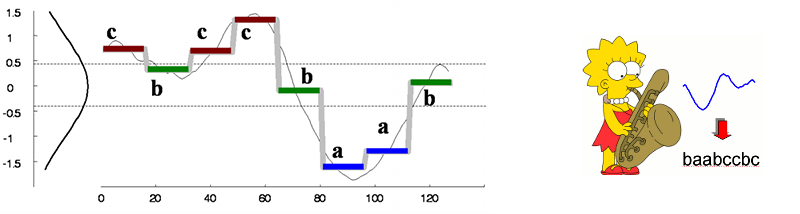
As discretization is probably the most used transformation in data mining, SAX has been widely used throughout the field. Find more information about SAX at its authors pages: SAX overview by Jessica Lin, Eamonn Keogh's SAX page, or at sax-vsm wiki page.
1.0 Building
The code is written in Java and I use maven to build it. Use the profile single to build an executable jar containing all the dependencies:
$ mvn package -P single

[INFO] Scanning for projects...
[INFO] ------------------------------------------------------------------------
[INFO] Building jmotif-sax
[INFO]    task-segment: [package]

...

[INFO] Building jar: target/jmotif-sax-2.0.2-jar-with-dependencies.jar
[INFO] ------------------------------------------------------------------------
[INFO] BUILD SUCCESSFUL
2.0 Time series to SAX conversion using CLI
The jar file can be used to convert a time series (represented as a single-column text file) to SAX via sliding window in command line:
$ java -jar target/jmotif-sax-2.0.2-jar-with-dependencies.jar
Usage: <main class> [options]
Options:
		--alphabet_size, -a
		   SAX alphabet size, Default: 3
		--data, -d
		   The input file name
		--out, -o
   		   The output file name
		--strategy
   		   SAX numerosity reduction strategy
   		   Default: EXACT, Possible Values: [NONE, EXACT, MINDIST]
		--threads, -t
   		   number of threads to use, Default: 1
		--threshold
   		   SAX normalization threshold, Default: 0.01
		--window_size, -w
   		   SAX sliding window size, Default: 30
		--word_size, -p
   		   SAX PAA word size, Default: 4
When run, it prints the time series point index and a corresponding word:
$ java -jar "target/jmotif-sax-2.0.2-jar-with-dependencies.jar" \
                      -d src/resources/test-data/ecg0606_1.csv -o test.txt
$ head test.txt
0, aabc
8, aacc
13, abcc
20, abcb
...
3.0 API usage
There are two classes implementing end-to-end workflow for SAX. These are TSProcessor (implements time series-related functions) and SAXProcessor (implements the discretization). Below are typical use scenarios:
3.1 Discretizing time-series by chunking:
// instantiate classes
NormalAlphabet na = new NormalAlphabet();
SAXProcessor sp = new SAXProcessor();

// read the input file
double[] ts = TSProcessor.readFileColumn(dataFName, 0, 0);

// perform the discretization
SAXRecords res = sp.ts2saxByChunking(ts, paaSize, na.getCuts(alphabetSize), nThreshold);

// print the output
System.out.println(res.getSAXString(""));
3.2 Discretizing time-series via sliding window:
// instantiate classes
NormalAlphabet na = new NormalAlphabet();
SAXProcessor sp = new SAXProcessor();

// read the input file
double[] ts = TSProcessor.readFileColumn(dataFName, 0, 0);

// perform the discretization
SAXRecords res = sp.ts2saxViaWindow(ts, slidingWindowSize, paaSize,
	na.getCuts(alphabetSize), nrStrategy, nThreshold);

// print the output
Set<Integer> index = res.getIndexes();
for (Integer idx : index) {
	System.out.println(idx + ", " + String.valueOf(res.getByIndex(idx).getPayload()));
}
3.3 Multi-threaded discretization via sliding window:
// instantiate classes
NormalAlphabet na = new NormalAlphabet();
SAXProcessor sp = new SAXProcessor();

// read the input file
double[] ts = TSProcessor.readFileColumn(dataFName, 0, 0);

// perform the discretization using 8 threads
ParallelSAXImplementation ps = new ParallelSAXImplementation();
SAXRecords res = ps.process(ts, 8, slidingWindowSize, paaSize, alphabetSize,
	nrStrategy, nThreshold);

// print the output
Set<Integer> index = res.getIndexes();
for (Integer idx : index) {
	System.out.println(idx + ", " + String.valueOf(res.getByIndex(idx).getPayload()));
}
3.4 Time series motif (recurrent pattern) discovery
Class EMMAImplementation implements a method for getting the most frequent structural patterns with EMMA algorithm:
// read the data
double[] series = TSProcessor.readFileColumn(DATA_FNAME, 0, 0);

// find the best motif with EMMA
MotifRecord motifsEMMA = EMMAImplementation.series2EMMAMotifs(series, MOTIF_SIZE,
				MOTIF_RANGE, PAA_SIZE, ALPHABET_SIZE, ZNORM_THRESHOLD);

// print motifs
System.out.println(motifsEMMA);
Class SAXRecords implements a method for getting the most frequent SAX words:
// read the data
double[] series = TSProcessor.readFileColumn(DATA_FNAME, 0, 0);

// instantiate classes
Alphabet na = new NormalAlphabet();
SAXProcessor sp = new SAXProcessor();

// perform discretization
saxData = sp.ts2saxViaWindow(series, WIN_SIZE, PAA_SIZE, na.getCuts(ALPHABET_SIZE),
    		NR_STRATEGY, NORM_THRESHOLD);

// get the list of 10 most frequent SAX words
ArrayList<SAXRecord> motifs = saxData.getSimpleMotifs(10);
SAXRecord topMotif = motifs.get(0);

// print motifs
System.out.println("top motif " + String.valueOf(topMotif.getPayload()) + " seen " +
	   		topMotif.getIndexes().size() + " times.");
3.5 Time series anomaly detection using brute-force search
The BruteForceDiscordImplementation class implements a brute-force search for discords, which is intended to be used as a reference in tests (HOTSAX and NONE yield exactly the same discords).
discordsBruteForce = BruteForceDiscordImplementation.series2BruteForceDiscords(series,
   WIN_SIZE, DISCORDS_TO_TEST, new LargeWindowAlgorithm(), NORM_THRESHOLD);

    for (DiscordRecord d : discordsBruteForce) {
       System.out.println("brute force discord " + d.toString());
    }
3.6 Time series anomaly (discord) discovery using HOTSAX
The HOTSAXImplementation class implements a HOTSAX algorithm for time series discord discovery:
  discordsHOTSAX = HOTSAXImplementation.series2Discords(series, DISCORDS_TO_TEST, WIN_SIZE,
      PAA_SIZE, ALPHABET_SIZE, STRATEGY, NORM_THRESHOLD);

  for (DiscordRecord d : discordsHOTSAX) {
    System.out.println("hotsax hash discord " + d.toString());
  }
For HOT-SAX, use NumerosityReductionStrategy.NONE for exact discord search. Other numerosity-reduction strategies can speed the search but may change the result.
The library source code has examples (tests) for using these here and here.
4.0 Time series bitmap
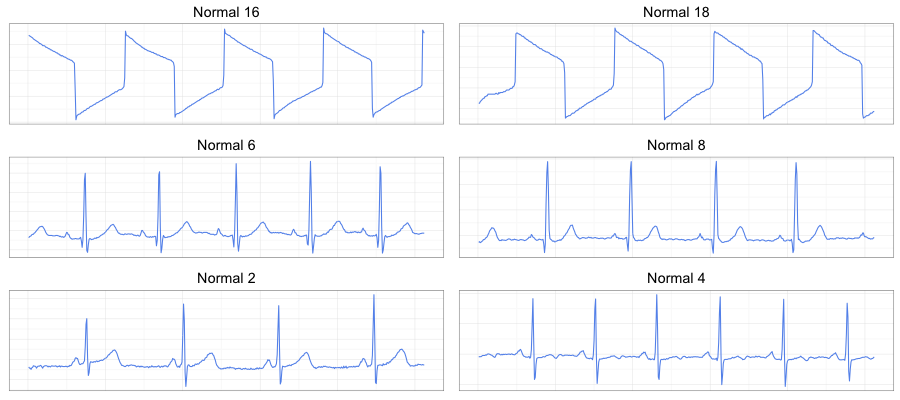
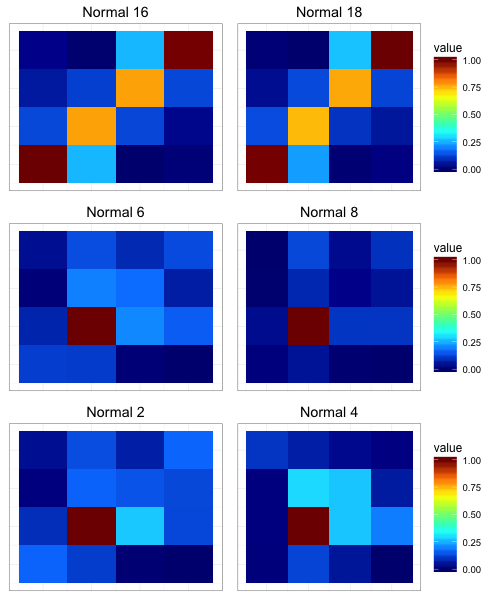
The library also implements simple routines to convert a time series to bitmap following [4]. Here is an example of six datasets from the paper:
which were converted into the bigram frequencies tables and colored with Jet palette:
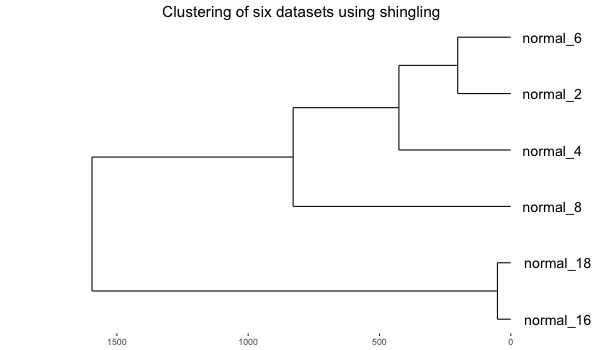
and then clustered (hc, ave) based on the bigram occurrence frequencies (euclidean):
5.0 Threaded performance
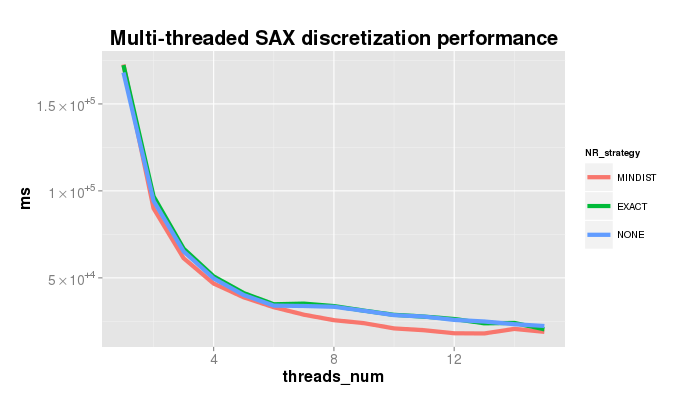
The plot shows the speedup achieved when using the parallelized SAX version on the dataset 300_signal1.txt of length 536,976 points. Parameters used in the experiment: sliding window size 200, PAA size 11, alphabet size 7, and three different NR strategies.
With the MINDIST numerosity-reduction strategy, the parallelized code discretizes with NONE first and prunes second. The 7+ CPU points on the plot below may reflect uneven server load during the benchmark run.
Made with Aloha!

Versions:
2.0.2
- maintenance release bundling post-2.0.0 fixes: parallel SAX pool reuse and
shutdown(), stricter error handling on cancel/interrupt, Maven dependency scopes, JaCoCo 0.8.15, SLF4J 2.0.9 / Logback 1.3.14 - cross-implementation checks live in jmotif-conformance
2.0.0
- the build now targets Java 21 (was Java 8); consumers need a JDK 21 or newer. Plugins refreshed (compiler 3.13, surefire 3.2.5, JaCoCo 0.8.15) and the CI/publish workflows updated to a 21/25 matrix
- z-normalization aligned to the population standard deviation (divide by
n), matching the saxpy reference; SAX words for values close to a Gaussian breakpoint may differ from earlier releases - HOT-SAX and brute-force discord search now compute distances on z-normalized subsequences, break ties by the lowest index, and exclude the trivial-match neighborhood of
±(windowSize - 1); reported discord positions/distances may differ from earlier releases - EMMA correctness fixes -- removed an unsound early-stop and added deterministic tie-breaking
- parallel SAX: fixed an order-dependent seam merge and a single-thread crash; the result now matches the single-threaded conversion exactly
1.1.4
- fixing EMMA for a case of "tie" -- choosing a motif with the smallest variance
1.1.3
- adding an EMMA implementation with a fake ADM
- some old code optimization (breaking some APIs)
1.1.2
- maintenance release -- most of changes in the shingling routines, fitting its API for other projects
1.1.1
- HOTSAX implementation parameters bug fix
1.1.0
- zNormalization behavior for a case when SD is less than threshold is changed -- yields zeros
- GrammarViz3.0 release
1.0.10
- shingling/bitmap CLI fixes
- SAX via chunking fixes -- proper symbol indexes computed (thanks s-mckay!)
1.0.9
- fixed the error with the discord size computation
- changed HOTSAX and BRUTEFORCE behavior by adding z-Normalization to the distance computation routine
1.0.8
- added shingling
1.0.7
- logback dependencies removed
1.0.5 - 1.0.6
- added discretization approximation error computation for grammarviz3 work
1.0.4
- fixed SAX transform via sliding window, last window is now added
1.0.3
- improved PAA performance
1.0.1 - 1.0.2
- more tests, bug fixes, CI
0.0.1 - 1.0.0
- cleaning up the old JMotif code and decoupling the SAX code from the rest