TMPA
August 25, 2026 · View on GitHub

AI agents can produce results. Production systems must prove who was responsible, what was accepted, and why.
CodeFlowMu Open (Historical) · Explore FCoP · Explore the research site · 简体中文









Open-science citation records
| Work | Zenodo DOI | OSF Registration |
|---|---|---|
| TMPA | 10.5281/zenodo.21888488 | 2jvqd |
| FCoP | 10.5281/zenodo.20457285 | 92nwm |
The Zenodo DOI records the citable release archive; the OSF Registration is the immutable, timestamped open-science snapshot.
CodeFlowMu product overview



Real PC and mobile captures · Chinese narration · multi-agent execution · final human approval
TMPA
TMPA (Textual Multi-Agent Process Architecture) is a vendor-neutral governance architecture for long-running work performed by AI agents and humans. It moves durable work facts out of volatile model memory, preserves responsibility across asynchronous execution, and reconstructs lifecycle, authority, conflict, and audit state from inspectable evidence.
This repository is TMPA's public research, specification, executable conformance, and evidence base. CodeFlowMu Open (site) is the frozen historical open-source edition, preserved at V1.2.29-open for engineering history, reproducibility, and research reference. It is not the current CodeFlowMu product distribution path. FCoP (site) is the MIT-licensed file-based behavior-governance protocol used across this engineering lineage.
If you are building agents that must survive restarts, handoffs, disputes, review, and real organizational accountability, this repository is for you. Star it to follow stable specifications, executable examples, and evidence-backed releases.
Start here
| I want to… | Best entry point |
|---|---|
| Inspect the historical open-source implementation | GitHub · Historical site — frozen at V1.2.29-open; not the current product distribution path |
| Add file-based coordination to agents | GitHub · Protocol site — Python package, MCP server, and protocol |
| Understand the idea in five minutes | Why TMPA exists |
| Browse the complete project visually | Open Digital Employee Works → |
| Read the stable theory and specification | Architecture A1.0 · Core S1.0 |
| Run something now | Execute the S1.0 Reference Reader |
| Inspect the engineering claim | Implementation Case I1.0 · Evidence package |
| Cite the work | TMPA DOI · TMPA OSF 2jvqd · FCoP DOI · FCoP OSF 92nwm · CITATION.cff |
Three public repositories, one system
| Repository | Primary job | GitHub | Website |
|---|---|---|---|
| TMPA / joinwell52 | Theory, specification, conformance, research, and evidence | Source & Star | Digital Employee Works |
| FCoP | File-based behavior-governance protocol, Python package, and MCP server | Source & Star | FCoP site |
| CodeFlowMu Open | Historical open-source implementation and reproducibility record | Source & Star | Historical site |
Each repository has one clear reason to be discovered and starred: TMPA explains and specifies; FCoP makes coordination reusable; CodeFlowMu Open preserves the historical public implementation that connected these ideas in a working product. The current CodeFlowMu product line is developed separately and is not represented by the frozen open repository.
Engineering origin: Xiaodian AI
The problem framing behind TMPA, FCoP, and CodeFlowMu did not begin with a paper definition. It grew out of engineering an enterprise AI application, Xiaodian AI. That work exposed two connected problems. The first was “who develops enterprise AI?”: one agent could not reliably own requirements, development, deployment, and acceptance, leading toward PM / DEV / OPS / QA, TASK / REPORT / ISSUE, and “files as protocol.” The second was “how should enterprise AI work inside a business?”: permission, query, analysis, action, and audit could not all be entrusted to one model; responsibilities had to be separated and inspectable facts retained. The first stream later developed into FCoP and CodeFlowMu; the second informed TMPA and the digital-employee architecture. They now meet again in the governed digital-employee production machine.
Current public boundary: The Xiaodian AI PWA Demo is now public for hands-on exploration; its source code and production systems remain private. The demo is a public experience entry point, not evidence of TMPA S1.0 conformance, independent validation, production readiness, or elimination of hallucinations.
Historical CodeFlowMu Open implementation
CodeFlowMu Open preserves the last open-source edition of the local application with its historical product site, PC Panel, Mobile PWA, project isolation, approval gates, FCoP work artifacts, and the fixed execution team PM / DEV / OPS / QA. EVAL observes delivery quality and risk independently.
Historical boundary: CodeFlowMu Open was frozen on 2026-08-22 at V1.2.29-open. The commands below are retained only for reproducibility and historical use. They are not the installation path for the current closed-source CodeFlowMu product line.
cd /d D:\
git clone https://github.com/joinwell52-AI/CodeFlowMu-open.git
cd CodeFlowMu-open
START-CODEFLOWMU-OPEN.bat
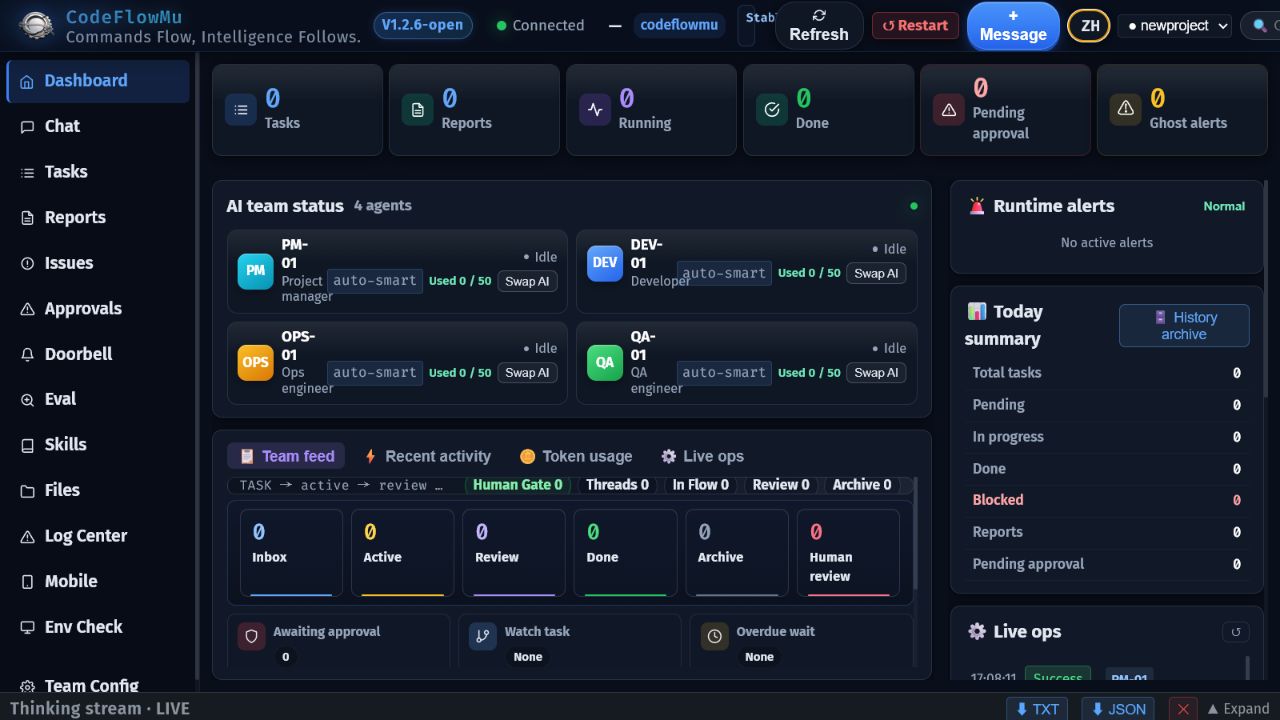
Historical product capture · open the frozen repository for the preserved PC/PWA walkthrough.
Trace is not governance
Agent traces tell you what ran. Production governance must answer a harder set of questions.
| Execution trace | Governance state |
|---|---|
| A tool returned success | Was the result independently accepted? |
| A model said “done” | Is there sufficient completion evidence? |
| A workflow reached its final node | Was the lifecycle transition legal? |
| A log contains an actor name | Did that actor have authority? |
| Events have timestamps | Can conflict and concurrency be reconstructed without inventing a false order? |
TMPA treats work as durable governance objects rather than facts trapped inside a chat, process, or model session.
The architecture in one view
Architecture Paper A1.0       theory and design direction
            ↓
Core Specification S1.0      normative objects, lifecycle, Reader, C01–C14
            ↓
FCoP                         file-based coordination and evidence profile
            ↓
CodeFlowMu V1.8.0            product Adapter and Governance Reader
            ↓
Implementation Case I1.0     bounded, inspectable engineering evidence
            ↓
Digital Employee apps        governed work in real production contexts
The direction matters. The architecture explains the theory; Core defines normative behavior; FCoP supplies a protocol profile; CodeFlowMu Open preserves the historical public implementation, while the current CodeFlowMu product line is developed separately; the case report states only what the exact-version evidence demonstrates.
Four connected rules
- Text carries durable messages and state. Work facts remain portable and inspectable outside any model session.
- Each writer owns a local serial stream. One actor cannot silently rewrite another actor's history.
- Multiple streams advance asynchronously. Collaboration preserves partial order and real concurrency.
- The Reader reconstructs governance state. Available evidence becomes lifecycle, responsibility, conflicts, judgments, and an explicit Issue Set.
TMPA Core is storage-neutral. Files, database rows, object-store items, or events may carry the same governance semantics.
Run the Reference Reader
The repository includes the complete TMPA Core S1.0 machine schemas, fixtures, profiles, author-produced Reference Reader, and C01–C14 runner.
Requirements: Node.js 20+.
git clone https://github.com/joinwell52-AI/joinwell52.git
cd joinwell52
npm ci
npm run demo
npm run tmpa:s1.0:conformance
npm run demo shows one delivery rejected because the developer reviews its own done claim, then accepted after independent QA evidence is added. This is a small TMPA specification demo; the historical public CodeFlowMu implementation is preserved in CodeFlowMu Open, while the current product line is separate.
Expected reference result:
PASS 14 · PARTIAL 0 · NOT RUN 0 · FAIL 0
This proves the frozen reference paths behave as tested. It is separate from the registered CodeFlowMu product run and is not independent certification. Read the conformance notes before interpreting the result.
Stable V1.0 publication set
| Publication | What it answers | Read online | Artifact |
|---|---|---|---|
| Architecture Paper A1.0 | Why agent work needs a governance-state architecture | Web | |
| Core Specification S1.0 | What objects, authority, lifecycle, Reader behavior, and conformance require | Web | |
| Implementation Case I1.0 | What CodeFlowMu V1.8.0 demonstrated against the exact S1.0 bundle | Web |
The complete checksummed bilingual dossier, citation metadata, manifest, and release notes live in docs/public/releases/tmpa/v1.0/. Permanent archive: Zenodo 21888488.
Engineering evidence snapshot
I1.0 evaluates the actual CodeFlowMu V1.8.0 product path—GovernanceReader.readSync—against the frozen TMPA Core S1.0 bundle.
| Evidence item | Recorded result |
|---|---|
| S1.0 criteria | 14 PASS / 0 PARTIAL / 0 NOT RUN / 0 FAIL |
| Mandatory assertions | 71 / 71 passed and recomputed |
| CodeFlowMu TMPA Runtime suite | 24 passed / 0 failed |
| CodeFlowMu Runtime full suite | 1,522 passed / 0 failed / 1 skipped |
| CodeFlowMu Shell coverage | 791 passed / 0 failed |
| Locked FCoP reference implementation | 1,210 passed / 2 skipped |
| Evidence integrity | 889 files covered by the internal SHA-256 manifest |
Inspect the exact-version registration or download the locked evidence archive and its SHA-256.
Claim boundary: this is author-run evidence for one exact implementation revision and one exact input bundle. It is not independent certification, universal conformance, proof of semantic truth, or proof that hallucinations have been eliminated.
Public access and open-source status
Transparency matters more than an attractive label:
| Component | Available in this repository? | Current status |
|---|---|---|
| TMPA papers, specifications, diagrams, and research | Yes | Publicly readable and citable |
| S1.0 schemas, fixtures, runner, and Reference Reader | Yes | Source-visible and executable |
| CodeFlowMu conformance evidence | Yes | Frozen evidence and exact-version registration |
| FCoP GitHub · Site | Separate repository | MIT-licensed protocol, Python package, and MCP server |
| CodeFlowMu Open GitHub · Site | Separate repository | MIT-licensed historical open implementation; frozen at V1.2.29-open |
The TMPA research content in this repository uses the terms in LICENSE.md. The two software repositories above carry their own MIT licenses. Their licenses and product boundaries are intentionally separate from the TMPA publication license.
Research and production system
Beyond the stable TMPA line, this repository contains a governed research production environment: source intelligence, Daily/Weekly/Academic/Program runtimes, research skills, publication gates, validators, and the VitePress site.
Recommended articles and external publication record
Pinned articles can be registered here before external publication, then updated in the same row with each platform URL. The regular external-publication log starts on 2026-08-12; earlier history is not backfilled. Chinese, English, and platform links for the same article stay together in one row. There are now six registered external channels: CSDN, DEV Community, Cursor Forum, OpenAI Developer Community, Zenodo, and Juejin. CSDN, DEV, and Juejin carry republished articles; Cursor Forum and OpenAI Developer Community support technical discussion; Zenodo provides research archiving and discovery.
| # | Article | Published versions | Summary |
|---|---|---|---|
| 📌 | From SaaS to SaaW: When a Codebase Starts “Developing Itself” | Research Center 中文 · Research Center English | Derives SaaW from governance, TMPA, FCoP, Agent PC, CodeFlowMu, and Self-Morphing while separating verified capabilities from the research frontier. |
| 01 | Trace Is Not Governance: From Work Facts to SaaW | Research Center 中文 · Research Center English · CSDN 中文 · Juejin 中文 · DEV English · Cursor Forum English | Starts from the boundary between Trace and Governance, then connects TMPA, FCoP, CodeFlowMu, the Meta-Development Runtime, and governed Self-Morphing into an engineering path toward SaaW. |
| 02 | One Agent Said “Done.” Why Didn't the Team Release It? | Research Center 中文 · Research Center English · CSDN 中文 · Juejin 中文 · DEV English | Shows how DEV, subexecution, PM, and QA rebuilt disk, Git, report, and test evidence before accepting a completion claim. |
| 03 | Agent Capabilities Are Being Packaged as Skills, Plugins, and Contracts | Research Center 中文 · Research Center English · CSDN 中文 · DEV English | Reusable agent capability is moving from hidden prompts toward inspectable skills, plugins, interfaces, workflow nodes, events, and minimum capability contracts. |
| 04 | Durable Agent Runtime Is Becoming the Baseline | Research Center 中文 · Research Center English · CSDN 中文 · DEV English | LangGraph, OpenHands, CrewAI, and AutoGen show that durable state, interruption, recovery, isolation, observability, and explicit completion control are becoming runtime fundamentals. |
Additional reference: Digital Employee Production Machine Architecture V0.3.1 Draft.
These outputs may interpret TMPA or inform future work, but they do not override Core S1.0.
Repository map
.
├── docs/
│   ├── en/ and zh/                  bilingual research site
│   └── public/
│       ├── spec/tmpa/s1.0/          machine-readable contracts
│       ├── releases/tmpa/v1.0/      checksummed publication dossier
│       └── evidence/tmpa/i1.0/      locked CodeFlowMu evidence
├── research/
│   ├── conformance/tmpa-core-s1.0/  Reference Reader, fixtures, results
│   ├── runtime/                      governed execution records
│   ├── intelligence/                 source registry and research signals
│   └── skills/                       staged research work contracts
├── scripts/                          validation, projection, and site tooling
└── .github/workflows/                validation, scheduling, Pages deployment
Contribute, cite, and follow
- Research and contribution policy:
CONTRIBUTING.md·RESEARCH-GOVERNANCE.md - Citation metadata:
CITATION.cff· V1.0 metadata - Rights and permitted use:
LICENSE.md - Questions and proposals: open an issue
If this work helps you reason about accountable AI work, give the repository a Star and share the specific artifact you found useful.
Zhu Wei / 朱卫 · joinwell52-AI
Digital Employee Works
·
Zenodo DOI
·
中文 README