README.md
September 10, 2026 · View on GitHub

@supernovae-st/nika
The TypeScript door to Nika: audit a workflow, run it, watch it, prove it.
Locally through the released engine, or against an authenticated nika serve.







Thirty seconds, no API key
One package installs the client, the nika command and the engine payload for
your platform (macOS and Linux, arm64 and x64):
npm install @supernovae-st/nika@0.118.7
./node_modules/.bin/nika --version
nika 0.118.7 (f3a31a6ee)
Write hello.nika.yaml. The mock/echo model rehearses with no key and no
network:
nika: hello
model: mock/echo
permits: {}
tasks:
  greeting:
    infer:
      prompt: "Say hello from the Nika SDK."
      max_tokens: 32
outputs:
  greeting: ${{ tasks.greeting.output }}
Audit it before anything runs:
./node_modules/.bin/nika check hello.nika.yaml
 ✔ ORDER    no exec: sits downstream of a net-effecting task · unauthored content never reaches a shell
 ✔ PERMITS  literal + const: args fit the boundary · computed paths + symlinks are the RUN's verdict
 ✔ TRIFECTA no lethal trifecta over the declared permits: without a human gate
 ✔ JOURNEY internal · 0 sources · 0 destinations · 1 model endpoint · no secret reaches an external destination
 ✔ audited · 1 task · 1 wave · permits {} · est out ≤\$0.0000 · 0 hints · risk low
 layers · valid ✔ · access ready ✔ · capacity fit ✔ · run ready ✔
Now drive the same engine from TypeScript:
import { Nika } from '@supernovae-st/nika';

const nika = new Nika({
  cwd: process.cwd(),
  // bin: '/absolute/path/to/nika', // or set NIKA_BIN
});

const report = await nika.check('hello.nika.yaml', {
  nativeStrict: true,
});
if (!report.clean) throw new Error('workflow did not pass nika check');

const run = await nika.run('hello.nika.yaml', { maxCostUsd: 0 });
const watching = (async () => {
  for await (const event of nika.events(run)) {
    // Native progress frames carry no status; only the terminal frame does.
    console.log(event.kind, event.status ?? '');
  }
})();

const result = await run.done;
await watching;
console.log(result.status, result.outputs, result.receipt);
Expected output: workflow_started, task_scheduled, task_started,
task_completed, workflow_completed, then run_settled succeeded, then the
terminal succeeded line with the outputs and the receipt.
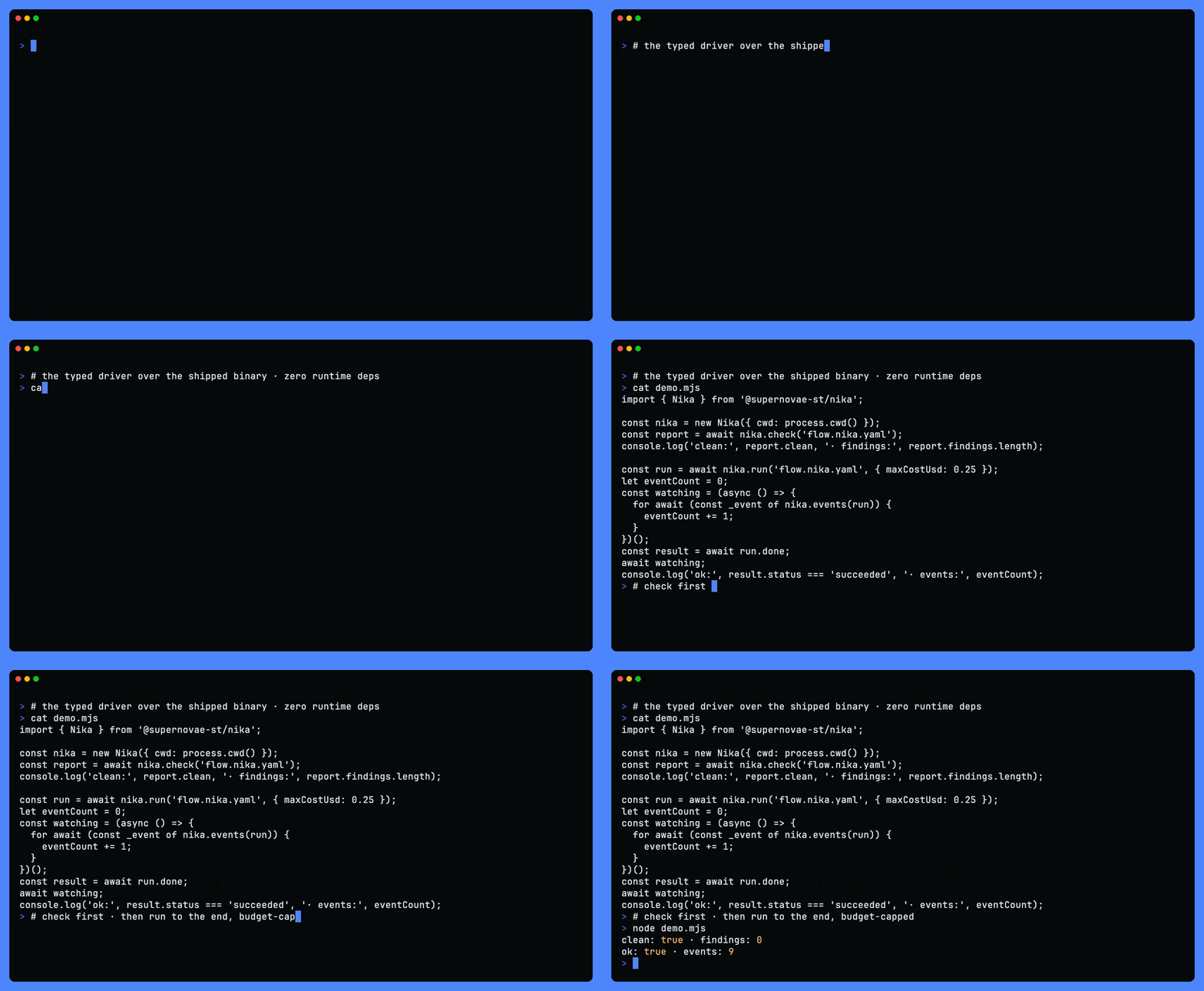
Recorded by scripts/media/render.sh against this package and the released
engine; every line on screen is the SDK's own output.
Native checks and explicit local snapshot checks preserve the engine's
findings[] and exitCode. A check by served name returns the resident's
compact acknowledgement with clean: true, or its typed workflow refusal
with clean: false; it does not invent local findings or an exit code.
run() returns after stable admission. run.done is the sole terminal result.
An admitted workflow failure is result data with status: "failed" and, when
the engine named the failing task, error: { code, message, task }; transport,
protocol, configuration, and compatibility failures throw typed SDK errors.
A try { await run.done } catch {} alone therefore never catches a failed
workflow: a CI job or an application must read result.status and treat
anything but succeeded as its own failure, or a red run passes silently.
Why this door
- Audited before it runs.
check()returns the engine's verdict on the order of effects, the permits, the lethal trifecta, the journey of every secret and the cost floor. A red check never becomes a run. - Sovereign by default. The same file runs on local models (Ollama,
llama.cpp, vLLM), on Mistral, Hugging Face, OpenAI, xAI, Anthropic and the
rest of the engine's catalog;
mock/echorehearses with no key and no network. - Traced after. Every native run leaves a hash-chained journal and hands
back a receipt;
traceVerify()asks the engine to verify it. The SDK never re-implements the proof. - One vocabulary, two transports.
check,run,events,cancel,traceVerifyandscheduleread the same against a local process and an authenticatednika serve; only the constructor changes.
One vocabulary
Nika exposes one lifecycle vocabulary: check, run, attachRun, status, events,
cancel, traceVerify, listWorkflows, workflow, schedule, and
scheduleStatus.
The engine remains authoritative for parsing, admission, execution, receipts,
traces, permits, scheduling, and cost. The SDK transports those facts; it does
not parse YAML or reconstruct proof in TypeScript.
Requirements
- Node.js 22 or newer (the tested floor; an older major is unsupported, not
refused, and
npm installdoes not warn about it) - for native execution or local snapshot capture, a compatible
nikaengine, resolved fromconfig.bin, thenNIKA_BIN(absolute paths only), then the exact optional platform package; a bare name or a relative path is refused because the operating system would resolve it throughPATHor the working directory, and anikafound onPATHis deliberately never used - a
.nika.yamlworkflow
Documentation
- Architecture · Modules, Interface, Seam, Adapters, lifecycle, and authority boundaries
- HTTP contract · every live route, recovery, security, idempotency, and schedule CAS
- Testing and release evidence · layered gauntlets and the Socratic risk matrix
- Migrating to 0.116 · the intentional breaking migration to the smaller durable client surface
- docs.nika.sh · the language, the engine and the other doors
Install
Pin the version you tested, then verify the package the project actually resolved:
npm install @supernovae-st/nika@0.118.7
node -p "require('@supernovae-st/nika/package.json').version"
This package metadata subpath is exported for CommonJS, ESM build tools and CI
pin checks. It reports the installed dependency, not a moving registry tag.
The native payloads @supernovae-st/nika-<os>-<arch> are optional
dependencies; npm installs the one that matches your platform.
Earlier packages expose the retired LocalNika/HTTP split and do not
implement the root facade documented here. This package carries the product's
name: up to 0.115.0 it was published as @supernovae-st/nika-client, a name
that is deprecated on npm, stays installable for the versions it already holds
and receives no further releases. The repository keeps its name
(supernovae-st/nika-client).
Scaffold with the engine
The lowest-friction creation door is the engine-owned scaffold:
./node_modules/.bin/nika init --project-file
./node_modules/.bin/nika new 01-hello hello.nika.yaml
nika.yaml is the project control plane. hello.nika.yaml is executable
workflow intent and is the file passed to check() and run(). The scaffold
writes the engine's own annotated 01-hello example (its task is named
greet and its prompt asks for French); the contract this README relies on is
the outputs.greeting key and the mock/echo model, which the hand-written
file above satisfies too.
Verify a local trace
Local terminal results carry an engine-issued receipt when tracing is enabled. Pass that receipt back unchanged:
if (!result.receipt) throw new Error('run did not issue a receipt');
const proof = await nika.traceVerify(result.receipt);
if (!proof.verified) throw new Error(proof.output ?? 'trace verification failed');
The SDK does not implement cryptography or inspect the trace itself. It asks the
engine to verify the receipt and its signed binding. A receipt from a native
run carries the proof-bearing fields (chain_head, chain_len, sealed,
trace_path) and verifies locally. A receipt from a nika serve job carries
identity only (job_id, execution_id, trace_id, snapshot_digest,
origin): the resident writes no trace journal yet, so that receipt verifies
through no door today, and the same NikaReceipt type covers both shapes.
Persist it as the job's identity, not as evidence. The remote endpoint
currently returns { verified: false, verdict: "unavailable", reason: "trace_journal_unavailable" } because the server has no path-free journal
authority; the typed verdict is preserved instead of being hidden as a 404.
/health.supportedCapabilities names authorities that can currently complete
their operation. It therefore does not advertise remote trace verification
while this diagnostic route can only return the typed unavailable verdict.
A resident with journal authority will answer the CLI's tiers (OK, SEALED,
ANCHORED, REPLAYED hold; INCOMPLETE, TAMPERED do not), with no
reason on a verdict that holds; verified reads them the same way.
Run-signing keys remain engine-owned. nika key init, nika key trust, and
nika key rotate manage their lifecycle. Nika prefers the OS keychain and uses
0600 files under ~/.nika/keys/ only as the local fallback; CI can inject an
explicit pair through NIKA_RUN_KEY_FILE and NIKA_RUN_PUB_FILE. Applications
should persist receipts and public trust material, never copy a private run key
into SDK configuration, source control, workflow inputs, or an HTTP request.
Cancel a run
const run = await nika.run('slow.nika.yaml');
const cancellation = await nika.cancel(run);
const result = await run.done;

console.log(cancellation.accepted, result.status);
Cancellation is idempotent per NikaRun. An AbortSignal passed to check,
events, or traceVerify only stops that request or observer; it never stands
in for cancel(run).
Over HTTP a running job answers the request with 202: cancellation reads
{ accepted: true, status: 'cancellation_requested' } and run.done settles
on the terminal the resident records, cancelled, succeeded, failed, or
interrupted once its grace expired. A job that already ended replays its
result with accepted: false and status: 'already_settled'. The native
transport signals its process the same way and settles interrupted.
Connect to nika serve
A contained workflow name such as hello.nika.yaml or
daily/report.nika.yaml is resolved by the resident registry. check() and
run() send that name without a local engine or a local workflow file.
Use listWorkflows() to discover the served names.
To capture your local file instead, pass an explicit path such as
./hello.nika.yaml. The compatible local engine captures an immutable
snapshot, and the SDK sends its exact bytes and verifies the acknowledgement.
Only this path needs bin, NIKA_BIN, or the exact optional native package.
Observation and scheduling also use the server identity alone.
The current persistent server requires a project file. If you ran
nika init --project-file above you already have one (it carries a default
cost ceiling); do not overwrite it. Otherwise a minimal nika.yaml is enough:
nika: my-project
Create a private bearer-token file and start the listener:
mkdir -p .nika
umask 077
openssl rand -hex 24 > .nika/serve.token
chmod 600 .nika/serve.token

nika serve \
  --bind 127.0.0.1:8787 \
  --workflows . \
  --token-file .nika/serve.token \
  --state-root .nika/serve
Connect from Node:
import { readFile } from 'node:fs/promises';
import { Nika } from '@supernovae-st/nika';

const token = (await readFile('.nika/serve.token', 'utf8')).trim();
const nika = new Nika({
  url: 'http://127.0.0.1:8787',
  token,
  allowInsecureHttp: true, // required for explicit loopback HTTP
  cwd: process.cwd(),
  // bin: '/absolute/path/to/nika',
});

const report = await nika.check('hello.nika.yaml');
const run = await nika.run('hello.nika.yaml', {
  idempotencyKey: 'hello-2026-08-30',
});
for await (const event of nika.events(run)) {
  console.log(event.sequence, event.kind, event.status);
}
console.log(await run.done);
If the Node process restarts after admission, recover the durable job without submitting the workflow again:
const recovered = await nika.attachRun(saved.jobId, {
  lastEventId: saved.lastEventSequence,
});
for await (const event of nika.events(recovered)) {
  await saveApplicationCheckpoint(recovered.id, event.sequence);
}
console.log(await recovered.done);
Persist the job id and last committed sequence in application state. The
idempotency namespace spans the server's entire state-root and currently has
no TTL; use globally unique business keys and do not recycle them between
workflows.
When observation loses connectivity past its retry budget, the SDK performs
one final durable read before giving up: a terminal record settles run.done
from the workflow's truth, and a still-running record rejects with
NikaObservationInterrupted, whose lastSequence feeds
attachRun(id, { lastEventId }) to resume.
Plain HTTP is accepted only for a loopback host (localhost, 127.0.0.0/8,
[::1]), and only when allowInsecureHttp: true is explicit. Every other host
must use HTTPS: the opt-in widens the scheme, never the destination, so the
bearer token never leaves the machine in plaintext. A URL may not contain
credentials, a query, or a fragment, and a 32–512 byte visible-ASCII token is
mandatory.
Remote snapshots currently do not have request envelopes for per-call vars
or model; declare those facts in the workflow. There is no per-run spend
bound over HTTP at all today: maxCostUsd is refused, the workflow language
has no budget field, and the resident applies its own server-wide default
ceiling. Bound a remote run by its model and max_tokens until the request
envelope carries a ceiling. Likewise, remote check does not accept model
or nativeStrict overrides. Supplying these options returns a typed
compatibility refusal instead of silently dropping them.
Resident schedules
Scheduling belongs to the resident HTTP authority. A direct native-process
client refuses schedule and scheduleStatus because a short-lived process
cannot honestly own durable schedule state.
const applied = await nika.schedule('hello.nika.yaml', {
  id: 'weekday-hello',
  when: { kind: 'cadence', expression: 'TZ=Europe/Paris 0 9 * * 1-5' },
  maxCostUsd: 0.01,
  missed: 'catch-up-once',
  overlap: 'skip',
  afterSkip: 'next_slot',
});

const status = await nika.scheduleStatus('weekday-hello');
console.log(applied.changed, status.next, status.lastDecision);

await nika.schedule('hello.nika.yaml', {
  id: 'weekday-hello',
  when: { kind: 'cadence', expression: 'TZ=Europe/Paris 0 9 * * 1-5' },
  maxCostUsd: 0.01,
  missed: 'catch-up-once',
  overlap: 'skip',
  afterSkip: 'next_slot',
  revision: status.revision,
  active: false,
  pauseReason: 'maintenance',
  pauseUntil: '2026-09-01',
});
Creates use If-None-Match: *; updates use the exact prior revision through
If-Match. Revisions are the opaque sha256:<64 lowercase hex> values returned
by the engine; callers must not invent placeholders. Stale well-formed writers
receive a typed operation error with the current revision. Returned planning
facts are engine-owned and additive.
Treat any status.finding recovered from older state as non-runnable. New active
declarations the current engine cannot plan are refused before durable mutation.
Timed hash jitter is currently unsupported and returns a typed refusal.
Cron expressions carry their zone as TZ=<IANA zone> ...; tolerance uses
m/k; afterSkip requires overlap: "skip" (the engine's default, so an
omitted overlap satisfies it); and active: false requires a pauseReason
together with a pauseUntil ISO calendar date (YYYY-MM-DD). Schedules refuse
maxCostUsd: 0 ("must be positive and finite") where a native run() accepts
it; a scheduled budget is always a real number.
Transport matrix
| Operation | Native process | HTTP |
|---|---|---|
check | yes; model and nativeStrict allowed | yes; those two overrides refused |
run | yes; vars, model, maxCostUsd allowed | yes; idempotencyKey allowed |
attachRun | typed refusal | reattach to a durable job with an optional SSE cursor |
status | typed refusal; await run.done | durable status projection |
events | raw engine lifecycle frames | sequenced SSE frames with bounded replay |
cancel | signal-backed, idempotent | 200 settles the job; 202 accepts the request and run.done settles on the resident's terminal |
traceVerify | engine verification + signed receipt binding | typed verdict: unavailable until remote journal authority exists, then the CLI's tiers |
schedule / scheduleStatus | typed refusal | resident schedule authority |
listWorkflows / workflow | typed refusal | contained path-free workflow catalog |
Event vocabulary is deliberately open. Native execution exposes detailed task lifecycle frames; HTTP exposes durable sequenced execution frames. Consumers must not assume identical cardinality across transports.
API
new Nika(config?)
Shared options:
cwd: engine working directory and snapshot rootbin: explicit engine patheventBufferSize: per-client observer ceiling, default 256machineBufferBytes: machine frame/diagnostic ceiling, default 64 KiB
Remote-only options:
url,tokenallowInsecureHttprequestTimeout, default 30 secondsfetch, for a custom standards-compatible implementation
Methods
| Method | Result |
|---|---|
check(workflow, options?) | clean plus the native check report or resident acknowledgement/refusal |
run(workflow, options?) | admitted NikaRun |
attachRun(id, options?) | reattached durable HTTP NikaRun |
status(run) | current durable HTTP status |
events(run, options?) | bounded AsyncIterable<NikaEvent> |
cancel(run) | NikaCancelResult |
traceVerify(receipt, options?) | NikaTraceVerifyResult |
schedule(workflow, options) | durable apply acknowledgement |
scheduleStatus(id) | fresh engine schedule projection |
listWorkflows() | contained resident workflow names |
workflow(name) | path-free resident workflow metadata |
Typed events, outputs, and identities
NikaEvent is a discriminated union over the known lifecycle kinds of both
transports. A native engine process emits workflow_started,
task_scheduled, task_started, task_completed, workflow_completed,
workflow_failed, workflow_interrupted, run_settled, and run_sealed. A
nika serve job streams execution.started, execution.settled,
execution.cancelled, execution.refused, and execution.interrupted (a
resident that restarts marks an orphaned running job interrupted). Kinds
this SDK version does not know yet stay representable through the
NikaUnknownEvent fallback, so the union is intentionally non-exhaustive and
every variant keeps its future fields open.
run, attachRun, and events accept one Outputs type argument. It types
the terminal settlement — run.done and the run_settled /
execution.settled / workflow_completed frames — without any runtime
validation, and defaults to Record<string, unknown> so untyped callers see
no change:
const run = await nika.run<{ answer: number }>('flow.nika.yaml');
const result = await run.done;          // result.outputs?: { answer: number }

for await (const event of nika.events(run)) {
  if (isNikaRunSettledEvent(event)) {
    // The settlement frame of either transport (`run_settled` natively,
    // `execution.settled` over HTTP): status, outputs, and receipt typed
    // together on the one frame that carries all three.
    console.log(event.status, event.outputs?.answer, event.receipt);
  }
}
A run can also end without settling outputs — cancelled, refused, or
interrupted. isNikaTerminalEvent(event) narrows those too: it reads the
engine-reported status (succeeded, failed, interrupted, cancelled)
rather than the kind, so it holds on either transport and on kinds this SDK
version does not know yet:
for await (const event of nika.events(run)) {
  if (isNikaTerminalEvent(event)) {
    console.log('no further frames for this run:', event.status);
  }
}
Run, execution, and job identities are branded opaque strings (NikaRunId,
NikaExecutionId, NikaJobId). They remain assignable to string, but a
plain string no longer stands in for one. Four words name three things:
a workflow is the file (or resident name) you pass in; a run is this
client's handle on one admission (run.id), and over HTTP that same string
is the server's job id (/v1/jobs/{id}, attachRun(jobId)); an
execution is the engine's own identity for what actually ran
(execution_id, the execution.* event kinds), distinct from the run id and
carried by the receipt together with the trace_id.
Errors
Every error the SDK raises for an engine, transport, configuration, or
compatibility condition extends NikaError. Misuse of the API itself (an empty
workflow name, a negative event cursor, a receipt that is not an object, a
workflow name that escapes the catalog) throws a plain TypeError or
RangeError before any engine or network work starts:
NikaError
├── NikaConfigurationError
├── NikaEngineUnavailable
├── NikaTransportError
│   ├── NikaProtocolError
│   └── NikaObservationInterrupted
├── NikaCompatibilityError
├── NikaOperationError
├── NikaEventBufferOverflowError
└── NikaRunOwnershipError
Native engine event vocabulary stays open. HTTP events instead enforce the
closed, redacted JobEvent projection advertised by the pinned OpenAPI contract;
unknown HTTP fields are rejected at the trust boundary. The SDK never turns an
unpriced model into $0.
A refusal that nika serve types as { error: { code, message } } surfaces as
NikaOperationError with the HTTP status, the server code (for example
unauthorized, job_not_found, idempotency_conflict, malformed_snapshot,
or a stamped NIKA-… admission code) and the operation that was refused.
Server messages are engine-owned and path-free; a reflected bearer token is
redacted before it reaches an error message. A non-2xx answer without that
typed body stays a NikaTransportError whose body is redacted entirely.
An engine refusal printed before a run starts — a NIKA-… code line such as a
cost-floor refusal — settles run.done with a NikaOperationError carrying
operation: 'run', the engine's code, and its full refusal line.
Security boundaries
- Token files stay out of argv and must be private (
0600, 32–512 visible ASCII bytes). - The constructor refuses plaintext HTTP off loopback, and requires the
explicit
allowInsecureHttp: trueopt-in on loopback. permitsremain default-deny engine policy; SDK types do not grant authority.- Machine frames, diagnostics, SSE lines, and observer queues are bounded.
- Receipts and traces are engine-issued proof. The SDK never synthesizes them.
- This package does not export a webhook-signature verifier. Verify webhook raw bodies with the sender's official library before admitting a Nika workflow.
Development proof
npm test
npx tsc --noEmit
npm run build

# Five clean installations from an npm tarball
NIKA_BIN=/absolute/path/to/nika npm run gauntlet:projects

# Concurrency, cancellation, corrupt streams/traces, redaction, and soak
NIKA_BIN=/absolute/path/to/nika npm run gauntlet:hostile
The repository also carries 100 distinct use-case workflows and provider proof
under gauntlet/.

Keeping it fresh
The client and engine follow one release train. nika doctor reports installed
drift without treating it as a workflow failure.
nika doctor
brew upgrade nika
npm update @supernovae-st/nika
The city · where this repo sits
📜 nika-spec ──── language law and conformance
    │
    ▼
⚙️ nika ───────── engine, admission, execution, receipts and schedules
    │
    ▼
🔌 nika-client ── this door, published as @supernovae-st/nika: native process or authenticated HTTP
    │
    ▼
🧩 Node.js applications
This repository consumes engine behavior and serves TypeScript/JavaScript applications. It is not authoritative for the workflow language.
All the buildings: nika-spec · nika · nika.sh · nika-docs · nika-client · nika-vscode · nika-plugins · gh-nika · homebrew-tap · nika-action · nika-actions-starter · nika-registry · nika-estate.
License
Apache-2.0. The engine remains AGPL-3.0-or-later; importing this SDK does not impose the engine's copyleft license on your application.