💬 pi-web-ui
August 31, 2026 · View on GitHub
💬 pi-web-ui
English | Chinese (Simplified)
The polished browser cockpit for the pi coding agent.






Stream conversations, inspect tool calls, manage files, and run your workspace — all from one place.
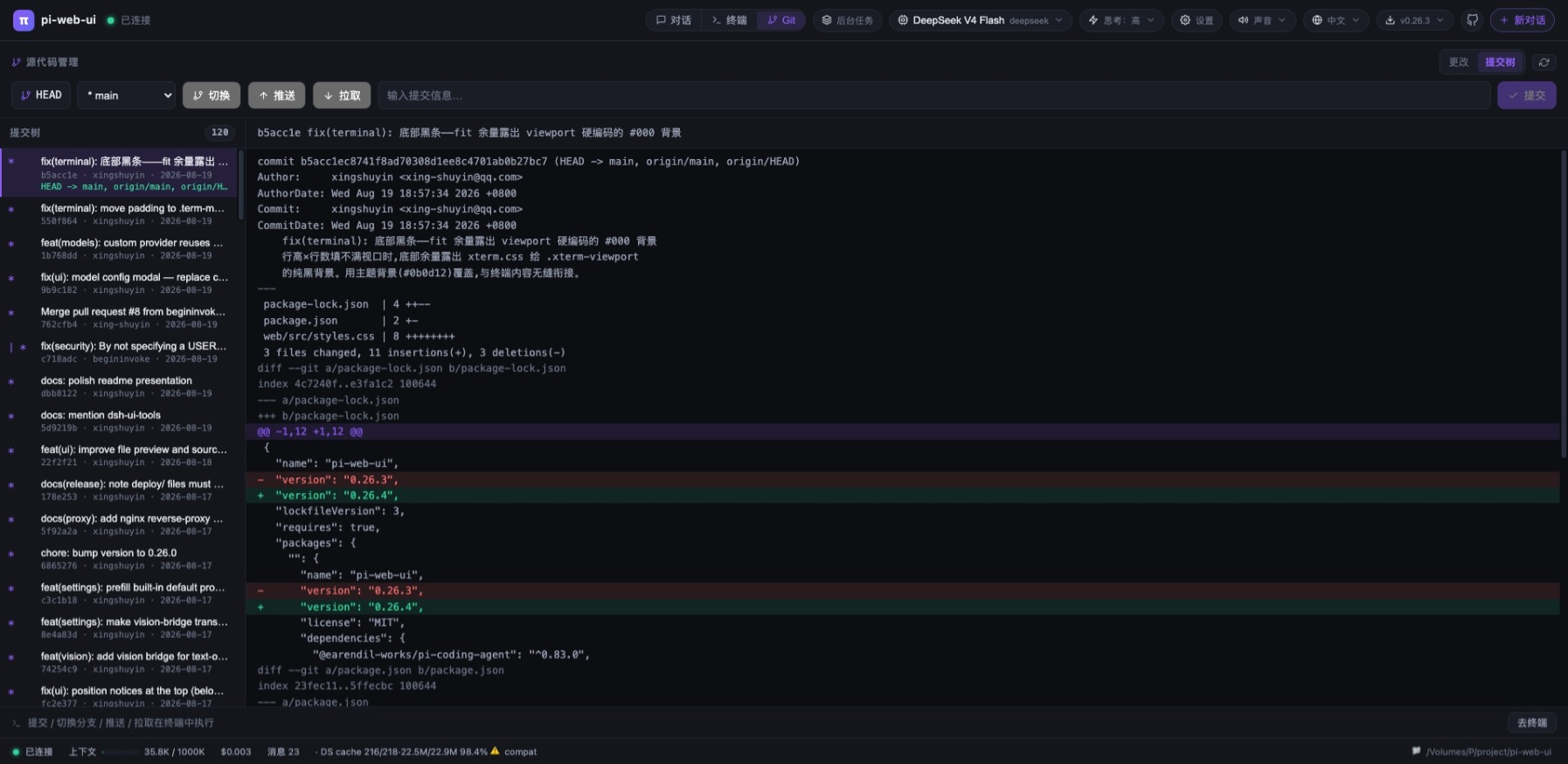
A web chat interface for the pi coding agent. The agent runs in-process via the pi SDK and streams events to the browser over WebSocket: thinking blocks, tool calls, file trees, a built-in terminal, model management, theme switching, and a full settings panel — tuned for daily development.
Requirements — Node.js ≥ 22.19 and a configured pi install.
More from the author
Building with DSH?
dsh-ui-tools is the author's companion project for building and extending UI tools in the DSH ecosystem.
✨ Highlights
| 💬 Chat that works like you do | 🖼️ Files & images | 🧩 Extensible by design | 🔒 Private by default |
|---|---|---|---|
| Streaming replies, steer & follow-up queueing, slash commands, multiple conversations per project, edit-&-re-ask. | Attach files, paste images, ask about pictures (vision bridge), preview anything with GBK fallback. | Drop-in UI plugins (extra top-bar tabs + agent tools) and standalone themes — no rebuild, no restart. | Loopback-only, credential-safe: provider keys & headers never reach the browser. |
📚 Table of Contents
- 🚀 Features
- 🖼️ Screenshots
- 📦 Install
- ⚡ Quick start
- 🖥️ System service
- 🧩 Plugins
- 🎨 Themes
- 🔒 Security
- 🌐 Reverse proxy (nginx)
- 🤝 Contribute
- 📄 License
Features
💬 Chat
- Streaming agent chat over WebSocket — the pi SDK runs in-process; events are pushed as snapshots (60 ms throttled) and the browser renders them.
- Thinking blocks, tool-call cards and bash outputs with live status (running → finished · waiting for the model · duration).
- Steer (follow-up queueing) — send a follow-up while the agent is replying; it is queued and injected as soon as the current turn's tool calls settle (the "Interrupt" equivalent of the pi CLI).
- Slash commands —
/opens a command picker (built-in / extension / template / skill); built-ins include/new /model /compact /cwd /thinking /resume, plus/help(command list) and/copy(copy last reply). - Multiple conversations per project — each conversation gets its own agent runtime and keeps running in the background after you switch away; the "Running conversations" list shows stream progress and lets you switch back.
- Edit & re-ask — fork any past question into a new branch and re-prompt; the original conversation stays untouched.
- Long threads auto-collapse messages older than 30 into lazy summary rows (click to expand).
- Question navigation — a floating rail plus per-question tags to jump between questions.
🖼️ Files, images & attachments
- Three attachment modes:
inline(≤12 KB),reference(path only),lines(selected ranges) — over-limit ones degrade automatically. - Paste / drag-drop / upload images — resized client-side and sent as image content when the model supports vision (warning otherwise).
- Vision bridge — when the current model is text-only, images are transcribed into text evidence by an auto-discovered vision model (cached per batch; model & on/off configurable in Settings).
- Attach arbitrary files without a workspace path — stored in a global uploads dir, inlined when small, referenced by absolute path otherwise.
- File preview — line numbers, click/drag/Shift selection (add to chat as
lines), GBK fallback decoding, binary hex view, media preview over HTTP with Range support, and a download button. - Live file tree — the server watches the listed directory (
fs.watch) and re-lists on change; oversized directories show a truncation warning.
🖥️ Terminal & Git
- Built-in terminal (xterm.js + node-pty) with per-client PTY management; Windows auto-selects Git Bash (busybox fallback).
- Source control (Git) panel — status / branch / diff / untracked files via a hidden query terminal; commit, switch branch, push and pull run in the visible terminal and auto-switch to the terminal view.
🎛️ Models & settings
- Theme switching — pick a theme in the top bar; themes are pure
:rootpalette overrides on top of the single layout stylesheet (default dark + bundled light/dark palettes). See Themes for how to add your own or contribute one. - Model management — edit
models.jsonin the UI and set per-provider API keys (keys/headers never leave the server). - Thinking level per model (only the levels the model actually supports are shown).
- First-run setup wizard.
- Settings panel — system prompt (append or replace), toggle skills/extensions on/off with immediate effect, save/apply/delete settings presets, and vision-bridge model & switch.
🎯 Goal mode
- Goal bar — set a target with a review model, max rounds and a lock switch.
- Goal wizard (AI Refine) — turns a raw request into a concrete goal through a guided questionnaire.
- Automatic review loop — after each turn an independent review session checks the goal against the final text and
git diff HEAD; on fail the feedback is injected as steer until it passes (or the round cap is hit).
⚙️ Background tasks
- Background-task panel — servers launched by the agent are detected via port snapshots and listed (port/pid/name); stop one or kill all.
- Tool watchdog — a tool call running over 20 minutes is aborted automatically.
- Stop bash command only — abort a running bash tool without killing the conversation.
🛡️ Safety & operations
- Loopback-only by default; set
PI_WEB_HOST=0.0.0.0for LAN / containers. - WebSocket Origin/Host same-authority check — cross-origin pages are rejected (403);
PI_WEB_ALLOW_ORIGINSwhitelist for reverse proxies. - Quiesce drain mode via a local control socket (
server status|quiesce|unquiesce). - Credentials stay server-side — provider headers are never sent to the browser.
- Sound alerts, Chinese/English UI, and a recent-projects list (click to switch workspace).
🚢 Deploy & update
- Foreground, global npm install, Docker (docker-compose), macOS launchd, Linux systemd, Windows Task Scheduler, and a desktop shortcut (
server shortcut). - In-app self-update — checks the npm registry, installs and auto-restarts the service.
Screenshots
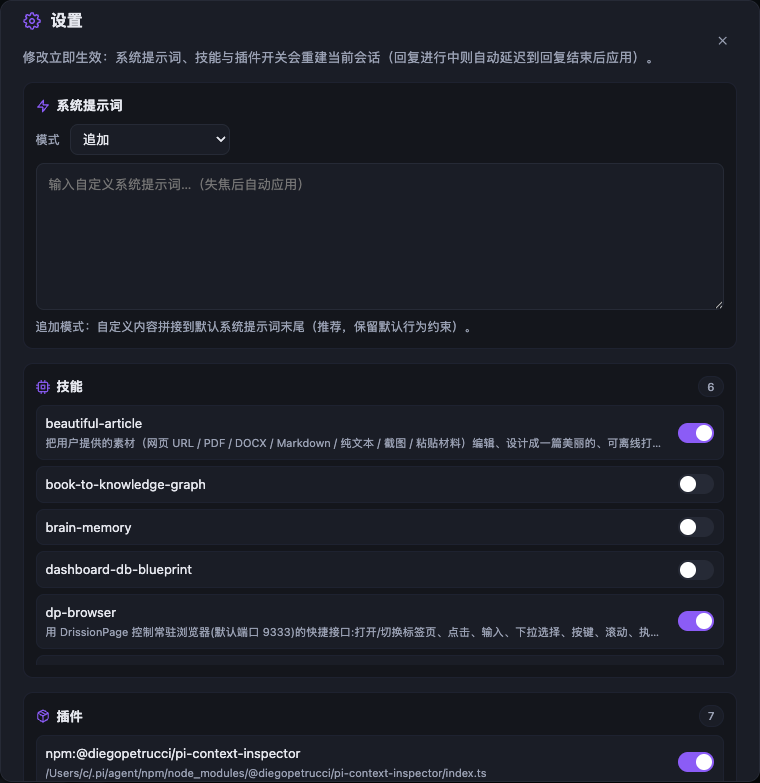 Settings panel |
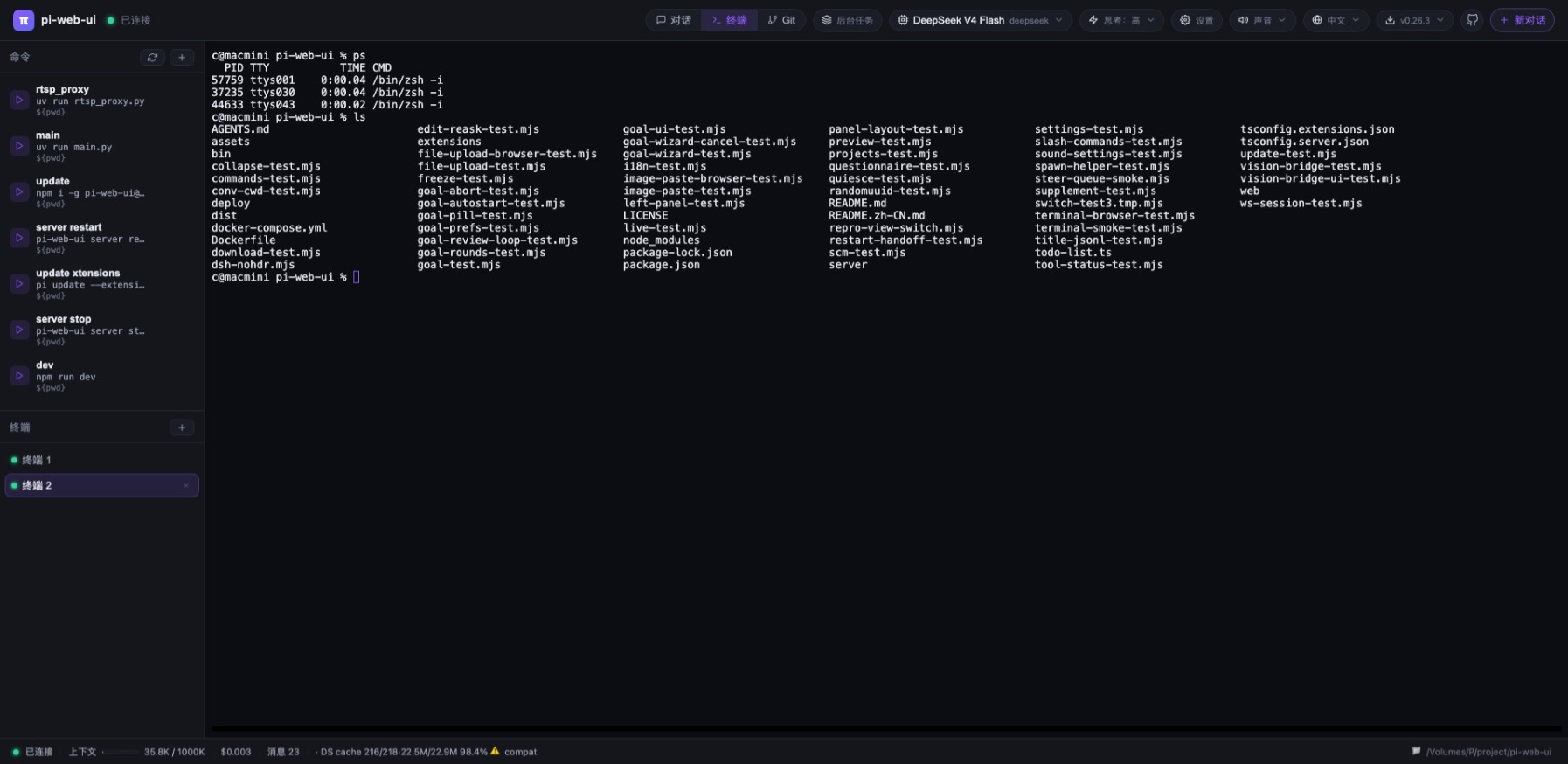 Built-in terminal |
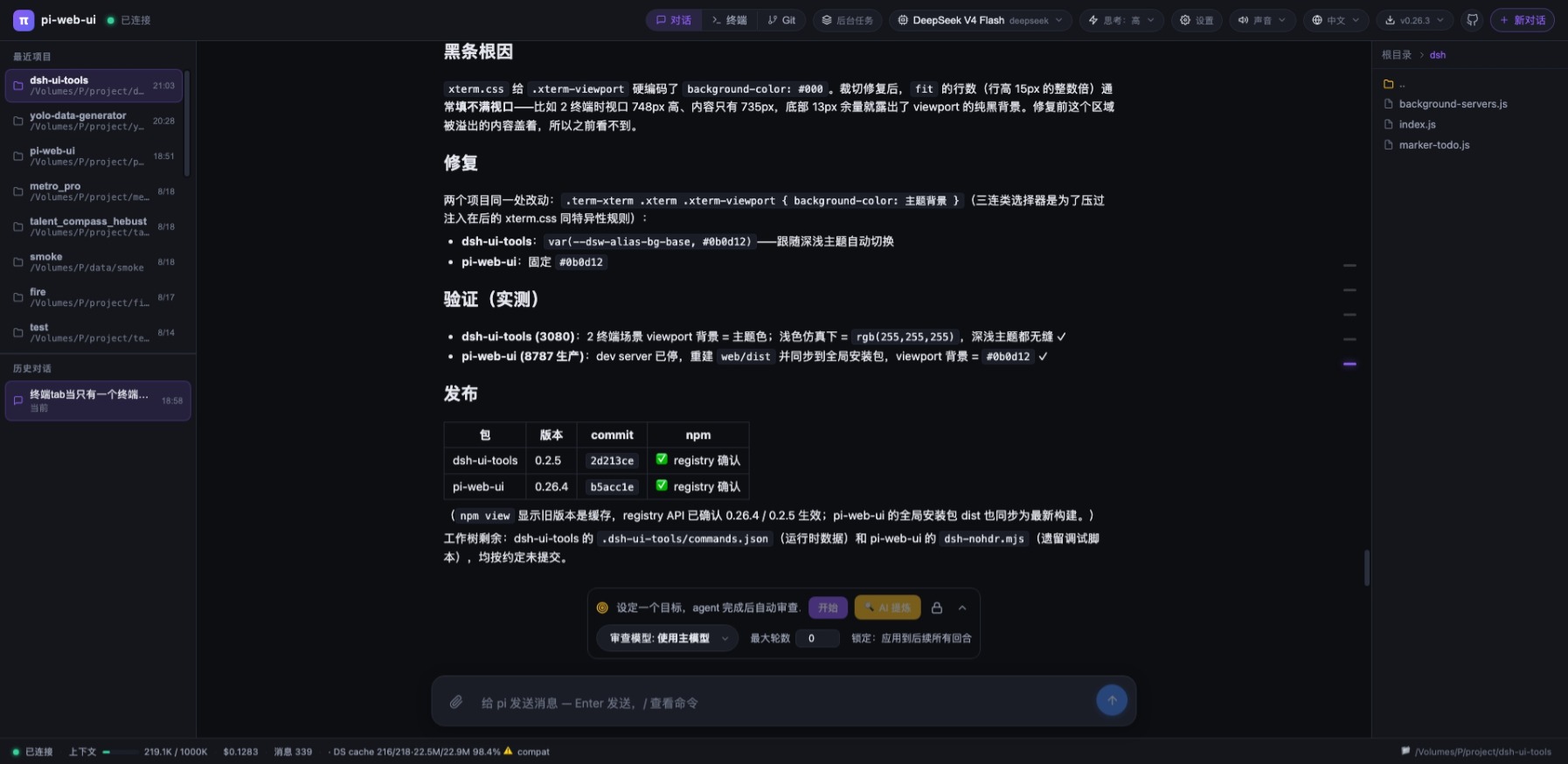 Chat interface |
Git source control panel |
Install
npm i -g pi-web-ui            # global install (recommended)
npx pi-web-ui                 # or run without installing (latest, starts on :8787)
npm i -g .                    # or install the local checkout
npm ≥ 12? npm 12+ blocks dependency install scripts by default (you'll see
npm warn install-scripts … blocked). node-pty is a native module, so allow its
script (the other two packages it lists are harmless no-ops — allowing them just
silences the warning):
npm i -g --allow-scripts=node-pty,@google/genai,protobufjs pi-web-ui@latest
Quick start
Start
pi-web-ui                                           # foreground, http://localhost:8787
PI_WEB_PORT=9000 PI_WEB_CWD=/path/to/project pi-web-ui     # custom port / workspace
Stop
- Foreground: press
Ctrl+Cin the terminal running it. - As a service:
pi-web-ui server stop(stops the instance; auto-start stays untilserver uninstall).
Update
npm i -g pi-web-ui@latest     # upgrade to the latest published version
pi-web-ui server restart      # restart the service to apply it (foreground: restart manually)
Uninstall
npm uninstall -g pi-web-ui
Uninstalling does not delete your chats — session data lives in
<cwd>/.pi-web (or PI_WEB_DATA_DIR) and survives uninstall/upgrade.
System service
pi-web-ui server install --port 9000 --cwd /path/to/project   # install + start
pi-web-ui server status                     # running? auto-start?
pi-web-ui server restart                    # restart (applies config/version changes)
pi-web-ui server stop                       # stop (auto-start stays)
pi-web-ui server start                      # start again
pi-web-ui server uninstall                  # remove the service entirely
pi-web-ui server shortcut                   # desktop one-click launch icon
pi-web-ui server quiesce                    # drain: refuse NEW chats/messages, let running ones finish
pi-web-ui server unquiesce                  # reopen admission
server status also shows live stats via a local control socket (version,
PID, quiesce state, connected browsers, running conversations) — the same
socket drives quiesce/unquiesce.
- macOS → launchd agent (no sudo), logs to
/tmp/pi-web-ui.log/.err - Linux → systemd unit (
systemctl enable --now), logs viajournalctl -u pi-web-ui -f - Windows → Task Scheduler logon task (hidden PowerShell window, no black console)
Options: --port (default 8787), --cwd (workspace), --data-dir (sessions),
--name (custom service name). Rerunning server install with new options
regenerates the config and restarts the service — that's how you change its
port/cwd.
Plugins
Plugins are optional UI components (extra top-bar tabs backed by their own
client view, optionally with a server-side entry and agent tools). They live in
your data-dir plugins folder (<dataDir>/plugins/<id>/, default
~/.pi-web/plugins/) — a plugin is simply a directory containing
manifest.json, an optional server entry (index.mjs) and an optional view
entry (client/entry.mjs). No plugin directories = no plugins, nothing shows
up in the UI.
Plugin catalog
These plugins ship in this repository (plugins/<id>/) and can be installed
straight from GitHub:
| Plugin | What it does |
|---|---|
| 📬 webmail | IMAP inbox browsing / search / read / mark / delete + SMTP sending, new-mail notifications, and an optional "allow AI to manage my mailbox" switch (six mail_* agent tools). Auto-installs its npm deps on first activation. |
| 🗄️ db-client | Database workbench: connection manager + schema tree for MySQL / PostgreSQL / SQLite / SQL Server / MongoDB / Redis — table structure, paginated data with sorting, SQL editor, and row editing. Drivers auto-install on first use. |
| 📝 vscode-editor | VS Code-like workbench: multi-root file tree (local + SSH hosts), CodeMirror multi-tab editor, Remote-SSH remote file browsing/editing, draggable multi-terminal panel (xterm.js), SFTP sync & upload/download to your computer. Auto-installs ssh2. |
| 📬 demo-mailbox | Minimal example plugin demonstrating the server entry + client view + two-way message protocol. Doubles as the plugin test fixture — start here if you want to write your own. |
Example — install the webmail plugin:
pi-web-ui install https://github.com/xing-shuyin/pi-web-ui/tree/main/plugins/webmail
Each plugin's directory in the repo has its own README.md with full feature
lists, configuration and per-plugin caveats.
Installing
From GitHub (any of these source forms):
pi-web-ui install owner/repo                                  # shorthand
pi-web-ui install https://github.com/owner/repo               # full URL (.git optional)
pi-web-ui install https://github.com/o/r/tree/dev/sub/dir     # branch + subdirectory inside the repo
pi-web-ui install owner/repo#v1.2                             # pin a branch/tag (#suffix works on any form above)
pi-web-ui install /path/to/plugin-dir                         # local directory (for development)
Useful options:
--name <id>— custom plugin id / directory name (defaults to the repo or subdirectory name; letters/digits/-/_only).--force— overwrite an existing installation. Your plugin's localconfig.json(credentials etc.) is preserved across upgrades.--data-dir <dir>— override the data dir (default~/.pi-web).
The CLI clones the repo (shallow; falls back to a tarball download without
git), locates the manifest.json (including inside subdirectories) and copies
the plugin into <dataDir>/plugins/<id>/.
No git? No network? You can also just copy a plugin directory into
~/.pi-web/plugins/ by hand — same result.
Updating
Re-run install against the same source with --force:
# example: update the webmail plugin to the latest version in the repo
pi-web-ui install https://github.com/xing-shuyin/pi-web-ui/tree/main/plugins/webmail --force
- The upgrade preserves the plugin's local
config.jsonautomatically. - Plugins that store other local state inside their directory (e.g. db-client's
db-connections.json, vscode-editor'sssh-hosts.json) are not covered by that preservation — back those up before a forced reinstall. - Refresh the browser afterwards; no server restart needed.
Activating
If the server is running, just refresh the browser — new plugins are picked up on attach without a restart. If it isn't, they load on next start. Each plugin appears as a tab (🧩 or its own icon) in the top bar.
Listing / disabling / uninstalling
pi-web-ui plugins             # list installed plugins (id / name / version / description)
pi-web-ui uninstall <id>      # remove a plugin
- To temporarily hide a plugin without uninstalling, use the Settings panel (⚙) → UI plugins switches — stored per client, purely visual, no restart needed. Re-enable any time.
uninstalldeletes the plugin directory; refresh the browser and its tab disappears. Plugin configuration written inside the plugin dir is removed too — back up<dataDir>/plugins/<id>/config.jsonfirst if you need it.
Themes
Each theme is a pure :root palette override — a small CSS file that only sets CSS variables (see the :root block in web/src/styles.css for the full variable list: base colors --bg/--accent/--term-* plus derived colors like --tooltip-bg/--code-bg/--notice-*). The layout lives ONLY in the bundled web/src/styles.css; picking a theme overrides the variables, so every theme works with every build and layout changes never touch themes. Built-in themes are generated by node make-light-theme.mjs.
Built-in themes ship in the npm package (themes/, e.g. the bundled light theme). The theme picker lives in the top bar (🌞 icon); the current choice is stored per browser in localStorage.
Using a theme
Just pick it in the top bar — built-in and user themes are merged in the same menu. User themes win over built-ins on the same id.
Providing a theme locally (no GitHub needed)
Any CSS file dropped into your data-dir themes folder shows up in the theme menu automatically — no restart, no rebuild:
- Find your data dir (default
~/.pi-web, override withPI_WEB_DATA_DIR). - Create
<dataDir>/themes/and drop your stylesheet in: e.g.~/.pi-web/themes/my-theme.css. - Reload the page and pick it in the top bar. The file name (without
.css) is the theme id shown in the menu.
~/.pi-web/
└── themes/
    └── my-theme.css          # appears in the menu as "my-theme"
Easiest way to write one: copy a built-in palette (e.g. themes/white.css from the source repo) and change the :root colors — list every variable you want to override; unlisted ones fall back to the dark defaults in styles.css. Notes:
- The terminal follows the theme — set the
--term-*variables (terminal ANSI palette +--term-bg) in your:rootand both the xterm canvas and its padded container adapt automatically (see the defaults instyles.css). - Syntax-highlight colors (
highlight.js'sgithub-dark.cssis bundled) must be overridden in your theme file or code will be unreadable on light themes — see the.hljsoverrides at the bottom ofthemes/white.cssfor the pattern (dark themes can skip it). - Theme ids must match
^[A-Za-z0-9_-]+$(no dots/slashes — path-traversal guard on the server).
Contributing a theme to the repository (GitHub)
Want your theme shipped to everyone? Open a pull request at github.com/xing-shuyin/pi-web-ui:
- Fork the repo and clone it.
- Create your theme as
themes/<id>.css— a pure:rootpalette. Copythemes/white.css(orthemes/cyberpunk.cssfor a dark palette) as the starting template. - Verify locally: run
npm run dev, then use the top bar theme picker — your theme must be listed and render correctly (chat cards, code blocks, tool-call cards, git/terminal panels). - Regenerate all built-in themes with
node make-light-theme.mjswhen you changed the variable list instyles.css. - Commit (
git add themes/<id>.css) and open the PR. Thethemes/folder is already in the npm packagefileswhitelist, so once merged and released,npm i -g pi-web-uiwill ship your theme to everyone.
Rules for merged themes: the file must be a single CSS file, set the --term-* variables for a readable terminal, and override .hljs syntax colors for readable code on light themes.
Security
- Loopback-only by default — the server binds
127.0.0.1and is not reachable from the network unless you explicitly setPI_WEB_HOST=0.0.0.0(e.g. LAN access, Docker port mapping — the compose file sets it for you). - WebSocket origin check — browser pages connecting to
/wsmust present anOriginwhose hostname and port match the requestHost; cross-origin pages are rejected with 403. Non-browser clients (noOrigin) are unaffected. AddPI_WEB_ALLOW_ORIGINS=http://your-host:portfor reverse-proxy setups. - Quiesce —
server quiescerefuses new prompts/forks/session resumes until youserver unquiesce; in-flight runs finish cleanly (useful before upgrades/backups). - Credentials stay server-side — provider
headers(which may carryAuthorization/ API keys) are never sent to the browser; the model management UI edits everything else and the server preserves the headers.
Reverse proxy (nginx)
Serve pi-web-ui behind nginx on the same host (it binds loopback only, so a
same-machine reverse proxy is the supported remote-access path — no
PI_WEB_HOST=0.0.0.0 needed):
# pi-web-ui on 127.0.0.1:8787, exposed as https://your-host/pi/
server {
    listen 443 ssl;
    server_name your-host;
    # ssl_certificate ... / ssl_certificate_key ...

    # App entry at a sub-path (strips the /pi/ prefix)
    location /pi/ {
        proxy_pass http://127.0.0.1:8787/;
        proxy_http_version 1.1;
        # $http_host keeps the port — the server's origin check compares the
        # full authority (hostname AND port). $host would drop it and get 403.
        proxy_set_header Host $http_host;
        proxy_set_header X-Real-IP $remote_addr;
        proxy_set_header X-Forwarded-For $proxy_add_x_forwarded_for;
        proxy_set_header X-Forwarded-Proto $scheme;
    }

    # WebSocket — MUST forward Host identically or the upgrade is 403'd
    # (page loads, but chat/terminal keep reconnecting)
    location /ws {
        proxy_pass http://127.0.0.1:8787;
        proxy_http_version 1.1;
        proxy_set_header Host $http_host;
        proxy_set_header Upgrade $http_upgrade;
        proxy_set_header Connection "upgrade";
        proxy_read_timeout 3600s;
        proxy_send_timeout 3600s;
    }

    # Absolute-path assets/API the built frontend requests (root, not /pi/)
    location /assets/  { proxy_pass http://127.0.0.1:8787; }
    location = /favicon.svg           { proxy_pass http://127.0.0.1:8787; }
    location = /favicon-streaming.svg { proxy_pass http://127.0.0.1:8787; }
    location = /api/file   { proxy_pass http://127.0.0.1:8787; }
    location = /api/health { proxy_pass http://127.0.0.1:8787; }
}
Key points:
Hostmust be$http_host(keeps the port) on both/pi/and/ws— the origin check compares hostname and port.proxy_set_header Host $hostor leaving it unset (defaults to the upstream127.0.0.1:8787) both fail with 403.- Same-origin works automatically: as long as the browser's
Originequals the forwardedHost(it does through a plain proxy), noPI_WEB_ALLOW_ORIGINSis needed. Only set it when the browser origin differs from the Host the server sees (e.g. a TLS-terminating proxy that changes the port). - No
proxy_protocolunless you really need real client IPs: it makes nginx reject every connection that does not send a PROXY header, which breaks direct LAN access and any non-frp clients. With frp, droptransport.proxyProtocolVersionfrom the proxy config unless nginx listens withproxy_protocoltoo. - LAN access without a proxy: just set
PI_WEB_HOST=0.0.0.0(and a firewall rule) — or put the whole server block above on port 80/443.
Full working example (with an frp tunnel): deploy/nginx-subpath.conf.
Contribute
pi-web-ui is a small open-source project — your contributions are what make it grow. Code, plugins, themes, docs, translations, ideas: everything is welcome, and every merged PR ships to all users with the next npm publish. ❤️
| Way to contribute | How to get started |
|---|---|
| 🧩 Write a plugin | Build your own UI tab + agent tools. Copy plugins/demo-mailbox as the minimal template (it doubles as the test fixture), develop locally, then either open a PR to ship it in the catalog or publish it standalone. |
| 🎨 Contribute a theme | Copy themes/white.css (light) or themes/cyberpunk.css (dark) as a pure-palette template, tweak the :root palette + --term-* + .hljs, verify with npm run dev, then open a PR — full walkthrough in Contributing a theme. |
| 💻 Fix a bug / add a feature | Look for open issues or propose something new. Fork → branch → PR. Keep the code conventions in AGENTS.md (tabs, i18n keys in both languages, protocol changes in server/protocol.ts). |
| 📖 Docs & translations | Improve the READMEs, write plugin docs, fix typos, or help translate the UI / docs into more languages. |
| 💡 Ideas & feedback | Open an issue or start a discussion — feature requests, bug reports, UI polish ideas, deployment experience reports. |
Before opening a PR, a quick sanity pass keeps reviewers happy:
npm run check:protocol+npm test— protocol sync and unit tests.npm run typecheck— no type errors.npm run build— both frontend and backend compile.- For protocol changes: add branches in both
server/index.tsandweb/src/use-chat.ts(see the "Protocol single source" note inAGENTS.md).
Enjoying pi-web-ui? Give the repo a ⭐ — it helps others find it. And if you built something cool on top (plugin, theme, deployment recipe), tell us — we love showcasing community work.